Book Excerpts That Don't Suck: "The Sure Thing"

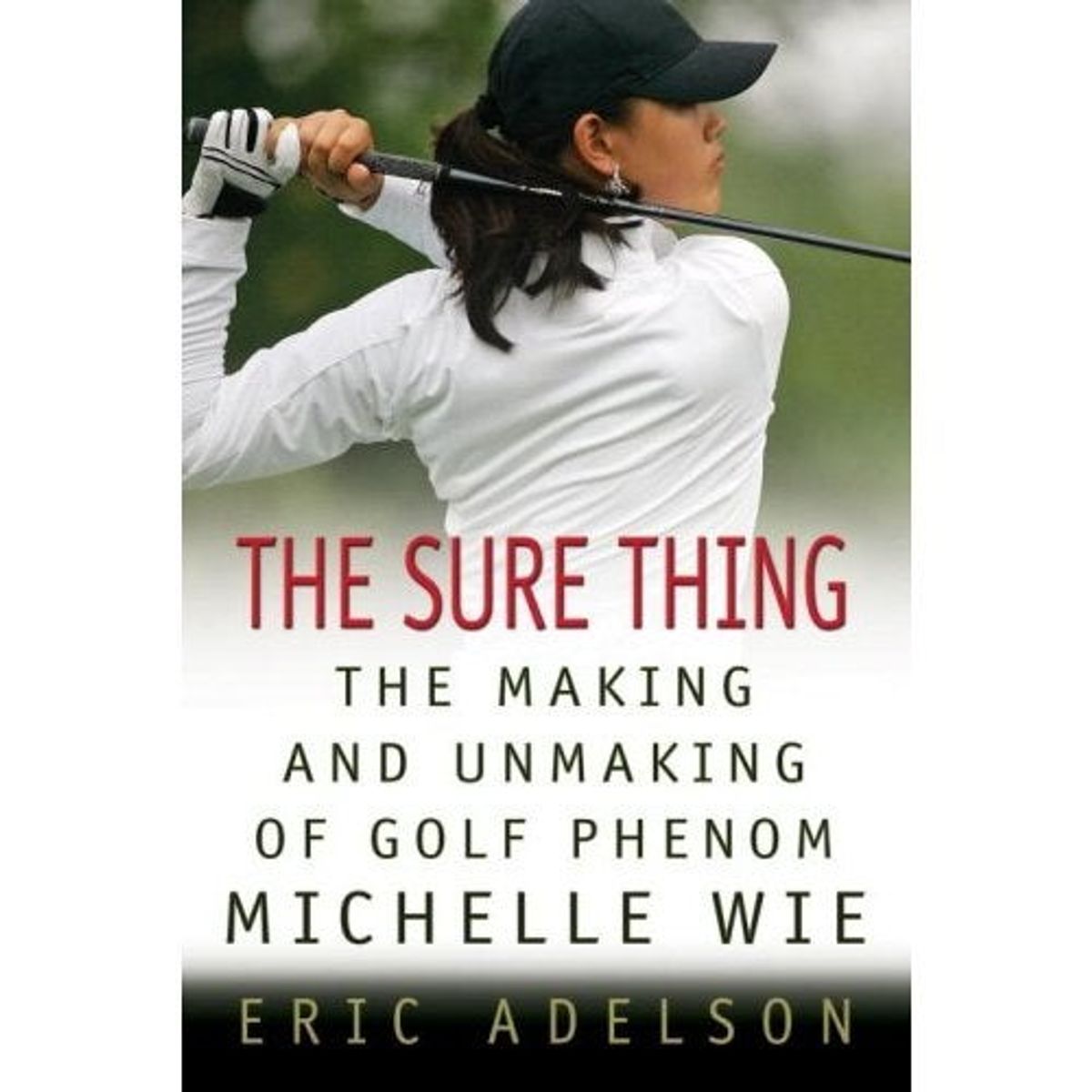
Today's excerpt is from Eric Adelson's book about prodigious lady golfer Michelle Wie, "The Sure Thing: The Making And Unmaking Of A Golf Phenom." Buy it here. And, of course, Mr. Adelson will field your inappropriate questions in the comments.
Suggested discussion topics:
• How important was her performance at the Solheim Cup for her career? • Does Wie suffer from anxiety attacks? • Is she as good as advertised? • Will she ever find true love? • Can she ride a unicycle? • Christina Kim's large breasts and bubbly personality.
Michelle advanced rapidly in everything she did. Walked at nine months. Ran and chased tennis balls around B.J.'s office soon after. Ate almost as much at 2 and 3 as adults. Tried out for her elementary school baseball team when she was 6 and quickly became the squad's best hitter. The minute she picked up a tennis racquet, Michelle appeared ready to conquer that game, too, but she quit soon after she started because she didn't like to run. (B.J. once threw a can of tennis balls into a garbage can because he was so upset by his daughter's unwillingness to hurry after volleys.)
But one sport grabbed Michelle and didn't let go. She was 4 the day B.J. took her to Haha'Ione Park in suburban Honolulu and walked her to a baseball field encircled by a low stone wall and a chain-link fence. He handed her one of her grandmother's clubs that he'd shortened so a four-year-old could swing it. She grabbed it with both hands, as if it were an axe, settled without prompting into a plausible golf stance with her pudgy legs shoulder-width apart, and stared at the little white ball at her feet.
Michelle poured everything her little body had into that first swipe. She felt the clubface meet its target, let the club head carry her arms around her body, and looked up to see the ball high in the Honolulu sky. B.J. watched as his daughter's drive soared, bounced, and rolled to rest deep in the outfield. B.J. looked down at his little girl. She gazed up at her father. Michelle wanted to do it again.
From the first, Michelle just flat-out loved crushing a golf ball. Soon she was launching them into neighbors' yards until she was instructed to take her drives elsewhere. She threw her entire body into the game, sliding her coiled legs through the downswing as if she were moving a couch. In no time, the heroes in the Wie household were the golf pros with the best swings. Michelle had a poster of Tiger Woods in her room, and B.J. carried a photo of him in mid-swing around so he could refer to it any time his daughter needed help. Michelle watched both the PGA Tour and the LPGA Tour on television, but she loved the big hitters on the men's side more than the finesse players on the women's. As she sat in front of her parents' TV at age six, nothing about her dreams seemed the least bit strange. After all, her mother had once shot a 69 in Maui and won an amateur tournament back in Seoul.
Why shouldn't she aim higher?
Neither mother nor father put any limits whatsoever on their daughter's dreams and ambitions. They encouraged her every swing, her desire to hit longer, longer, longer. And that's just what she did. But Michelle's determination to measure her talent against others sparked a backlash the moment she started playing on municipal links. When she was 7, her parents walked her to the first tee at a local course and the starter asked Michelle for her age. She gave it. "Sorry," he said, shaking his head. "Too young." Michelle was stunned. "What I really wanted to tell him," she said later, "was, ‘I can beat you!'" The starter finally relented. He paired Michelle with a single-handicapper; the older woman wasn't pleased. Michelle, full of fire, airmailed her drives past her reluctant playing partner. She birdied a 200-yard par 3. The woman left the course after nine holes. By age 9, Michelle was beating her parents, who gave up their own games to mentor her. With no course within walking distance of their home, they drove east about 15 minutes along the Kalanianaole Highway, which curls along seaside cliffs and then up and around a mountain range, to the Olomana Golf Links, a public course in Waimanalo. There they went to the top shelf of a bi-level driving range, where Michelle pounded away until, one day, B.J went downstairs looking for the head pro.
Casey Nakama was born in Honolulu in 1958. Athletic as a kid, he played shooting guard in high school but soon realized he was too short for basketball. He picked up golf in 1976, won an Oahu amateur tournament three straight years, and turned pro in 1985. Nakama went on to play on the Asian Tour, made the Hogan Tour back in the States, but struggled and returned to Hawaii to teach. He started at Olomana with adults, then a parent asked him to teach juniors in 1996. Tiger Woods turned pro the next year and suddenly dozens of kids showed up at Nakama's door.
Two years later, he spotted a tall girl wailing away, spraying her shots everywhere and not seeming to care. He saw the potential right away-the 10-year-old Wie was more than 5' tall already-but there were problems. "She could carry the ball 200 yards," Nakama said. "But the only thing she had going for her was her size. Her swing plane was flat and laid-off. Her short game was really bad. She didn't know what she was doing." Yet Michelle had inherited another important family trait: her intelligence. She could recite the alphabet at one and started reading at two, even though her parents spoke to her in Korean and sometimes struggled to find the right word in English. She was accepted at the top academy in Hawaii, the elite Punahou School, founded in 1841 by missionaries and now the largest independent school on one campus in the United States. Wie applied as a rising sixth grader, enrolled, and earned mostly A's throughout her stay there.
But her greatest gift was her ability to learn visually-almost photographically. She could burn through her homework during the forty-minute drive to Olomana. She could receive a swing lesson and incorporate what she learned almost immediately. Then, somehow, she could lock in the motion and not stray from it. Nakama went to work, telling Michelle to point the club toward the target at the top of her backswing, hinge her wrists, and make sure her top two knuckles pointed upward when she gripped the club. Michelle would watch herself in the huge wall mirror outside his office and practice until dark. Once she got home, she practiced some more. "After a couple days," Nakama said, "she would come back and say, ‘Casey! I think I got it!'" And she had: gradually Michelle's spray became a sweet draw, and she started chaining perfect shot after perfect shot.
In 2000, when Michelle was 9, she won the girls' division of the Oahu Junior Championship. Newspapers love young achievers -Honolulu feels more like an extended family than a big city-so few reporters dampened the achievement by harping on the fact that Oahu had very few girl golfers. All that mattered was that the local girl had won despite plunking three shots in the water. She never tired of practicing. "It didn't bother her to work on her swing five or six days a week," Nakama said. "I remember one Halloween night, my wife and I had just gotten a puppy. I asked Michelle, ‘Are you going to go trick-or-treating?' She said no. Instead she went to ask her dad to ask, ‘If I stay and practice, can I play with the puppy?' It was borderline sad." The Wie family tolerated no laziness. From the moment B.J. realized his daughter had talent, there would be no letting up. Michelle had the engine, ignited by her mother's love for the game, but B.J. did the steering and stepped on the gas. His daughter reported to Olomana after school every day to follow the same drill: practice at the range, play nine holes, then chip. "Her dad was in control of everything," Nakama said. "He was always pressing, pressing, pressing for more. Never rude, but always pressing." Nakama noticed early on that B.J. didn't know the game as much as he let on. "It was kind of hilarious to see him on the greens," Nakama says. "He didn't know what he was looking at. It was comical." B.J. allegedly played to a two-handicap, yet Michelle chipped with her hands straight out instead of flexed. When Nakama showed her the right way, Michelle turned to her dad and said, "See, I told you I was doing it wrong!" "He doesn't know how to play golf," Nakama said to himself. Yet B.J. kept pressing for improvement, for more work, for smarter application of the lessons. His expectations were sky-high not only for himself and for Michelle, but for everyone around him. "Everything hinged on Mr. Wie," Nakama said later. "He was brutal."
Talk to Mr. Adelson below. Buy the book here.
Related

- MLB Predictions and Best Bets for Saturday's Biggest Games
- UFC Vegas 118 Betting Picks: Three Fights to Target on Saturday Night
- MLB Picks Today: Two Pitchers Set Up To Fall Short On Outs Props
- MLB Pitcher Props Today: Best Bets for June 3rd
- NBA Finals Game 1 Best Bets: Knicks vs. Spurs Predictions and Player Props
- Stanley Cup Final Game 1 Best Bets: Hurricanes vs. Golden Knights Picks
- Knicks vs. Spurs Game 1 Props: Three Best Bets for the NBA Finals