<![CDATA[Deadspin: malcolm gladwell]]> http://tags.deadspin.com/assets/base/img/thumbs140x140/deadspin.com.png <![CDATA[Deadspin: malcolm gladwell]]> http://deadspin.com/tag/malcolmgladwell http://deadspin.com/tag/malcolmgladwell <![CDATA[Gladwell, I Am Told, Is Often Misunderstood]]> Deadspin's part-time weekend wrecker Moe Tkacik has penned an epically long story about Bill Simmons admirer and pezzy-haired cultural point-tipper Malcolm Gladwell for "The Nation." Feast.[The Nation]

]]>
http://deadspin.com/index.php?op=postcommentfeed&postId=5398154&view=rss&microfeed=true
<![CDATA[Malcolm Gladwell Demands Bill Simmons Be An NBA GM]]> Bill Simmons' new doorstop of a book arrives in stores tomorrow. In a canny move, he had Malcolm Gladwell pen the foreword. And what does Fry Guy do in that foreword?

Why, tell the entire world that Bill Simmons is only the super smartest basketball expert on Earth who really SHOULD be a GM, of course. I took a look at a copy of the book this morning. It's girthy, that's for sure. But it's clear right from the get-go that this is less a book than it is a resume for Simmons' basketball credentials. Let's go right to the opening paragraph of Gladwell's little reference letter…

Not long ago, Bill Simmons decided to lobby for the job of general manager of the Minnesota Timberwolves. If you are a regular reader of Bill's, you will know this, because he would make references to his campaign from time to time in his column.

Let's stop Gladwell right here and correct him. Simmons has been pimping himself as an NBA GM candidate since well before that Timberwolves job opened. He devoted plenty of column space to demanding the Milwaukee Bucks hire him. And he didn't just lobby for the T-Wolves job from time to time. He tweeted about the idea incessantly, and even devoted podcast time to it. He interviewed with Mike Rand to lay out his qualifications. There was even a Facebook group created specifically to advance the cause.

But if you are a regular reader of Bill's column, you also know enough to be a little unsure about what to make of his putative candidacy. Bill, after all, has a very active sense of humor.

Indeed he does, for someone who has seen a grand total of eight movies in his lifetime.

He likes messing with people, the way he used to mess with Isiah Thomas, back when Thomas was suffering from a rare psychiatric disorder that made him confuse Eddy Curry with Bill Russell. Even after I learned that the Minnesota front office had received something like twelve thousand emails from fans arguing for the Sports Guy, my position was that this was a very elaborate joke. Look, I know Bill.

No. Apparently, you do not. Because it's a classic Simmons move to do something like lobby for an NBA GM job, go to great pains to illustrate how many people support him and why it would be crazy awesome for a team to hire him because he inherently makes things more interesting, and then deflect all criticism of his efforts by saying he was only joking. He does this constantly, and it's one of his worst qualities. Because it means he's either being disingenuous, or just fucking obnoxious. Even in his excerpt from the book…

I explained the purpose of my column, how I write from the fan's perspective and play up certain gimmicks — I like the Boston teams and dislike anyone who battles them, I pretend to be smarter than every GM…

He keeps up with the "pretending" bullshit. Let's go back to Gladwell:

He lives in Los Angeles. When he landed there from Boston, he got down on his hands and knees and kissed the tarmac. He's not leaving the sunshine for the Minnesota winter. Plus, Bill is a journalist, right? He's a fan. He only knows what you know from watching games on TV. But then I read this quite remarkable book that you have in your hands, and I realized how utterly wrong I was. Simmons knows basketball. He's serious. And the T-wolves should be, too.

ZOMG! He was serious?! I'm SHOCKED! That wasn't the impression I got at all when I first thin sliced him!

Let's get a few things straight here. I don't think many people doubt that Simmons is a devoted basketball junkie who knows the minutiae of his favorite sport as well or better than most people. I certainly don't doubt it. The NFL is another matter. But yeah, I'd say the Sports Fella knows himself some basketball. And I don't even need to read his book to tell you it will be both entertaining and informative, and that it deserves to sell the zillion copies it ends up selling.

But the guy has spent his entire adulthood being either a writer or a fucking bartender. And wouldn't you know it: NBA General Manager is a job position that requires you to fucking MANAGE people. Isiah Thomas knows a shitload about a basketball. But guess what? He was the fucking worst manager of people in the history of everything ever. So while Simmons may clearly have the basketball IQ to warrant consideration for such a position, that's not the only skill you have to master in a job that requires hiring people, firing people (perhaps people you may feel affection towards), getting people to work together in harmony (Simmons feuds with his editors all the fucking time), being a canny marketer, not banging the office Hundley, and dealing with striking beer vendors or whatever the fuck else those poor schlubs have to do.

Oh, and it probably requires one other thing Simmons may lack: fucking humility.

Special thanks to Craggs, who provided the book excerpt and Napkin Gladwell.

]]>
http://deadspin.com/index.php?op=postcommentfeed&postId=5390271&view=rss&microfeed=true
<![CDATA[The Sportswriting Of Malcolm Gladwell Reaches A Tipping Point]]> By now, you've probably made it through all three parts of the Simmons-Gladwell ESPN.com tandem bike ride. Let's thin-slice! Here's my reaction: Could Malcolm Gladwell please stick to being wrong about dog trainers and Enron?

Because this sort of thing is starting to get out of hand. Yes, Gladwell is an effortless writer who manages to only occasionally sound like a PowerPoint slide. And yes, he clearly knows his sports. But to say he might be our best sportswriter is to suggest he is, in fact, writing about sports, which he most definitely isn't. Sports are incidental to him, just the front end of another in a long series of tedious analogies, as often as not to management culture (basketball is batch processing!). As it is, we're up to our bow ties in slumming dilettantes seeking out tiny epiphanies in sports. The last thing we need is to start anointing another.

Just flip through some of Gladwell's work for the New Yorker: "Most Likely to Succeed" (how Chase Daniel [!] explains teacher evaluation and the hiring practices of financial-services firms); "Game Theory" (how Allen Iverson explains the difficulties of evaluating the relative abilities of heart surgeons and determining proper compensation for CEOs); "The Art of Failure" (how Jana Novotna and Greg Norman explain, or maybe don't explain, the death of John F. Kennedy Jr. in a plane crash). And of course the latest: "How David Beats Goliath" (how the full-court press explains asymmetric warfare, simulated naval warfare, the Bedouins under T.E. Lawrence, antisemitism in early 20th century Ivy League admissions and the value of real-time processing over batch processing).

In the Simmons logrolling extravaganza, Gladwell drew an even more improbable analogy:

I wonder if there isn't something particularly American in the preference for "best" over "better" strategies. I might be pushing things here. But both the U.S. health-care system and the U.S. educational system are exclusively "best" strategies: They excel at furthering the opportunities of those at the very top end. But they aren't nearly as interested in moving people from the middle of the pack to somewhere nearer the front.

The New Yorker piece has been picked mostly clean here and elsewhere. That Gladwell took great pains to turn Rick Pitino into Coach Norman Dale is probably the least insipid thing about this story. (You can read his response to critics here. Of the charge that he significantly lowballed the talent Pitino has enjoyed as a coach, Gladwell's petulant defense seems to rest on the idea that Francisco Garcia isn't a very famous professional basketball player.) What Gladwell gets truly wrong is the toxic notion at the heart of the story that most talented basketball players are just too lazy to succeed. He writes of a 1971 UMass-Fordham game (almost going out of his way to underscore the racial implications):

The Redmen's star was none other than Julius Erving-Dr. J. The UMass team was very, very good. Fordham, by contrast, was a team of scrappy kids from the Bronx and Brooklyn. ... Phelps sent in one indefatigable Irish or Italian kid from the Bronx after another to guard Erving, and, one by one, the indefatigable Irish and Italian kids fouled out. None of them were as good as Erving. It didn't matter. Fordham won, 87–79.

In the world of basketball, there is one story after another like this about legendary games where David used the full-court press to beat Goliath.

And now here he is, with Simmons:

The other, related question is whether you can ever truly run the press with elite players. ... Realistically, could you convince a couple of McDonald's All-Americans, who have been coddled and indulged their whole lives, to play that way today? When we were talking, Pitino called over Samardo Samuels, who is, of course, Jamaican — his point being that this was his ideal kind of player, someone who substituted for a lack of experience with a lot of hunger. There is something weird, isn't there — and also strangely beautiful — about a coach who deliberately seeks out players who aren't the most talented?

Got that? If you're an American-born McDonald's All-Americans, you are coddled and indulged; if you're a Trelawny-born McDonald's All-American, however, you're hungry.

This is dangerous territory (and well-worn, besides, at least since Gung Ho). Hearing him implicitly push the idea that the best NBA players are simply too rich to try, it's hard not to think the author has spent too much time glad-handing business gurus and CEOs in rented hotel ballrooms. He talks like management now, another suit caterwauling about lazy, overpaid workers. We should've known this was coming, I guess. Maybe it should've been obvious from the moment he started plumping for that Wages of Wins book, written by three joyless, neo-Calvinist prigs and "Right Way" fetishists who swing Allen Iverson around like a cudgel against various straw men of their own devising and who insist Jerome Williams was one of the great players of his generation.

The writer who sings the praises of The Wages of Wins has traveled a vast distance from the writer who once declared that "Iverson is worth a dozen Larry Browns" and who took it for granted that "to be a great athlete, you have to care." It's a writer who seems to be doing quite a bit of thinking without thinking.

]]>
http://deadspin.com/index.php?op=postcommentfeed&postId=5256118&view=rss&microfeed=true
<![CDATA[Malcolm Gladwell Wants To Know Why Your Team Doesn't Press More]]> There's a very lengthy article in The New Yorker this week, from uber-contrarian Malcolm Gladwell arguing that basketball teams should press more often, because it helps weak teams upset strong ones. (Except when it doesn't.)

As usual with a Malcolm Gladwell story, there's a nugget of truth hidden under mountains of dubious anecdotal evidence. The premise makes sense—unconventional warfare (or sports-fare) allows weak opponents (Davids) to expose the flaws of a larger, more powerful adversary (Goliaths). When David does something unexpected, Goliath becomes confused and panicky, usually leading to his downfall. The proof? A eighth-grade girls basketball team.

Well, there are other examples, like George Washington, T.E. Lawrence, and of course Rick Pitino—the three pillars of leadership—but much of the article is on basketball and the lost art of the full-court press. Pressing always works, you see, because it gets teams out of their comfort zones and all it takes to be good at the press is hustle and anyone can do that. Yet, hardly any teams press full-time. Why so stupid, America?

Because hustle is not all it takes. It's actually very difficult to run a well-executed press and teams that specialize in it are usually lousy at everything else. (Because all their precious practice time is devoted to pressing.) All it takes is one calm point guard to mess everything up. Plus, when you press all the time, that's what you become known for and teams on your schedule can prepare for it. The idea of "changing the rules" is as much about the element of surprise as it is about the unusual tactic. Those eighth-grade girls who were so flummoxed by the heroines of the story had probably never seen a press before in their lives and would probably fare much better the next time around. Just because it works in specific isolated situations, that doesn't mean it's a guaranteed path to success. Sooner or later you run into a Goliath who can dribble through a trap.

Gladwell's other examples of this winning strategy include a military simulation from a computer that places no value on human life and the actual story of David and Goliath, which did not really happen. And it's also disingenuous to say that Rick Pitino worked his Kentucky magic with a bunch of no-talent chumps.

College coaches of Pitino's calibre typically have had numerous players who have gone on to be bona-fide all-stars at the professional level. In his many years of coaching, Pitino has had one, Antoine Walker.

Umm, ever hear of a little fellow by the name of Nazr Mohammed? I rest my case. (Seriously, though nine players from his national title team played in the NBA, so it's not like he was recruiting wheelchair players.)

Annals of Innovation: How David Beats Goliath [The New Yorker]

]]>
http://deadspin.com/index.php?op=postcommentfeed&postId=5239721&view=rss&microfeed=true
<![CDATA[You Should Wikipedia Kevin Garnett Sometime, He's A Fascinating Fellow]]> I actually did know who Kevin Garnett was before today. In fact, we talked one time. It was a conference call though, lacking in intimacy. Those were the days before you could Wikipedia helpful icebreakers.

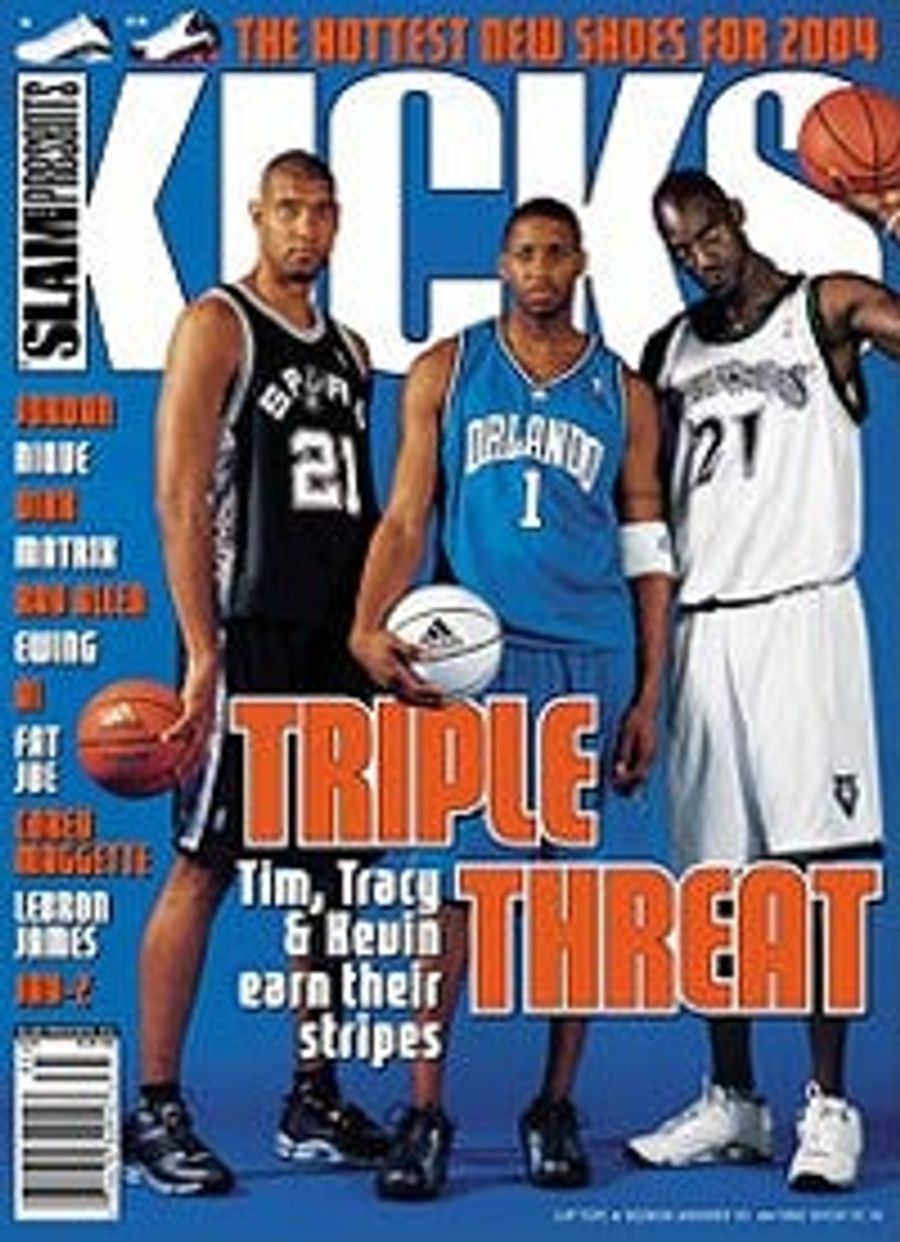
Like: "so do you ever think about the different path your life might have taken if you had been the son your father named 'O'Lewis Jr.'?" Or, "I've been meaning to ask someone what's it like to be arrested for lynching…" But this was back in the day as they said back in the day. And he had just signed a contract with Adidas, which used to outfit the Nazis, and I wrote a story that was all, "Kevin Garnett Tim Duncan whatevs." And Adidas was kind of proud of this fact because they'd just disposed of Kobe and then he had gone and raped some girl, but none of this did anything for sneaker sales.

In any case, sometimes I think that it's bad that the internet gives everyone access to all this personal information about total strangers they might someday meet and think, "hey, I saw you on the sex offender registry," because it sort of takes the element of discovery out of first encounters, but I didn't realize there was such a wealth of discoverable nuggets of information to learn about Kevin, and that, I guess, is the difference between known and unknown unknowns, or as Malcolm Gladwell would put it, "puzzles" and "mysteries." Watergate, he wrote, was a puzzle; Enron was a mystery; and I am getting the sense that Kevin Garnett's future in the playoffs is out of our hands, but that said it seems to be what everyone's writing about this morning so I thought I'd start there.

]]>
http://deadspin.com/index.php?op=postcommentfeed&postId=5217788&view=rss&microfeed=true
<![CDATA[Revisiting All The Old Records]]> Either New Yorker and "The Tipping Point" author Malcolm Gladwell is just angry because Barry Bonds is the only human who might actually have a bigger head than he does, or he might actually be onto something. Gladwell, who says "Game Of Shadows" is "a death sentence for Bonds," suggests hiring a team of forensic economists to dig through baseball records and see which ones should be discounted because of steroids.

Having just finished "Game Of Shadows" ourselves, we understand the inclination; the book is beyond convincing of not just Bonds' usage, but also Gary Sheffield's, Jason Giambi's, Marion Jones' and, less interestingly, Bobby Estalella. But we're not sure how one would actually pull this off. We're reminded of the old quandary of when Giambi homered off fellow doper Ryan Franklin: Whom are we supposed to hate more again?

For the record, though, in case you were wondering, we think Bonds could probably take Gladwell in a fight.

Forensic Analysis Redux [Malcolm Gladwell's Blog]
We're Not Sure Whom We're Supposed To Hate [Deadspin]

]]>
http://deadspin.com/index.php?op=postcommentfeed&postId=166271&view=rss&microfeed=true
<![CDATA[At Last, Bill Simmons Emerges Victorious]]> After resounding losses to Isiah Thomas and Mark Cuban, Simmons has scored his first win in our Curious Guy fight series.

Honestly, we think he picked Gladwell just because he knew he could beat him in our poll. If he wants to keep winning, we suggest he stick with writers.

By the way, Part II of the interview is up. Reading these, we're starting to think Gladwell could put up a better fight than some have given credit.

Poll results below.

Gawker Media polls require Javascript; if you're viewing this in an RSS reader, click through to view in your Javascript-enabled web browser.

]]>
http://deadspin.com/index.php?op=postcommentfeed&postId=158221&view=rss&microfeed=true
<![CDATA[Who Would Win In A Fight: Bill Simmons or Malcolm Gladwell?]]> After what had been a considerable hiatus, our boy Bill Simmons is cranking out his Curious Guy segments like crazy these days. We had David Stern just a week ago, and now, punching back in his weight class, he banters with "The Tipping Point" author Malcolm Gladwell for, let's see, 5,000 words ... and it's only Part I!

The piece, as usual, is a mutual backrub, but it's an entertaining read, if just because Gladwell is an excellent writer (even if not everyone agrees.) But enough of that. Let's get to the real question: Who would win in a fight? Previously in our Simmons fight series, the guy has lost heavily to Mark Cuban but gave Isiah Thomas a tougher battle than we expected. We actually think he might have a chance here.

You can vote below; polls will be open until noon tomorrow. Should be a tight one.

Gawker Media polls require Javascript; if you're viewing this in an RSS reader, click through to view in your Javascript-enabled web browser.

]]>
http://deadspin.com/index.php?op=postcommentfeed&postId=158011&view=rss&microfeed=true