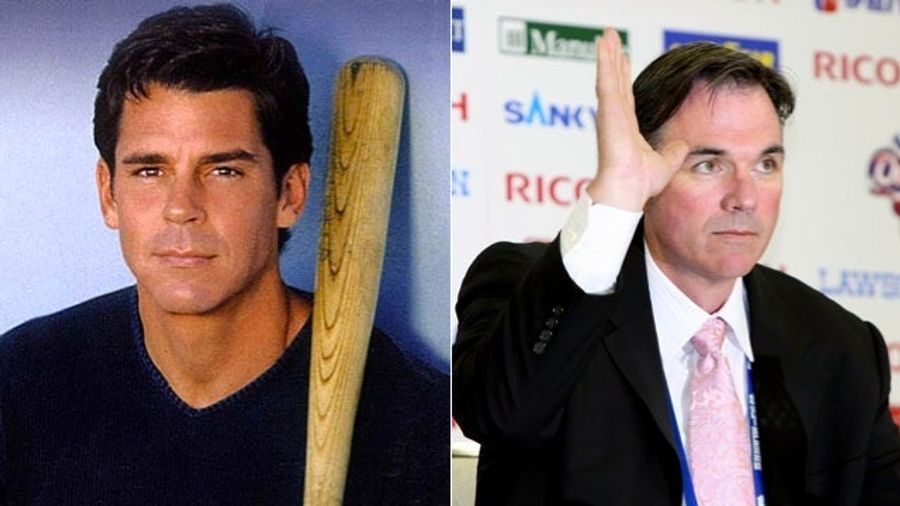
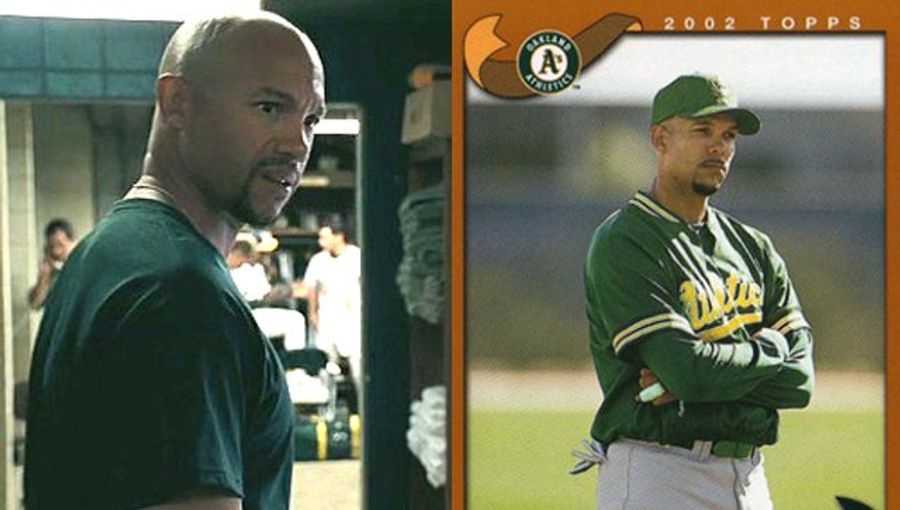
<![CDATA[Deadspin: moneyball]]> http://tags.deadspin.com/assets/base/img/thumbs140x140/deadspin.com.png <![CDATA[Deadspin: moneyball]]> http://deadspin.com/tag/moneyball http://deadspin.com/tag/moneyball <![CDATA[Moneyball's Back On]]> Bennett Miller, the guy who did the Truman Capote movie that didn't subject us to Peter Bogdanovich's acting, will direct. He replaces Steven Soderbergh, who was traded to the White Sox for three prospects and a reliever. [Variety, via NYMag]

]]>
http://deadspin.com/index.php?op=postcommentfeed&postId=5420875&view=rss&microfeed=true
<![CDATA[Bissinger Continues His Moneyball Trolling]]> Buzz Bissinger, shit-pissing author of Three Nights as Tony La Russa's Sock Puppet, is back on his battered old Moneyball hobbyhorse, firing off angry fallacies left and right. [TNR, of all places]

]]>
http://deadspin.com/index.php?op=postcommentfeed&postId=5386141&view=rss&microfeed=true
<![CDATA[The Forgotten Man Of Moneyball, Part 2]]> Read Part 1 here.

Modern analysis has shown a whole treasure chest of interesting and often useful performance metrics, but it remains so that the bedrock principle of classic analysis is simple: out-making controls scoring. What I call "classic" analysis is the principles that I presented to the Oakland Athletics in the early 1980s, which governed their thinking through 20 or so successful seasons, and which were dubbed "moneyball" by Michael Lewis in his book of that title. Because of that book, there has arisen a belief that whatever the A's do is, by definition, "moneyball"; with the decline in their fortunes in recent years has come a corresponding belief that "moneyball" is in decline — dead, some would say [1] — because the A's and moneyball are seen as essentially one thing.

That is simply wrong. Analysis is not moneyball, and moneyball is not analysis. "Moneyball," as the name says, is about seeking undervalued commodities. In my day, what I regard as the crucial aspects of run-generation, notably on-base percentage, were seriously undervalued, so "moneyball" consisted in finding batters with those skills.

A team that today sustains one of the lowest on-base percentages in baseball, and actively acquires players with drastically low career on-base numbers, is very obviously practicing a different "moneyball" than that for which it became famed. Today's A's, it seems, see the undervalued commodities as "defense and athletic players drafted out of high school" (as a recent article on the organization put it). These are not your father's A's. What success their new tack will have remains to be seen (their present fortunes are a transition state); but "moneyball" as practiced today by the A's seems no longer to have at its core the same analytic principles that then-GM Sandy Alderson and I worked with a quarter-century ago, and that I presented to Billy Beane in that now semi-famous paper.

* * *

Back then, Sandy was fighting an uphill battle. As a man who had not come up through the baseball establishment, he met quite a lot of entrenched opposition, especially to the ideas of the then-new analysis. He thus kept mostly quiet about analysis, even while using its results to help shape both general approaches and particular decisions. When I had worked for the Giants, I was under express orders to not disclose my relation with the team; with the A's, I adopted a policy of silence on my own, but there were subtle suggestions that that was the way Sandy preferred it. I think almost everybody in the front office (including the Haas family, the owners) knew who I was and what I was doing, but I believe no one at the field level did.

In 1994, Sandy promoted Billy Beane to assistant GM. At the same time, he asked me to prepare an overview of the general principles of analysis for Billy, so that Billy could get in one sitting an idea of the way the organization was looking at talent. In the end, I delivered a report titled "Winning Baseball," with the subtitle: "An objective, numerical, analytic analysis of the principles and practices involved in the design of a winning baseball team." The report was 66 pages long; I still grit my teeth whenever I remember that Michael Lewis described it as a "pamphlet."

Both Lewis in Moneyball and Alan Schwarz in The Numbers Game have reported Billy's reaction to his first reading of "Winning Baseball." Lewis says Beane "experienced — well, he couldn't quite describe the excitement of it." He quotes Beane:

It was the first thing I had ever read that tried to take an objective view of baseball. Something that was different than just a lot of people's subjective opinions. I was still very subjective in my own thinking but it made sense to me.

Schwarz put it in much the same terms: Beanes's "eyes all but popped out of his head when he read it."

One of those two (Lewis, I think) told me that the phrase Billy used to describe his initial reaction was "the scales fell from my eyes." Billy took up the new ideas with, as is now known, considerable enthusiasm. I remember once being in Billy's office when he told me — pointing to a sample copy — that he had had "Winning Baseball" printed up in quantity and distributed throughout the organization, to scouts and minor-league managers and coaches. (That was one of the very few times that either Sandy or Billy ever made clear to me that they were placing more than casual emphasis on the work I was doing for the club.)

My goal in that report, which I seem to have met, was to put the ideas — not the detailed principles, just the ideas — forward in simple, clear language and logical order, so that they would be comprehensible by and reasonable to a working front-office executive. Sandy Alderson didn't need a document like this, then or at the outset, but he was a Harvard-trained attorney; I considered myself to be writing not just to Billy Beane but to any veteran baseball man (which, as it turned out, was just as well).

As I now look back and reflect, I think that possibly the most important thing I accomplished in those years was not so much the actual analyses I did (though I believe they were important), but rather that communicating to baseball people what analysis was all about in ways that made it reasonable and plausible. Despite all the seasons that have flowed by since Rickey and Cook and James, there remains to this hour a great divide, a sort of cultural barrier, between "old-time baseball men" and the so-called "new breed" of analysis users. That pains me, because though the details of analysis can be abstruse and mathematical, the basic concepts, with only a modicum of patience, can be explained even to hostile disbelievers, who disbelieve for the very reason that no one has ever troubled to make those clear explanations to them — at least not in language they speak. Some of the published materials on analysis have been more educational than others, but none that I can recall offhand has ever been aimed at actual working baseball men. Indeed, not a few modern analysts almost brag about the fact that they have never been down on a field or in a front office.

At least in the receptive atmosphere of the Oakland organization of the 1980s, with that report I was able to bridge that cultural gap. I admit that we never tried to take it down to the field level during Tony La Russa's term, by the end of which I was 150 miles away from the Coliseum and not able to visit in person frequently. But it is my firm belief that there are few "old-time baseball men" who could not — unless they were to willfully refuse to listen — be persuaded of the logic and validity of analysis. It is, after all, the way things really work, and its logic is not hard to follow if presented with the idea in mind that the audience has hard-won preconceptions. Selling ideas to interested fans with open minds is a very different kettle of fish from selling ideas to men who have been acknowledged as important experts in their field and who have spent a lifetime acquiring a set of beliefs that they think work well. And the disdain for and sarcasm about such folk found in most books of analysis do nothing to ease the way.

* * *

Re-reading "Winning Baseball" now, after 15 long years and a lot of advances in the field, I am pleased to see that it holds up remarkably well. Throughout the text, I placed in boxed, emphasized text such summary keystone statements as I wanted readers to remember. They were, many of them, quite iconoclastic at the time, though most will today sound quite familiar to anybody who's been paying attention to baseball over the past decade. Things like:

Winning a seven-game major-league baseball series is much more a matter of luck than inherent ability.

There is a definite relation between runs scored and runs allowed over a stretch of games and games won during that stretch.

Young pitchers' arms are easily damaged by extended outings.

Virtually all tactical ploys—the sacrifice bunt, the stolen base, the hit-and-run—operate on average to reduce run scoring.

From Double-A on up, minor-league stats mean just as much as major-league stats.

Trade all players by age 29.

No free agents!

And most important of all, on the subject of roster construction:

NOT ALL GIANTS—
JUST NO MIDGETS.

The only two particular player-personnel matters I can remember ever being asked about by Sandy were an evaluation of Reggie Jackson versus some other old DH possibilities prior to the 1987 season (for what it's worth, I recommended Jackson over the others, and he was the one they signed), and of the defensive play of shorstop Alfredo Griffin (Sandy wanted to get rid of his dreadful bat, but faced a lot of resistance from within the organization on the supposed value of Griffin's fielding), whom the A's did trade away after the 1987 season.

When Sandy left and Billy took over as GM, one of the major changes in my work was an especial emphasis on evaluation of six-year minor-league free agents, Rule 5 draft possibilities and some veteran free agents. Recall that translations of minor-league stats were, at that time, rather arcane matters; Bill James had published a methodology, but few if any other front offices were then (to my present knowledge) doing much in that area. A couple of names that I am particularly pleased to recall are Billy Taylor and Matt Stairs, each of whom I pushed hard for. Seeing their successes was, I must say, immensely gratifying. I certainly didn't have everything my way — the A's despite my continual pleadings, didn't acquire Mike Aldrete till late in his career (a career that could and should have been a lot more distinguished, the next Keith Hernandez, but he had the misfortune to come up at the same time as Will Clark) — but all in all it was rewarding work.

I think the worst thing that happened during that era derived from the growing tension between the front office and the field level. A young man named Doug Jennings, who had outstanding minor-league translations (especially in OBP) was put on the 25-man roster. Tony La Russa apparently took the position that you can force me to have him, but you can't force me to play him. Jennings was on the big club's roster for parts of four seasons, and never accomplished anything; but it is hard to accomplish anything when in four seasons you get 323 plate appearances. A precious few men can still be productive with scant and irregular play, but most cannot (that's an analytic fact). The needless barriers between modern and old-time cost Doug Jennings a career — probably a pretty good career.

* * *

Today, I have retired, both from baseball and from my non-baseball business, but I keep an iron or two in the fire (in fact, I keep far too many irons in). Besides my main baseball site, High Boskage House, I not long ago established another baseball-related site, Steroids, Other "Drugs", and Baseball. As Alan Schwarz put it in his New York Times article on it, "One of the most influential baseball minds of the last 40 years is angry. And he is coming out of retirement to vent." That site can and does speak for itself, but the long and the short of it is that I was, and am, sickened and angered by all the dolts, from senators to sports writers, mindlessly and pompously parroting as fact things about which they know as much as a fish knows about bicycles.

Maybe one of these days I'll desktop-publish a copy of my report to Beane, perhaps coupled with a reprint of The Sinister First Baseman, which folk are constantly inquiring about. Or maybe I'll just re-write the report a little and shop myself around again to some teams. Who knows?

I left the A's in the late 1990s (I forget the exact year). They did not, as The Numbers Game mistakenly put it, "stop contracting" my services. I resigned. Why? It's ironic, all things considered: The team I helped teach how to win on the cheap wasn't willing to pay enough to keep me.

[1] I hear a lot today that "analysis is dead," meaning that its crucial lessons are few and now understood and accepted as a basis for planning by virtually all organizations. What nonsense! The merest glance at even just team on-base percentages (never mind things like Pitcher Abuse Points) should make it blindingly obvious that a good fraction of ball clubs still Just Don't Get It.

That gravels me. I cannot think of another industry in which the uttermost basics of how the product works are a mystery to the people in that industry. There is nothing, to any with IQs much over their hat size, mysterious or controversial about analysis: it's just the way things work, and that's that. Yet a coach on the major-league level (coaching on a team last in all the majors in OPS) can to this hour be found publicly remarking, "You want to see a walk? Go watch a mailman." How is that possible? How can businesses with annual payrolls approaching a tenth of a billion dollars not have any least idea how their business works?

* * *

Eric Walker lives in eastern Washington State. He currently maintains over a dozen web sites, two of which are related to baseball: The High Boskage Baseball-Analysis Web Site and Steroids, Other "Drugs", and Baseball. A full menu can be found at his main web site. He can reached at webmaster@highboskage.com.

]]>
http://deadspin.com/index.php?op=postcommentfeed&postId=5375605&view=rss&microfeed=true
<![CDATA[The Forgotten Man Of Moneyball, Part 1]]> He calls himself "the pebble that started the avalanche," the man who taught baseball analysis to Billy Beane. Gandhi, someone wrote, sparking MLK's revolution. Today, Moneyball remains a hotly debated phenomenon. Eric Walker is a footnote. Here's the footnote's story.

This is a two-parter. The first discusses Walker's stint as a consultant with the Giants (more than 20 years before Bill James would secure similar work with the Red Sox). The second, which will run this afternoon (you can read it here), will look at Walker's time with the A's and the evolution and distortions of what's come to be known as moneyball.

On a warm morning in mid-May of this year I was standing on a hilltop overlooking Los Angeles, talking with Steven Soderbergh, the noted movie director, about baseball. The conversation was not a casual chat: Soderbergh was interviewing me about Billy Beane, the Oakland Athletics, and more generally about what Michael Lewis used as the title of his famous (or notorious) book, Moneyball, and I was being filmed — the end result, with who knows how much cutting, to be used as one or more inserts in Soderbergh's movie adaptation of the same name.

Regrettably — certainly for me — only a few weeks later, for reasons still not generally agreed on, the studio put the movie in turnaround (even though over $10 million dollars had already been spent on it). Even if the project is revived, all indications are that my little interview, as well as several more with other key figures in moneyball history, will end up on the proverbial cutting-room floor. But it is not simply Moneyball the movie project that may be dead: not a few voices are now proclaiming that moneyball the concept is dead, or at least dying.

But who am I, and why would I be considered some sort of expert on moneyball? Perhaps you recognized my name; more likely, though, you didn't. Though it is hard to say this without an appearance of personal petulance, I find it sad that the popular history of what can only be called a revolution in the game leaves out quite a few of the people, the outsiders, who actually drove that revolution.

Anyway, the short-form answer to the question is that I am the fellow who first taught Billy Beane the principles that Lewis later dubbed "moneyball." For the long-form answer, we ripple-dissolve back in time ...

* * *

. . . to San Francisco in 1975, where the news media are reporting, often and at length, on the supposed near-certainty that the Giants will be sold and moved. There sit I, a man no longer young but not yet middle-aged, a man who has not been to a baseball game — or followed the sport — for probably over two decades, but a man who in childhood used to paste New York Giants box scores into a scrapbook, and who remembers, dimly but fondly, such folk as Whitey Lockman and Wes Westrum.

Carpe diem, I think.

With my lady, also a baseball fan of old, I go to a game. We have a great time; we go to more games, have more great times. I am becoming enthused. But I am considering and wondering — wondering about the mechanisms of run scoring, things like the relative value of average versus power. Originally an engineer by trade, I am right there with Lord Kelvin: "When you cannot measure it and express it in numbers, your knowledge is of a very meagre and unsatisfactory kind." I fiddle with some numbers; but I vaguely remember Branch Rickey's work, the cover story in Life magazine for Aug. 2, 1950, and think that I may not need to reinvent the wheel. I go to the San Francisco main library, looking for books that in some way actually analyze baseball. I find one. One. But what a one.

If this were instead Reader's Digest, my opening of that book would be "The Moment That Changed My Life!" The book was Percentage Baseball, by one Earnshaw Cook, a Johns Hopkins professor who had consulted on the development of the atomic bomb. Today, when numerical analysis of baseball performance is a commonplace, it is hard to grasp how revolutionary, even shocking, were the concepts Cook was developing (Rickey's work, which had quickly dropped off everyone's radar, notwithstanding). The book was, and remains, awe-inspiring.

That is, it remains so to me, anyway: Bill James and some others, who were in high school when Cook was conceiving the many sorts of formulae they would later get famous publicizing in their own works, have had harsh things to say about Cook and his work. James, for example, wrote in 1981, "Cook knew everything about statistics and nothing at all about baseball — and for that reason, all of his answers are wrong, all of his methods useless." That is breathtakingly wrong, and arrogant. Bill James has done an awful lot for analysis, both in promoting the concepts and in original work (most notably a methodology for converting minor-league stats to major-league equivalents). But, as Chili Davis once remarked about Nolan Ryan, "He ain't God, man." A modicum of humility and respect is in order. (Wikipedia reports that Cook's slide rule, which he used during his research for Percentage Baseball, was donated, by their request, to the Baseball Hall of Fame.) Cook's further work, using computer simulations of games to test theory (recorded in his second book, Percentage Baseball and the Computer), was ground-breaking, and it came long before anyone thought to describe what Cook was up to as "sabermetrics" and longer still before anyone emulated it.

I chronically wince at the term "sabermetrics" today. James coined the phrase as a "catchy" name for analytic methodology; its ensuing popularity abetted the idea that baseball analysis popped full armored from the brow of James like Athena from the brow of Zeus; that is misleading, and disrespectful to the largely anonymous many who labored to bring forth this new land. I know that I risk sounding peevish by saying that, but it's not about me: a major thrust of this article is that there are a lot of folk needing more public credit than they're getting, especially those who were there before this was a cottage industry — Craig Wright, Eddie Epstein, I daren't try a comprehensive roll call lest I, too, omit worthy names.

Well, eventually, I wanted to get a lot closer to the game than box seats. I had, some years before, been a radio newscaster and telephone-talk host, and I decided to trade on that background. But in a market like the Bay Area, one does not just walk into a major radio station and ask for a job if it has been years since one's last position; so, I walked into a minor radio station, a little off-the-wall FM outfit, and instantly became their "sports reporter"; unsalaried, but eligible for press credentials from the Giants. My output then was a daily five-minute report — not "news" but commentary and analysis. I'm not terribly proud of that output, and am glad virtually nobody ever heard it, because I was pretty much phoning it in (sometimes literally): the station didn't really care, but it validated my standing as "press".

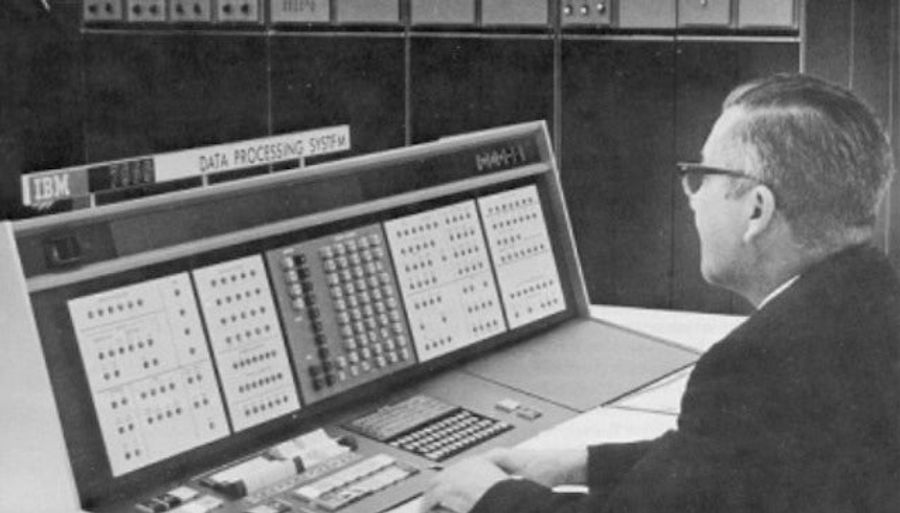
Meanwhile, however, I was constantly working on expanding Cook's work in various ways, trying to develop more-practical methods of applying his, and in time my, ideas. It seems risible when I look back on it: endless quantities of yellow legal-size pads and a handheld calculator. It was a banner day when I brought home my first computer, a "luggable" Kaypro that took half an hour to compile a fairly simple program in BASIC.

When I felt I had my principles in a practical, usable condition, I started nagging the Giants about their using the techniques. At first, it was a very tough slog; in those days — this would be 1979 or so, well before Bill James' Abstracts were more than a few hundred mimeographed copies -– even the basic concepts were unknown, and, to old baseball men, they were very, very weird ideas.

* * *

In early 1981, as a demonstration, I gave the Giants an extensive analysis of their organization; taking a great risk, I included predictions for the coming season. I have that very document beside me now as I type; I don't know its page count (the sections were individually paginated), but it's about an inch thick: it includes detailed analyses of every man on the major-league roster at the time, and combines their numbers for team stats. As we all know, the 1981 season was strike-shortened; but, pro-rated for actual games played (and weighted for the actual playing time of individual men), I was, despite the relative crudeness of the methodology in those days, a winner: 440 runs projected, 427 scored; ERA projected, 3.35, ERA achieved, 3.28; errors projected, 103, actual errors committed, 102; and, bottom line, projected wins, 57, actual wins 56.

Now a rational soul might think that such results, predictive results, would have brought the front office running breathless to my door; but this is baseball we're talking here. It was not till quite some time later that I finally entered into a contract with the Giants for consulting services, and that came about, I think, chiefly because I spent an entire Spring Training (attended at my own expense) daily haranguing Tom Haller, then the Giants' general manager.

By this time, I had taken a big step up as a broadcaster, moving from that inconsequential little station to KQED, the NPR outlet in San Francisco, whence I would eventually be syndicated by satellite to 20 NPR affiliates across the country, about half in major markets.

As a first consequence of that move, a book editor who had heard the daily module while driving to work and thought it interesting approached me with a proposal that I write a book in the general style of my broadcasts. I began work in the fall of 1981, and the book, The Sinister First Baseman and Other Observations, was published in 1982, to excellent reviews and nearly no sales. Frank Robinson, then the Giants' manager and a man I had come to know tolerably well, was kind enough to provide the Foreword for the book, which was a diverse collection of baseball essays.

It is now apparently a part of the folklore that in that book I set forth much of my analytic work, but that is not so: only about one-third of the essays concern what one might call numeric matters (a deliberate choice: one-third informational, one-third lyrical, and one-third numerical), and not even all of the latter deal with what one today would call "analysis." It was in one of those essays that the runs-scored equation I was using, somewhat dumbed-down for simplicity [1], first saw print; but it was in "A Desultory Phillippic" that there first appeared the words that would later become the crux of moneyball:

In baseball, some numbers are known, some are not, and the meaning of most of them can be debated. But there's one number everyone knows and agrees with: three. Three outs and you're gone. Period. The end. All runners cancelled, all theories moot, all probabilities zero. That number must, in any rational evaluation of the game, dominate planning.

Many, many years after, George F. Will — the foremost living exemplar of the term "pundit" — was to write in a New York Times review of Alan Schwarz's excellent book The Numbers Game:

Alderson was in a San Francisco bookstore when he came upon a volume by Eric Walker, the most important baseball thinker you have never heard of. Alderson reading Walker was, Schwarz says, like Martin Luther King Jr. reading Gandhi, sparking a revolution. Scoring runs has always been the point of baseball, but Walker's epiphany was that when you make three outs you have to start over from scratch. Hitherto, the assumption was that runs — and wins — were achieved by hits. Nowadays the stress is on avoiding outs. [2]

At any rate, there I was, finally on contract with a major-league ball club, the Giants, but in a dubious situation. The GM, Tom Haller, was, ah (let us not speak ill of the dead), not a progressive thinker, and the rest of the team's Brain Trust was of the same vintage. I was fairly close to the field manager, Frank Robinson, but that was a minus, not a plus, in that there was open hostility between Haller and Robinson. I did persuade them to trade Gary Lavelle to the Blue Jays, but instead of names like John Cerutti and Jimmy Key, whom I had suggested, Haller got Jim Gott, who gave the Giants one good year as a starter and two forgettable years in the pen, plus two guys who never made the majors. But deals for Ken Oberkfell and especially for John Tudor, which I lobbied for intensely, didn't get made (Haller called 20 minutes too late to get Oberkfell). I still remember then-Giants owner Bob Lurie, when I was actually admitted to the Brain Trust sanctum on trade-deadline day, saying around his cigar, "What's all this about John Tudor?" (Tudor, then openly available, had a high AL ERA because he was a lefty in Fenway — this was well before "splits" and "park effects" were commonplace concepts — and I tried to explain all that, but no dice; Tudor went on to an NL ERA of 2.66 over seven seasons.)

When Robinson was fired by the Giants, I knew that owing to guilt by association (remember, Robby wrote the Foreword to my book) I would soon be gone, and so I was. My term as a consultant with the Giants was about half a season. In that brief term, I had had some input into a few decisions, but most of what I advocated, while listened to, was never acted on.

But having once crossed the major-league threshold, I was not about to sink back into oblivion. Across the Bay was an organization with a famously more forward-looking front office, with which I had already had contact. I asked, they answered, and so my career with the A's began.

[1] For fun, I just applied that "dumbed-down" equation to the Giants' 2009 final stats: it was within 1.4% (648 calculated vs. 657 actual) — not so very dumb.

[2] Also in that book, written in 1981, well before even the first printed Abstract had hit booksellers' shelves, was the presentation of a concept called "Fielding Efficiency" — the percentage of balls put in play that a team's defense turns actual outs as a measure of team fielding competence. Today, essentially the same measure, called "Defense Efficiency Ratio," is universally described as an invention of Bill James. Am I peeved over that one? Yes.

]]>
http://deadspin.com/index.php?op=postcommentfeed&postId=5365138&view=rss&microfeed=true
<![CDATA[Famous Actor Desperate To Portray Nerdy GM]]> Brad Pitt says that Moneyball: The Movie is still very much alive and he would very much like to play Billy Beane. So world-famous actors with beautiful movie star wives dream about being nerdy baseball executives? [MTV]

]]>
http://deadspin.com/index.php?op=postcommentfeed&postId=5336575&view=rss&microfeed=true
<![CDATA[Buzz Bissinger's 3 Nights In August To Become 2 Hours Wasted At Your Local Multiplex]]> That other baseball movie is flailing about, but the adaptation of 3 Nights In August, Bissinger's Moneyball diss track and paean to Tony La Russa and the manly virtues of lineup construction, is moving along nicely. The nerds can't win.

The latest is that Billy Bob Thornton has signed on as a co-producer. Writes the Hollywood Reporter:

Thornton, known to be a vocal Cardinals fan, will join Red Bird Cinema managing director John Loar in producing the picture. Writer-actor Kevin Pollak, La Russa and Bissinger will executive produce.

Thornton is known primarily as an actor and director, though he did produce one movie, the Tex-Mex romance "All the Pretty Horses," which he also directed.

There's a possibility he could take a role in the picture, but it likely won't be the La Russa part, Loar said.

Baseball projects like "Moneyball" have had a rough time in Hollywood of late, but the project's producers say they think "August" offers a refreshing take on the subject.

"There are a lot of baseball movies out there, and a lot of them are based on the won-loss component," Loar said. "What this does is go inside the day-to-day happenings of the locker room and how a manager thinks about all the decisions he has to make. It's going to be challenging, but Billy Bob has a good handle on it."

La Russa, Bissinger and Billy Bob Thornton. That's enough testosterone in one room to revive Sam Peckinpah. And just so you're clear: An ode to the technocratic brilliance of a baseball general manager? Get me rewrite, sweetheart. But an ode to the technocratic brilliance of a baseball manager? "Refreshing."

Billy Bob Thornton joins "Three Nights" team [Hollywood Reporter]

]]>
http://deadspin.com/index.php?op=postcommentfeed&postId=5315166&view=rss&microfeed=true
<![CDATA[Now It's Aaron Sorkin's Turn To Fail At Writing A Moneyball Script]]> Columbia has enlisted Sorkin, the sanctimonious West Wing creator last seen making Ed Asner say "Macau" over and over, to write a draft of the star-crossed Moneyball script. Such waste. Such inefficiency. Somebody could write a bestselling book about this.

Writes Steven Zeitchik of The Hollywood Reporter:

The writer has been brought on to do a draft of the baseball drama that will draw on Steve Zallian's earlier take on the project. The studio wants to move forward quickly with the new iteration, with Sorkin set to turn in his version as soon as August.

Brad Pitt remains on board to star in the Michael DeLuca-produced pic, but Steven Soderbergh will no longer write or direct, and is not involved in the film in any capacity.

[...]

Sorkin is believed to have a close relationship with Sony. The A-list scribe recently completed "The Social Network" for the studio, colloquially known as the Facebook movie.

The writer also has experience writing tales set in the sports world, creating the critically well-received "Sports Night" for ABC a decade ago.

We excerpted Zallian's draft, which Sorkin will no doubt rewrite as a series of snappy conversations between two people walking down hallways. More interesting is that the making of the movie is quickly becoming a meta-commentary on the ideas in the book itself, something Steven Soderbergh — in his much-reviled script — vaguely seemed to toy with. With Sorkin, Columbia is Yankee-ishly tossing yet another big-name talent at a project that was probably doomed from the minute the script got optioned. If Billy Beane worked there, he'd throw a chair through a wall right about now.

Aaron Sorkin game for 'Moneyball'
[Hollywood Reporter]

]]>
http://deadspin.com/index.php?op=postcommentfeed&postId=5311298&view=rss&microfeed=true
<![CDATA[Soderbergh's Moneyball Script Too Real To Get Made]]> The Sony Pictures executive who pulled the plug on Moneyball says that Steven Soderbergh changed the original script because he didn't want anything in the movie that didn't actually happen. So Billy Beane isn't a sweaty, foul-mouthed, Hooters waitress slayer?

Everyone loved Steven Zallian's version (he's an Oscar-winner, you know!), because it had jokes and snappy dialogue and actually made sabermetrics non-mind numbing. But Soderbergh wanted realism so much, he was determined to only film events that took place in real life. He also scrapped the conceit of having Bill James as the "Greek chorus", bookending the film with his anecdotes with and wise old man stories. The verdict:

That might make for an intriguing art film, but it clearly was no longer a film that any studio would spend $58 million to make, especially with baseball films having virtually no appeal outside of the U.S.

We got our hands on the Soderbergh draft, and it's about as bad as others have said. Gone, thankfully, is the Beane-as-dork-Messiah stuff. Soderbergh's Beane is more of a proxy for the audience this time — Bud Fox meets Crash Davis, as they say in Hollywood — and in his script, Moneyball is more of a Beane-Paul DePodesta buddy movie, which maybe makes some sense when you imagine Brad Pitt and Demetri Martin in those roles. Maybe.

The script was probably doomed from its second page, from which the above image was taken. Here's Soderbergh's disclaimer:

Billy Beane's minor and major league career will be shown via filmed interviews with scouts, coaches, managers, players, and family members who were with him at the time. These interviews will comprise approximately ten percent of the film.

Another ten percent of the film will consist of re-enactments of real events as remembered by the people playing themselves. The purpose of these scenes will be to provide set-up and perspective for subjects, situations, or relationships which currently appear in the screenplay without the requisite/normal amount of context.

All that is to say an important portion of this film will be written in the editing room. This isn't a cop-out; it's just a fact, and entirely by design.

That sounds an awful lot like, "Yes, this script sucks. But trust me. I made The Limey." It was probably at this point that Amy Pascal, the Sony executive, optioned the script to the bottom of her coffee mug. Even though it was five days from shooting and Sony had already sunk $10 million dollars into the film, Pascal pulled the plug. The movie is now in limbo. The studio would presumably still make the Zaillian version if they could find a director, but would likely lose Brad Pitt if Soderbergh walks. And the current talent is free to take the project somewhere else, but no one is biting, because that brings us all back to the original argument, "Why anyone make a movie about this?" Maybe Scott Hatteberg is really big overseas?

(Additional Soderbergh script reveals, information by Tommy Craggs.)

Sony's Amy Pascal speaks out about 'Moneyball' [Los Angeles Times, via Gawker]
What happened to...Moneyball? [ScriptShadow]
Billy Beane Is A Golden God: Excerpts From The Scrapped Moneyball Script

]]>
http://deadspin.com/index.php?op=postcommentfeed&postId=5305316&view=rss&microfeed=true
<![CDATA[Billy Beane Is A Golden God: Excerpts From The Scrapped Moneyball Script]]> It looks like Moneyball might not be coming to the big screen anytime soon because director Steven Soderbergh tinkered with the script and everyone realized that a movie version of the book made about as much sense as Joe Morgan.

But an earlier draft of the script, dated Dec. 1, 2008, is making its way around the Web. It's 129 pages, which means it's up to the intern to parse through it, pick out the good parts and then compile the particularly entertaining excerpts. It wasn't hard to find a handful of lowlights, and in addition to the ones included, there are a surprisingly large number of pointless factual inaccuracies: The Charlotte Knights are Triple-A, not Double-A; Scott Hatteberg never played one year for the Rockies; Bryan Bullington and Roger Ring were not the draft choices directly before Jeremy Brown; and when Olmedo Saenz grounded out in the ninth inning of the fifth game of the 2001 ALDS, there were no outs, not one, thank you very much.

Besides that — and plot twists that pit Beane as an avid concertgoer and convert Paul DePodesta into a weightlifter — the screenplay made me wish some studio would take a chance with this movie, even if Michael Lewis himself didn't see the movie in the book. The first two acts are slow, relying on Bill James to explain sabermetrics to the women dragged to the theater by their geeky boyfriends brothers. The last 30 pages, though, are as action-packed and climactic as a trading deadline and AL West race can be.

And yes, there are cameos from Lenny Dykstra and Joe Morgan, outright allusions to Roy Hobbs and Jimmy Stewart and subtle nods to Bobby Knight and Angels in the Outfield. It's Moneyball, coming to a theater near you... well, maybe never, but hopefully soon.

"OK, Let's start with a naked Billy Beane, the steam rising off the shower and crowning his head, like... God!"

"Great idea, but here's a better one. We'll cut to a Bill James voiceover, and then cite Henry Chadwick."

"Oh, I like it. But it's a bit too, hmm, secular. Let's throw some stigmata in there."

"You sure you want to go that route?"

"Absolutely. And blood! Lots of blood!"

Lest the movie offend the Jewish crowd, Arn Tellem makes a cameo when Beane goes to Tellem's son's bar mitzvah and, like everyone else, struggles to keep a yarmulke on his head. Bobby pins, Billy. That's the trick. And don't be depressed — bar mitzvahs are fun!

A few scenes in and Beane's already throwing chairs against the big board. Nobody pays any attention. Apparently there is fighting in the war room.

I think this is the beginning of a beautiful uncomfortably intense friendship.

Because after you seduce an Outback waitress, your next step isn't to call the Indians' general manager in the middle of the night?

Ah, Christmas — makes more sense than you think. But don't bother trying to figure out how It's A Wonderful Life comes into play.

I thought this was the most entertaining soliloquy of the movie, but then everyone's favorite Sunday Night Baseball analyst makes an appearance.

And the Lord said, "Ask and ye, Chad Bradford, shall submarine, no problem."

Well, all of this certainly makes a lot more sense now.

From bar mitzvahs to Auschwitz? Let's hope this was one of the segues Soderbergh edited out.

One of the screenplay's more puzzling revelations is that Jeremy Giambi is obsessed with The Natural. And, apparently, he's so caught up in the climax that he yells, "Yeah, Hobbs!" even though he's seen it hundreds of times. Also, this is why Beane trades him. Yeah, Beane!

Billy Beane and fantasy baseball owners across the country: not so different after all.

Should make for an interesting Spanish subtitle.

Aaaaaaaand scene!

]]>
http://deadspin.com/index.php?op=postcommentfeed&postId=5302144&view=rss&microfeed=true
<![CDATA[Moneyball's Deep-Sixed]]> Break out the baseball puns! Columbia has dropped Steven Soderbergh's Moneyball adaptation like an overvalued, arbitration-eligible pitcher after a career year. Why, it's as if producers made a running, 20-foot backhand flip to cut down the movie at the plate.

Reports E! Online (which went with the decidedly weak "Columbia Drops the Ball on Brad Pitt's Moneyball" for its punning headline):

They can't all be home runs for Brad Pitt.

His latest project, the Steven Soderbergh-directed Moneyball, has been put into "limited turnaround" by Columbia Pictures honcho Amy Pascal after receiving a much different final draft of a script she once fought for.

Production on the film was set to start Monday in Phoenix, and with only 96 hours to go, Soderbergh's change in vision unsettled Pascal and the brakes were immediately applied to the project.

The "limited turnaround" gives Soderbergh the opportunity to try and settle with another studio, the aim being bigwigs such as Paramount and Warner Bros. The filmmaker has until Monday to tie down the deal, having spent the weekend with both his and Pitt's CAA agents attempting to hit one out of the park-so to speak.

If that doesn't happen, America will very likely have lost its only chance at ever seeing Lenny Dykstra and Demetri Martin together on the big screen. Just a few weeks ago, Lewis seemed nonplussed that the movie was being made at all. In an interview with the Today Show's Dan Fleschner, he said: "I didn't understand why they bought it for a movie in the first place."

At least the adaptation of Lewis' Blind Side is proceeding apace. Sandra Bullock and Tim McGraw, folks. Touchdown!

Columbia Drops the Ball on Brad Pitt's Moneyball
[E! Online]
Has Soderbergh's Moneyball Movie Been Canned? [Slate.com]

]]>
http://deadspin.com/index.php?op=postcommentfeed&postId=5299791&view=rss&microfeed=true
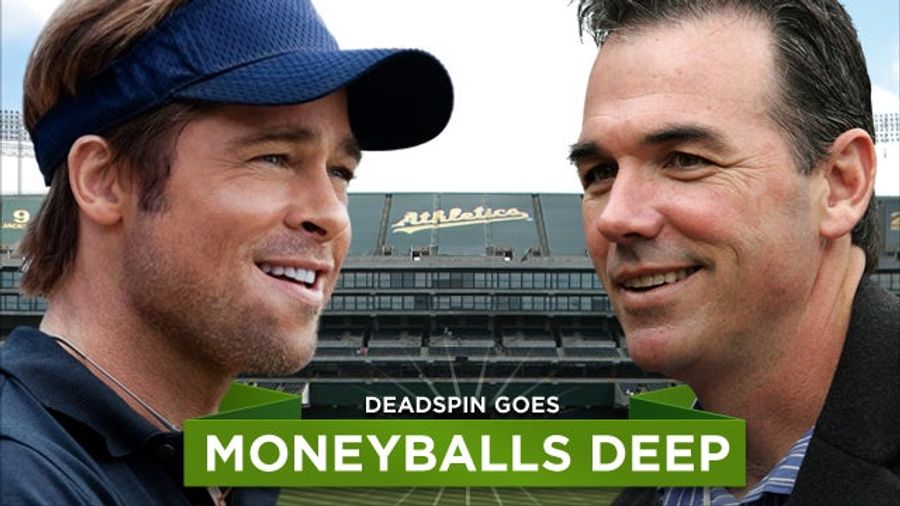
<![CDATA[Moneyball’s Deep: How Baseball Prospectus Is Like The Oakland A’s]]> Under Billy Beane, the Oakland A's won by scraping together undervalued assets. Since the rest of baseball has started valuing assets properly, the A's are having a harder time. The same thing is happening to baseball's leading propeller-heads.

When it launched on the Web in 1997, Baseball Prospectus was a gadfly that hadn't yet caught the ear of the major leagues. Nevertheless, it became a gathering place for sabermetrics' brainy hobbyists: The site laid out the concept of value over replacement player, pushed for teams to do a better job tracking pitch counts, and ran Voros McCracken's breakthrough study that pitchers have little control over the hits they allow.

By the time Moneyball came out in 2003, major-league teams had figured out the value of BP's writers. In 2002, the Blue Jays hired BP's Keith Law as a consultant. Keith Woolner, who invented VORP, left in 2007 to join the Indians, James Click and Chaim Bloom joined up with the Rays, and Dan Fox quit to work for the Pirates. Last year, the entire world realized that Nate Silver was an undervalued asset when he started devoting his genius-power to politics. Two months ago, he resigned as BP's managing partner and announced he'd likely "not be able to write about baseball with the frequency that [he] once did."

Kevin Goldstein, the site's new lead business guy, says the departure of the site's top analytical minds is "a real pain in the ass." He says there are now more than 10 people working for major-league clubs who have BP on their resume. "If someone's really valuable to you, you can usually keep them if you play the money game," he says. "We can't do that because working in baseball is their dream."

Unlike a baseball team, BP doesn't get talented youngsters back in trade when its veterans leave town. The need to find new, cheap, unknown talent explains something as bizarre and seemingly un-wonky as the site's current Prospectus Idol contest, in which 10 finalists are competing to become a columnist.

Along with getting raided by the big leagues, BP also has to compete with a bajillion other baseball-wonk clearinghouses—and the other guys don't charge a subscription fee. One quantitative analyst who does work for several major-league teams told me that BP has less path-breaking statistical material these days than sites like Fangraphs and The Hardball Times. Fangraphs has done more and better work than BP using Pitch f/x, the amazingly rich new data on pitch types, speeds, and location. (BP's former Pitch f/x guru, Dan Fox, is one of the guys who left for MLB. Another f/x expert, Eric Seidman, is now writing for BP along with Fangraphs.) I also heard from several different people that Dave Cameron, who writes primarily for Fangraphs and the Wall Street Journal, is the closest thing on the Web to a proto-Silver—the most-promising young sabermetrician writing today.

Goldstein says that, while he believes BP's writing is better than the competition, Fangraphs has moved the ball when it comes to tech-y tools. He doesn't see it as a problem, however, that BP is no longer the lone port of call for spreadsheet lovers: Joe Sheehan is one of the best baseball columnists anywhere, Will Carroll is the industry's leading injury guru, and Goldstein himself is a respected prospect evaluator. "I don't want [statistics] to be only what we do," he says. "I don't want to be pigeonholed as that, and that's ticked off a lot of people. … There is a certain subset out there who wants us to stick to our roots and talk about the numbers and be more hardcore."

While Prospectus might be losing stathead mindshare, it does still have PECOTA, the player-forecast system invented by Nate Silver. Goldstein emphasizes that the site's subscriber-base and traffic are bigger than ever. The BP gospel has also spread to mainstream publications like ESPN.com and Sports Illustrated, and the Prospectus brand has now extended to include a basketball site and a hockey site. Inspired by Silver's political work, Goldstein and co. are now thinking about moving beyond sports. "I don't want people stealing our ideas, but we've got things in our cooker for the next couple of years," Goldstein says. One clue: "We wouldn't do data on the plumbing industry, because there's not a lot of plumbing fans."

]]>
http://deadspin.com/index.php?op=postcommentfeed&postId=5279714&view=rss&microfeed=true
<![CDATA[Michael Lewis Explains Why Your Kid Is Overvalued]]> An interesting Q&A with Michael Lewis covers Moneyball ("The A's have no intellectual advantage, as evidenced by their performance"), the Rockets, his books being turned into movies, and his new tome about being a father. Joe Morgan's kids have already panned it. [MSNBC]

]]>
http://deadspin.com/index.php?op=postcommentfeed&postId=5273849&view=rss&microfeed=true
<![CDATA["Moneyball" Casting Department Seeking Undervalued Actors]]> The cast of Steven Soderbergh's ridiculous Moneyball adaptation is starting to come together and it looks to be about as awesome as a dramatic feature about sabermetrics could possibly be.

As you all know, Brad Pitt has signed on to play Billy Beane—a hilarious concept in its own right—but now some of the other characters are filling out the picture. Dimitri Martin, who has slightly less star power than Pitt, will play Beane's assistant and future Dodger GM, Paul DePodesta. (The opening of DePodesta's Wikipedia entry is a master stroke, by the way.) Rick Peterson, a former A's pitching coach featured in the book will be played by ... Rick Peterson. David Justice and Scott Hatteberg have also been tabbed to play themselves. Obviously they are digging very deep into the talent pool for this one.

So Brad Pitt, a dude who has been Comedy Central-famous for like 10 minutes, and a bunch of former ball players will somehow attempt to make a book about nerds working in an office a compelling family-friendly box office draw. This should go about as well as the last three games of the 2001 ALDS did for Oakland.

Demetri Martin Cast in Steven Soderbergh's Moneyball [IFilm]
Brad Pitt in no way resembles Billy Beane; nobody apparently resembles Rick Peterson except for Rick Peterson [Big Picture]

]]>
http://deadspin.com/index.php?op=postcommentfeed&postId=5221261&view=rss&microfeed=true
<![CDATA[Michael Lewis Gives The NBA Its "Moneyball"]]> It took me the entire weekend and most of Monday, but I finally got through Michael Lewis' epic deconstruction of Shane Battier, also known as "Moneyball: NBA Edition."

If you didn't read it, here's the Cliff Notes:

• The Houston Rockets are the Oakland A's of basketball and GM Daryl Morey is their Billy Beane.

• They have quietly invented a whole new class of basketball statistics that the article will not share with you, because right now that is their biggest advantage over the rest of the league.

• Those statistics say that Shane Battier is the greatest player alive.

It is not surprising that Lewis would write an article about math nerds (Morey went to Northwestern and M.I.T.) changing the way players are evaluated, but it is sort of amusing to see Battier as its protagonist. He is slow, undersized for his position, can't dribble, can't shoot and is kind of a pathetic loner—facts that everyone already knew about him when he played at Duke. However, he spent four years there infuriating college basketball fans as the Dick Vitale brigade fawned over his "heart" and "hustle" and "determination"—universal code words for "the best white guy in the room." (Even though Shane's father is black.) The media proclaimed him the best back then, even as it was painfully obvious to everyone else that he was not. Yet, somehow his teams just kept winning. Now it turns out that he really was the best in the room.

Of course—before I get a letter from Joe Morgan's taller brother—if you read the story closely you can see that it is not actually arguing that Battier is better than Kobe Bryant. It is more simply that the strengths of his game (good defensive awareness, smart shot selection, and yes, hustle) are not measured by traditionally obvious statistics and—via the original corollary gleaned from "Moneyball"—those strengths are grossly underrated by most ball clubs. That's what most critics of Beane and the A's always missed. It's not about re-defining what's valuable—it's about finding value that others can't see.

On the other hand, last week Lewis also wrote a bizarre screed—which may an intentional joke—for Bloomberg arguing that the problem with Wall Street is actually a lack of greed and selfishness, so take his advice for what it's worth. However, this article is also partly a fascinating bio of Battier, a brief examination of race and playing styles, and a small glimpse behind the curtain at an NBA game. I highly suggest that you read it all yourself, if for no other reason than it may be the first shot in basketball's upcoming sabermetric war and you'll want to be well prepared.

Sorry, firebillwalton.blogspot.com was already taken.

The No-Stats All-Star [NY Times Magazine]

]]>
http://deadspin.com/index.php?op=postcommentfeed&postId=5154705&view=rss&microfeed=true
<![CDATA[The Curious Case Of Billy Beane]]> Soderbergh has almost committed, but Pitt's on board to star in film adaptation of "Moneyball". Scott Hatteberg was originally supposed to be played by Joaquin Phoenix. Dude went crazy, though. [Variety]

]]>
http://deadspin.com/index.php?op=postcommentfeed&postId=5147515&view=rss&microfeed=true