<![CDATA[Deadspin: scoring at home]]> http://tags.deadspin.com/assets/base/img/thumbs140x140/deadspin.com.png <![CDATA[Deadspin: scoring at home]]> http://deadspin.com/tag/scoringathome http://deadspin.com/tag/scoringathome <![CDATA[Scoring At Home: Your SportsCenter Catchphrase-O-Meter]]> An occasional feature in which we explain and evaluate a SportsCenter anchor's pet phrase. Today's phrase: "Mahatma ... Gandhi."

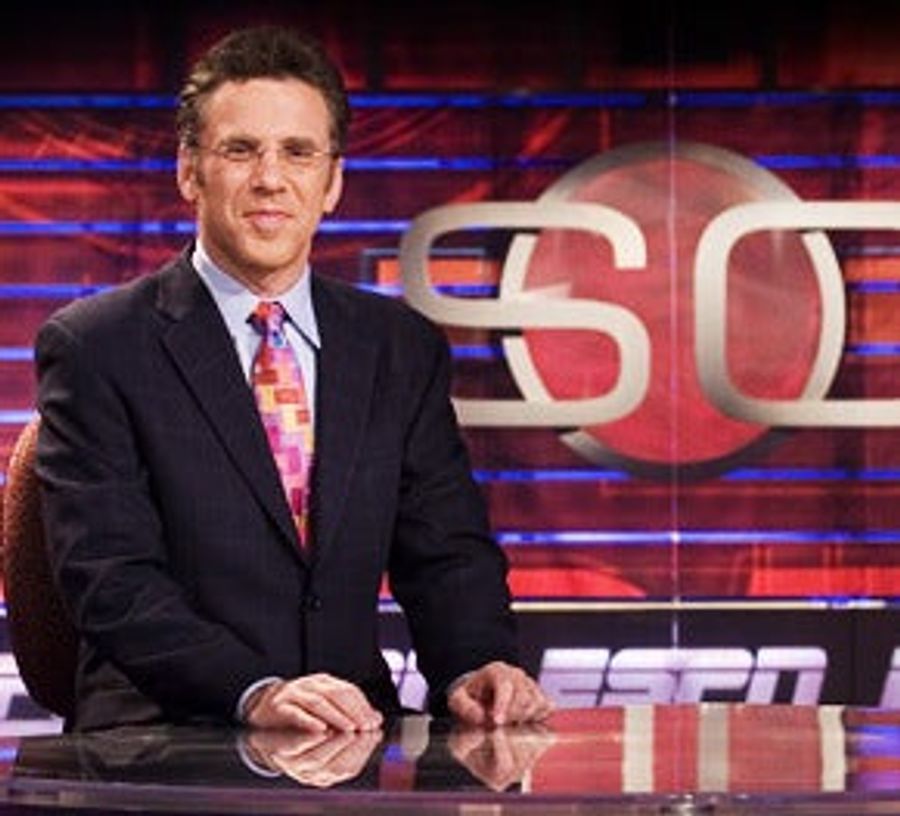
Anchor: Neil Everett
Context: Rockies outfielder Ryan Spilborghs hits a grand slam in the bottom of the 14th inning to give Colorado a 6-4 victory over the Giants.
Origin: Mahatma Gandhi was, of course, the renowned prophet of nonviolence and Indian independence who died by an assassin's bullet in 1948, whereupon, one correspondent wrote, "humanity wept." His given name was Mohandas, but he was known around the world by the honorific "Mahatma," which combines the Sanskrit words "maha" (great) and "atma" (soul). There is some dispute about who first bestowed the title, but it is said that in 1915, at a Jetpur city meeting, a supporter read aloud a commendation in which he addressed Gandhi as "Shriman Mahatma Mohandas Karmchand Gandhi" and then declared, "It is not an exaggeration to honor you with the title of 'Mahan Yogi,' it is based upon your self-knowledge of the Mahan soul." The surname, Gandhi, is an occupational name that means "perfume seller." The first syllable sounds like "gone," a word often used by SportsCenter anchors to characterize a home run, thus providing Everett with his pun. In its delivery, the phrase may recall Everett's "Bartender ... Jack," a sort of drunk uncle to "Mahatma ... Gandhi." In an e-mail, the anchor explains: "Gandhi was two kids from Kansas City emailing me one night...they liked 'bartender' and thought Gandhi would kill..."
Analysis: The call comes from a rich and rarely tapped vein of SportsCenter Dadaist phrasemaking, which, in another era, gave us "... with Port authority" and "... with Brad Daugherty," both of them riffs on the hugely clichéd "... with authority." The literal-minded may complain that the phrase cheapens the memory of a great leader, but they miss the irony here. This one floats above all the common Bermanisms, operating simultaneously as a reference and a rebuke to their soft-headed foolishness. "Mahatma ... Gandhi" is the reductio ad absurdum of catchphrases, and whenever it's spoken, it's a wink to the audience, as if Everett were informing us that the whole catchphrase pursuit had at last consumed all of its mass and collapsed in on itself, like a dying star. Humanity does not weep.
Humor (out of 5): 4
Aptness (out of 5): Technically zero, but the inaptness is its very point. This will be scored a 5.
Obscurity (out of 5): 3
Quality of referent (out of 5): 5
Total (out of 20): 17

]]>
http://deadspin.com/index.php?op=postcommentfeed&postId=5346870&view=rss&microfeed=true
<![CDATA[Scoring At Home: Your SportsCenter Catchphrase-O-Meter (UPDATE)]]> An occasional feature in which we explain and evaluate a SportsCenter anchor's pet phrase. Today's phrase: "Hotter than a fox in a forest fire."

Anchor: Neil Everett
Context: Florida Marlins shortstop Hanley Ramirez sends one deep to left off Tampa Bay's James Shields, his third home run in four games.
Origin: Unknown. "It's parody country-and-western guy talk," says Michael Preston, an English professor at the University of Colorado who studies vernacular culture. "You wouldn't expect to come across a woman saying this." In a 1976 paper, Preston's wife, Cathy, also an English professor at Colorado, grouped the phrase "hot as a fox" with similar folk comparisons: "drunk as a skunk," "eyes like a hawk," "busier than a beehive." Says Cathy now: "Since 'hot as a fox' carries kind of a sexual overtone rather than referring to heat or fire, it's possible that it might be a little bit later in date." Whenever it arrived on American tongues, the phrase soon was subjected to a number of comic elaborations, in much the same way that "cold as a witch's tit" would eventually become "cold as a witch's tit on the north side of an iceberg in Alaska," or "flat as a fried egg" would become "flat as two fried eggs nailed to a barn door." In this case, the elaborations were alliterative: from "hotter than a fox" to "hotter than a fox in a forest fire" to "hotter than a fresh-fucked fox in a forest fire" to "hotter than a fresh-fucked female French fox in a fuel-fed forest fire." The initial phrase, "hotter than a fox," is used much like a jazz musician might use an old standard like "Stardust." A sort of personal style is expressed through elaborate, improvised riffs on the original theme.
Analysis: Of the many options available to him, Everett chooses "hotter than a fox in a forest fire." How boring. Unembellished, the simile is mere cliché and lacks the sense of play and discovery that comes from spinning evermore fanciful variations out of a basic phrase. I don't expect Everett to bait the FCC with any "fresh-fucked" business, but a little wit and inventiveness is called for here. I'll defer to Cathy Preston. "When you do get the riffs on the phrase," she says, "then you've got someone who clearly likes verbal play. It's playful. It shows a spark of imagination on an individual's part. I like that."
Humor (out of 5): 0 1
Aptness (out of 5): 3
Obscurity (out of 5): 4 5
Quality of referent (out of 5): 3 5
Total (out of 20): 10 14

UPDATE: Everett has e-mailed us to clarify the reference:

Ronnie Van Zandt, former lead for Lynyrd Skynyrd, used to do shows in his barefeet so he could feel the heat on the stage…on one live album, he says, 'it's hotter than a fox in a forest fire"…that's where it came from…aloha, Neil Everett

Scoring has been adjusted accordingly.

]]>
http://deadspin.com/index.php?op=postcommentfeed&postId=5334977&view=rss&microfeed=true
<![CDATA[Scoring At Home: Your SportsCenter Catchphrase-O-Meter]]> An occasional feature in which we explain and evaluate a SportsCenter anchor's pet phrase. Today's phrase: "Winner winner chicken dinner."

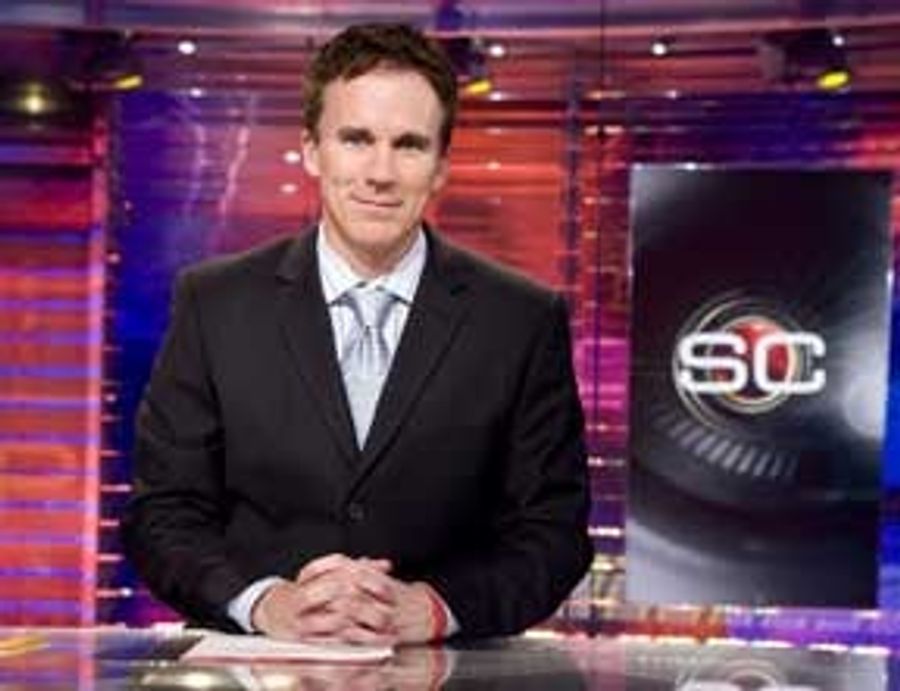
Anchor: John Buccigross
Context: Andy Roddick hits a forehand winner to finish off Igor Kunitsyn in the second round at Wimbledon.
Origin: The phrase, popularized by the unwatchable movie 21, apparently derives from the rich lexicon of craps, which is full of amusingly inscrutable patter. In an e-mail, David Guzman, an author of A Guide to Craps Lingo from Snake Eyes to Muleteeth, writes: "'Winner Winner Chicken Dinner' came from alley craps back in the Depression. They used to play craps in alleys and didn't always use $$$, but if they did it use $$$ and they where winning, it meant they they could afford chicken for dinner that night." The literature on the subject is limited, however, and Guzman allows that "Winner winner chicken dinner" may have roots in Cockney rhyming slang.
Analysis: The line has become something of a crutch for Buccigross, and no one seems to like it. The San Francisco Chronicle's Bruce Jenkins cites the phrase as evidence that Buccigross is "the unquestioned king of the idiot patrol." Witless and inapt, the phrase is delivered with a thick coat of irony, as if to suggest Buccigross knows full well it is witless and inapt. That does not absolve him, however, especially now that it sounds like he's merely paying tribute to a wretched Kevin Spacey vehicle.
Humor (out of 5): 0
Aptness (out of 5): 0
Obscurity (out of 5): 3
Quality of referent (out of 5): 2
Total (out of 20): 5

]]>
http://deadspin.com/index.php?op=postcommentfeed&postId=5304961&view=rss&microfeed=true
<![CDATA[Scoring At Home: Your SportsCenter Catchphrase-O-Meter]]> An occasional feature in which we explain and evaluate a SportsCenter anchor's pet phrase. Today's phrase: "I know a cat named Way Out Willy."

Anchor: Neil Everett
Context: Willy Aybar of the Tampa Bay Rays hits a deep fly ball.
Origin: The phrase comes from the 1958 Johnny Otis hit, "Willie and the Hand Jive," a Bo Diddley-influenced song whose opening lyric is, "I know a cat named Way Out Willie." Otis, the son of Greek immigrants, has been called "the Godfather of Rhythm & Blues," though he was less a trailblazer than an artist who synthesized the styles and genres of his day. "Willie and the Hand Jive" was his only big hit, peaking at No. 9 on the pop charts. The hand jive became a brief dance craze and will be familiar to fans of the film Grease and the music of Sha Na Na.
Analysis: Everett deserves credit for the obscurity of his allusion, though in this particular instance, the phrase loses much of its heft when Aybar's fly ball is caught. Points should be docked, as well, because the line is inapplicable to virtually any situation that does not involve a baseball player named Willy.
Humor (out of 5): 1
Aptness (out of 5): 0
Obscurity (out of 5): 5
Quality of referent (out of 5): 4
Total (out of 20): 10

]]>
http://deadspin.com/index.php?op=postcommentfeed&postId=5302027&view=rss&microfeed=true