<![CDATA[Deadspin: the game]]> http://tags.deadspin.com/assets/base/img/thumbs140x140/deadspin.com.png <![CDATA[Deadspin: the game]]> http://deadspin.com/tag/thegame http://deadspin.com/tag/thegame <![CDATA[Sissies, Drunk Yoga And The Last Pure Football Game: A Dispatch From Harvard-Yale]]> Deadspin correspondent Craig Fehrman went to the 126th edition of Harvard-Yale, where he confronted both the overwrought mythology of The Game and the overexposure of at least one penis.

The biggest controversy at this year's Harvard-Yale game centered not on a coach's atrocious call on fourth-and-long, but on a T-shirt. For its official fashion statement, Yale's Freshman Council opted for a wildly popular design featuring an F. Scott Fitzgerald quote ("I think of all Harvard men as sissies") — until the university's LGBT Cooperative protested the shirt's "thinly-veiled gay slur." University administrators started lumbering around, and, trapped in a classic lose-lose shit storm, the Council pulled the design.

It turns out the Harvard-Yale rivalry boasts a long, contentious history of T-shirt warfare — a personal favorite, though it apparently flopped, is "Ve-ri-tas My Salad" — and, in this and many other aspects, it happily lives up to your expectations. When they played for the first time in 1875, with Harvard winning 4-0, seven students got arrested "for creating disturbances by hooting and singing in the public streets." In 1908, Harvard's coach (allegedly) strangled a live bulldog in the locker room to fire up his players. (Harvard won again.) Every year, the rivalry delivers healthy doses of tone-deaf posturing, as when, this time around, the overly earnest kiddos at the Yale Daily News cooked up a provocation under the headline, "Budget Cuts Hit Harvard Harder." The story devotes several paragraphs to Harvard pulling its hot breakfasts, but skims over the 350 workers laid off by the two universities (and we're talking janitors and cooks, not professors).

All this — even the T-shirts — seems to suggest a lively football rivalry. Indeed, other than a sports-of-the-weird story on squash or rowing, Harvard-Yale is the Ivy League's only chance to break into the collective sports consciousness. Despite living in New Haven for going on three years, though, I'd never attended what everyone refers to as "The Game." So this year, with Deadspin's blessing, I decided to check out everything I'd heard — about the sordid partying, the fierce rivalry and, most of all, the alleged glories of college football's last great relic of untainted amateurism. Everything I'd heard turned out to be more or less wrong.

Myth No. 1: Harvard-Yale is decadent and depraved.

On Saturday at 8 a.m., I catch the first shuttle to the Yale Bowl. In addition to the parking lots surrounding the stadium, Yale opens up the neighboring fields as a kind of tailgating annex, and, by the time I arrive, it's already operating at 10 percent capacity. People stumble around, all on their cell phones and all doing their best Vince Vaughn impressions. Soon, the first U-Haul rumbles in. The driver pops the hatch, and out spill 20 frat types. They quickly set up a perimeter of battered couches — quite an accomplishment given their already tipsy state and the bottle of wine or hard liquor gripped in each off hand.

I decide to start closer to the stadium — it seems tamer, judging from the fact that the tailgating tables have centerpieces. There's a mix of creaky alumni, pets wearing Yale sweaters, and young parents cradling future legacy admits. To one side sits a cluster of huge, outdoor wedding-type tents for places like Mory's, an iconically snotty Yale club, and Yale Investments, which manages the endowment. I hear someone say, "Yeah, that's right," and turn to see what must be a donor checking to find his name engraved in the Bowl's new cobblestone terrace.

People here don't dress like your standard tailgater. There's a range of brands and blazers and stoles, along with a few people slumming it in corduroys and varsity sweaters. (And who knew Coach made sneakers?) Nor do they eat like your standard tailgater. I find ornate pastries, bagels topped with cream cheese and prosciutto, shrimp cocktails, at least one portable lobster set-up and enough Merlot to float the Yale Bowl.

When I tire of tabulating varieties of scotch, I head back to the annex. There's now row after row of cars — mostly typical tailgaters with folding chairs, cheap beer and cornhole sets. But there's also a loose formation of Yale and Harvard U-Hauls, which seems to be the undergrad locus of choice. It's everything the discerning Deadspin reader might expect. The students pack in tight, and, already, there's a lot of what is plainly exploratory groping. Everything takes on a hipster sheen: neon sunglasses, goofy Russian ear-flap hats, an inexplicable amount of vintage U.S.A. Olympic merchandise. I count five distinct ways to tie a scarf. Once or twice, through the various brands of charcoal and propane and cigarettes, I catch a whiff of what I'm 98 percent sure is really good weed.

Nothing goes on at The Game that doesn't happen regularly at UConn or Boston College. But that didn't stop the Boston Herald from splashing "HARVARD HOOLIGANS" across its front page after 2004's game. Of course, the paper did so more because it was Harvard and less because the students were actual hooligans. And because it was Harvard, the story drew the attention of alarmists statewide and led to stricter rules for The Game. This year's version promised to crack down on underage drinking and warned, in its best schoolmarm passive voice, that "all student tailgates will be closed at the start of the third quarter. It is expected that all fans will enter the Bowl by the start of the third quarter." Only a Harvard or a Yale would require a special set of tailgating rules for one game per year. (In 2007, the last time Yale was any good, more fans attended the Harvard game than the other four home games combined.) At other universities, tailgating is a lifestyle choice — you might not embrace it, but you still respect the hell out of it. Here, it's one weekend of desperate grasping at a normal college experience. What we have here is more a pageant than a party. It's a tailgate in quotation marks. A Yalie might call it a simulacrum.

Myth No. 2: The Game is one of our all-time great rivalries

I decide to watch the game from the press box. It's nearly full, but I find a seat next to Bob Ryan, who doesn't say hello. Behind us sit Harvard's student broadcasters; somehow, they get stuck with only a land-line phone, which the analyst and play-by-play guy must politely pass back and forth for the entire game.

At 12:08, Harvard kicks off. Yale's had a rough 2009 (4-5) and, against Harvard, a rough decade (2-7), but today the Bulldogs look great. I don't think anyone can deny that the players get pumped for The Game, and Yale's are chest bumping and helmet pounding at an impressive clip. By the end of the first quarter, they lead 10-0.

For the second quarter, I hit the stands. It becomes clear that this is not the most alert or passionate crowd; many seem not to realize what's happening when Harvard goes for it on fourth down (or when Yale stops them). While moving to another section, I get trapped in a tunnel with some Yale undergrads. It smells like a brothel, and someone leads us in a deafening "Harvard Sucks" chant. When we emerge into the sunlight, the students start high-fiving. "Dude, we're winning!"

The score remains 10-0 at halftime, and I check in at the annex to see how everyone's handling that third-quarter deadline. The crowd seems to have only grown, and they're now universally trashed. A few have passed out on the couches; others remain upright only through the press of the crowd. One girl in a Harvard hoodie walks around by herself, stomping on empty plastic cups. Two people are doing drunk yoga ("Feel it stretch your core"). One guy just starts pissing, and I make eye contact, first with his penis, then with his face, then with the empty bathroom 200 feet away. I see a Catholic priest in his clerical collar snapping and posing for pictures with the obviously drunk students. (To be fair, I never make it to the "Chabad at Yale" RV.) I get a visual on that weed.

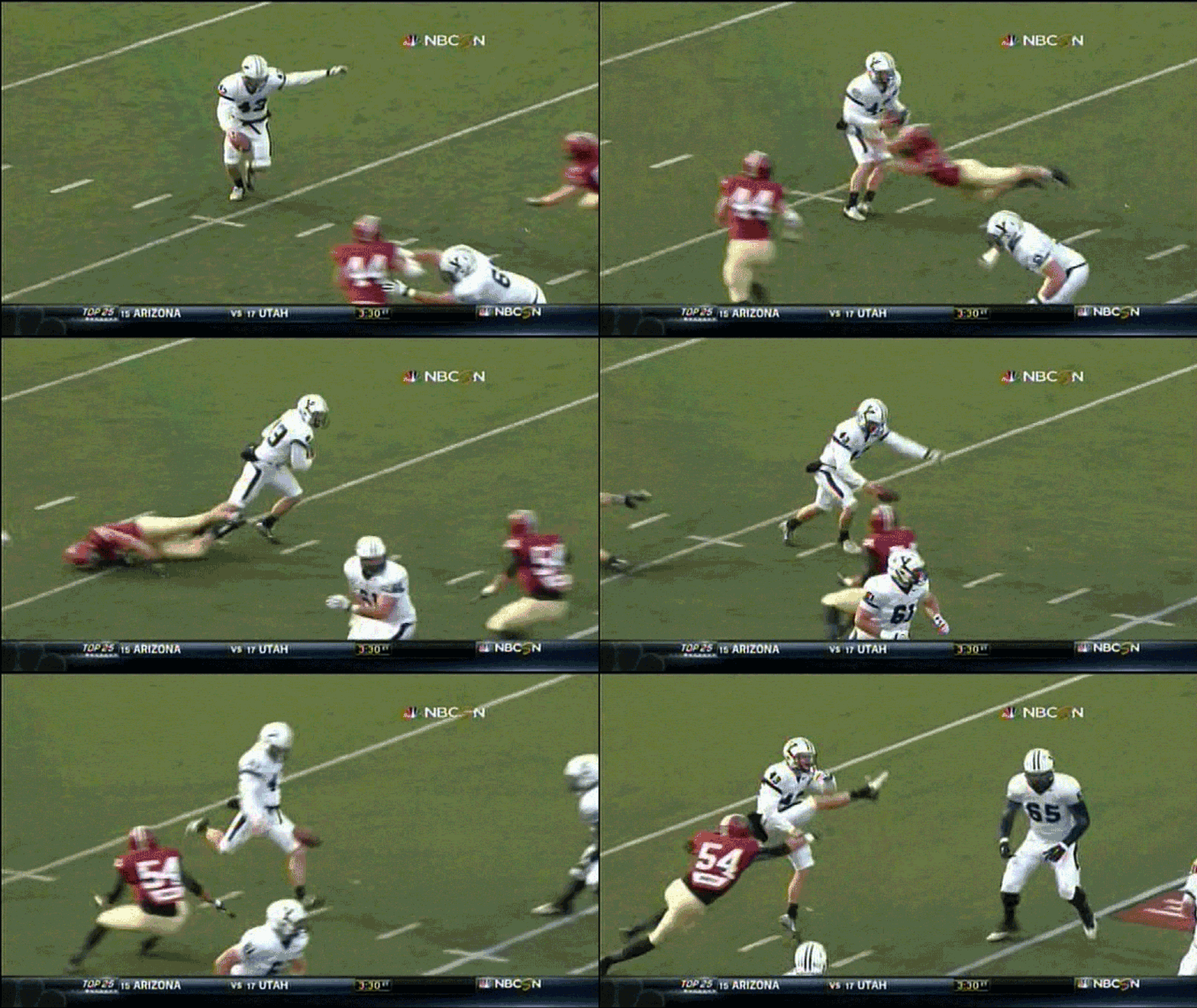
By the time I get back to the Bowl, Harvard's managed to score, making it 10-7. Then, in a decision that would've gotten Belichicked all over Around The Horn if Harvard-Yale actually mattered, Yale's coach calls for a fake punt on fourth-and-22 from his own 26 — even though punter/kicker Tom Mante, all joking aside, is Yale's best offensive player and a legit NFL prospect. Three plays later, Harvard scores again, and the Crimson wins 14-10. Outside and a world away, the U-Hauls have closed up shop. But everyone's still at it, and no one knows or cares about the call or the score.

It seems a little ludicrous, then, to consider Harvard-Yale the sixth-best rivalry in college sports, as Sports Illustrated did in 2003 — or to get offended when College GameDay chooses Michigan-Ohio State over Harvard-Yale. Rivals don't need the world to be watching. Each year, my undergrad's basketball team, the University of Southern Indiana Screaming Eagles, gets all kinds of fired up to play Kentucky Wesleyan; no one outside of Evansville or Owensboro notices, but the drunk people at least make it inside.

That obviously isn't the case for Harvard-Yale. Here's a picture of the Yale Bowl taken right before this year's kickoff:

And here's a picture of the annex taken 30 seconds later:

You can pile up all the history and trivia you want — the 60 gallons of paint used for the two "H-Y" logos; the guy who's been to 67 straight Harvard-Yale games — but it won't change the fact that The Game no longer registers as A Rivalry. In the stands and around the U-Hauls, the crowd breaks more cleanly along lines like old/young or snob/poser than Harvard/Yale. There's no animosity. And why should there be? What do they have to get riled about? That they didn't get into each other's universities? If you want to see them get worked up, ask them to compare the schools' Classics departments.

Myth No. 3: The Game is one of our last pure sporting experiences

How you feel about a book with dueling forwards by Ted Kennedy (Harvard '56) and George Pataki (Yale '67) will say a great deal about your taste for Harvard-Yale. In The Only Game That Matters, Pataki writes: "For Yale-Harvard represents a time, an afternoon, when ... top-flight athletes at our best academic universities can reaffirm our belief in the student-athlete and the true meaning of amateur sport."

The former New York governor would never admit it, but the Ivy League is actually a much younger organization than the Big Ten or the SEC. In 1954, the eight university presidents signed the Ivy Group Agreement (PDF), which formalized all the stuff we now associate with Ivy League football: no scholarships, no postseason play and a firm commitment to education. "Players shall be truly representative of the student body," the Agreement reads, "and not composed of a group of specially recruited athletes." Even with these restrictions, Yale could crack the AP Top 25 as late as 1981. But that year, the Ivy League also found itself caught in a nasty crossfire between the NCAA and its most powerful programs — and at stake was the further consolidation of both fan interest and TV revenue in the emerging behemoth of Big Football.

The history between Ivy League football and television runs surprisingly deep — the first footage of a college football game came from New Haven, when Princeton played Yale in 1903, and, in 1938, Penn became the first team to broadcast a full game. (All six Philadelphia sets tuned in.) By 1981, though, things had changed. The NCAA controlled college football's relationship with CBS and ABC and was eyeing cable outlets like the newly-launched ESPN. So, to increase their bargaining power, the sport's top coaches decided to squeeze out smaller universities like the Ivies. Joe Paterno, today's avatar for all that's right with college football (and himself a Brown football alum), told The New York Times: ''The Ivy League is in another world all by their own. They are in another world. I'm in the real world." Yale actually met the requirements to remain in Division I, but elected to join its Ivy brethren in the purgatory of the I-AA football.

In 1984, the Supreme Court found the NCAA in violation of the Sherman Act and inaugurated the multi-network arms race we have today. But the Ivy League had made its final break — economically, philosophically, competitively — with Big Football. Since moving to I-AA, Ivy League attendance has dropped by more than 30 percent; Yale went from appearing on the major networks to gratefully taking a three-game "Yale on YES" deal. More to the point, the decline in intensity of even Harvard-Yale, both on campus and at large, stems directly from this series of choices.

Let's be clear: the Ivy League deserves plenty of credit for taking a moral (or at least a principled) stand. Every university struggles to balance athletics and academics, and most are finding increasingly creative ways to punt the latter — see the University of Florida, whose football players' SAT scores lag 346 points behind its average. But while the Ivy League enforces its academic standards through a Hollinger-esque formula, it also allows its teams plenty of wiggle room. Coaches compile lists of "priority candidates," who get in at four times the rate of their academically comparable peers. You'll also hear plenty of whispers about top prospects with offers from Stanford or Duke who somehow lucked into a "merit" scholarship. It all adds up to the fact that Ivy League athletes answer to a measurably lower standard than Ivy League students — and this is especially true of Ivy League football, which, as 2003's Reclaiming the Game has shown, boasts its own SAT gap: 165 points.

To be fair, Ivy League administrators, when confronted with data like these, have cracked down, reducing the number of annual football recruits from 50 to 35 (1993) to 30 (2002) and instituting a seven-week "dead time" when teams can't practice. At the very least, they respond to pressure.

But pressure comes from all sides. Coaches need to win — and any accusations of lowered standards or sketchy scholarships get out only through intra-Ivy leaks — because, for Yale and Harvard as much as for anyone else, college sports remain a cash cow. According to the Department of Education's data, Yale football's operating expenses in 2008 were $538,290, its revenues about $3 million. That's not much in comparison to, say, the University of Florida, which spent ten times as much per player and still took in $66 million. (It's also not much in comparison to Yale's $16-billion endowment.) But even in the Ivies, football has a way of firing up the donors. You can see this in positive instances — Yale's program for The Game names more than 500 donors, including Dick Jauron, a member of the $5,000-$9,999 Eli Club. And you can see it negative ones — Dartmouth alumni freaked out when their dean of admissions congratulated a different university for eliminating its football program. (While we're on the subject, you owe yourself a visit to Yale Athletics' site for itemized donations. All that's missing is a PayPal button.)

It could be worse. But the Ivy League is not, as one recent story put it, "college football ... in its purest form." Nor is Harvard-Yale "one of the last bastions of the true student-athlete." What Harvard and Yale are living isn't a lie, but it is certainly a compromise.

* * *

On Oct. 13, 1956, the Ivy League officially opened for business, and a young Bernard Gwertzman commemorated the event in the Harvard Crimson:

Whenever a new scandal is uncovered in the West, the Ivy League is immediately pointed to as the last "vestige of true amateurism." Anyone with a gripe against Big Time always looks to the Ivy League as the potential saviour of football.

But Gwertzman goes on to detail what, in his words, "those close to Ivy football know": players can expect preferential treatment, miraculous amounts of financial aid, even wink-wink internships and summer jobs.

The Game isn't a museum piece. It doesn't float above the mercenary scrum of college athletics, and it never has — not since Yalie great Walter Camp, inventor of both the down system and the faculty stonewall, helped turn the sport into big business. In many ways, it's college football in miniature, only with nicer cars and better weed. When it comes to Big Football vs. the Ivy League, the latter's merely not quite as bad.

"Yale: Not Quite as Bad." Put that on next year's T-shirt.

Craig Fehrman is a writer and grad student living in New Haven. You can find more of his work here.

]]>
http://deadspin.com/index.php?op=postcommentfeed&postId=5412127&view=rss&microfeed=true
<![CDATA[The Haughty Drunken Excess That Is Harvard-Yale In Pictures]]> Each year during "The Game" (which most tailgaters do not even pay attention to) the blue bloods invade the yard and show off their finest Ivy League elbow-bending techniques. It's like a beer-sopped L.L. Bean catalog come to life.

By the looks of these photos, most of these fine upstanding individuals seem to be conducting themselves just like most other sots would during a tailgate.

If you're featured in this photo gallery, please do not fucking email me to complain about how you will get fired from your job that pays you way too much money. Your names aren't listed. Let's keep it that way. If it upsets you that much, try to convince your friends not to post all of your shenanigans on Facebook. Or, you know, don't get arrested for public urination.

In fact, be more like this guy:

Who's that kid, I need to send him a congratulatory email.

Same thing happened to me in 1987 at Yale Bowl in New Haven. Couldn't get out of the Bowl to piss, so went to the back and pissed on the press box. Perp walked, paddy wagoned, spent the game sitting on a concrete floor in a pile of cigarette ash in New Haven lockup. A lot warmer than the subzero bleachers, I have to say.

I think New Haven PD loves "The Game", they get to bust Yalie f*@ks and — in a nice two-fer — little Harvard f@#ks while they're at it. Fish in a barrel

Full report on Saturday's game coming tomorrow.

Thanks for your continued support of Deadspin. Barry's here soon.


(Photo: DPShow)

]]>
http://deadspin.com/index.php?op=postcommentfeed&postId=5412124&view=rss&microfeed=true
<![CDATA[The Game Disembowels Bow Wow in $100k Madden Challenge]]>
Playing with the New England Patriots against Bow Wow's Cincinnati Bengals (What?), The Game raced out to a 21-0 lead and cruised in for the 55-23 victory. I have to say I'm glad Bow Wow got his beatdown because Lil' Bow Wow stood up Deadspin. And by Deadspin, I mean me. After our post about the game, we were contacted by the publicists behind the contest to see if we wanted to talk to the video game combatants. I said I did. A time was scheduled (for Friday night no less) and I received multiple calls letting me know that, "You'll be hearing from Bow Wow soon." You can imagine my excitement.

I cut short my drinking and even sketched out a few questions. Sample: "Are you afraid The Game will shoot you if you win?" Then, blessed night of reckoning, my phone rang from LA. From the very scene of the big game! I scrambled up from the couch and took the phone call. There was raucous noise and I could barely hear anything. What's more it sounded like lots of people were even trash-talking at once. This was going to be the greatest interview ever! Except Bow Wow refused to talk with me. I could actually here him say in the background. "Naw man, naw man." So an apologetic publicist took the phone back and said, "Mr. Bow Wow can't talk now. It's too close to the game. Can we call you back later?"

I said they could, and then went back to drinking. A friend of mine said, "You know if Bow Wow loses you're not getting that call back." And that friend was right. No Friday night call ever came. So good riddance Bow Wow, you're as dead to me as the Lil' in front of your name.

Video highlights of the battle [World Star Hip Hop]
The Game Destroys Bow Wow in Madden [The Sporting Blog]

]]>
http://deadspin.com/index.php?op=postcommentfeed&postId=5046762&view=rss&microfeed=true
<![CDATA[Bow Wow, The Game Wager $100k on Madden 09 Contest]]>
No word on whether field goals are allowed. The loser's donating the money to charity. And by money I mean, part of the record company's marketing budget. Which then becomes a tax deduction. Bow Wow (nee Shad Moss), who will also be appearing in the upcoming season of Entourage (that's really unfortunate), is rumored to have an album coming out in November. You might recall him better as Lil Bow Wow, a moniker the 21-year-old has now outgrown. The Game (top result on Wikipedia is Harvard-Yale) was teammates with Baron Davis in high school and Davis is the godfather to his son. Whatever. Raise your hand if you're also the dorky white guy who looks up rapper bios on Wikipedia.

The contest will take place at an undisclosed location and is being sponsored by Konsole Kingz (Tagline: Where video games and hip-hop combine). The real question is, will they serve Madden-tinis?

Madden 09 Contest [Konsole Kingz]
Bow Wow, the Game put up $100k on Madden [FIRST CUTS]]

]]>
http://deadspin.com/index.php?op=postcommentfeed&postId=5043152&view=rss&microfeed=true
<![CDATA[Becks Is Welcomed By The Game]]> OK, we're going to need an ruling on this one. But we think what just happened is that LA rapper The Game offered to kick David Beckham's ass if he should ever see him. At least we hope that's what he said. You make the call:

"I'd kick David Beckham's ass on any given day. I'd just pick the ball up and kick the shit out of the stadium, game over."

The second portion of the quote, however, is shrouded in mystery. As The Guardian pointed out, was The Game referring to the ball, Beckham, or simply the action he was planning to take against LA Galaxy's Home Depot Center? Is he offering to fight with every soccer fan in attendance? Does anyone on this plane speak jive?

'I'd Kick Beckham's Ass', Says LA Rapper [Guardian Unlimited]

]]>
http://deadspin.com/index.php?op=postcommentfeed&postId=228977&view=rss&microfeed=true