A Second Wave Of Coronavirus Is Inevitable. Do Sports Leagues Even Care?

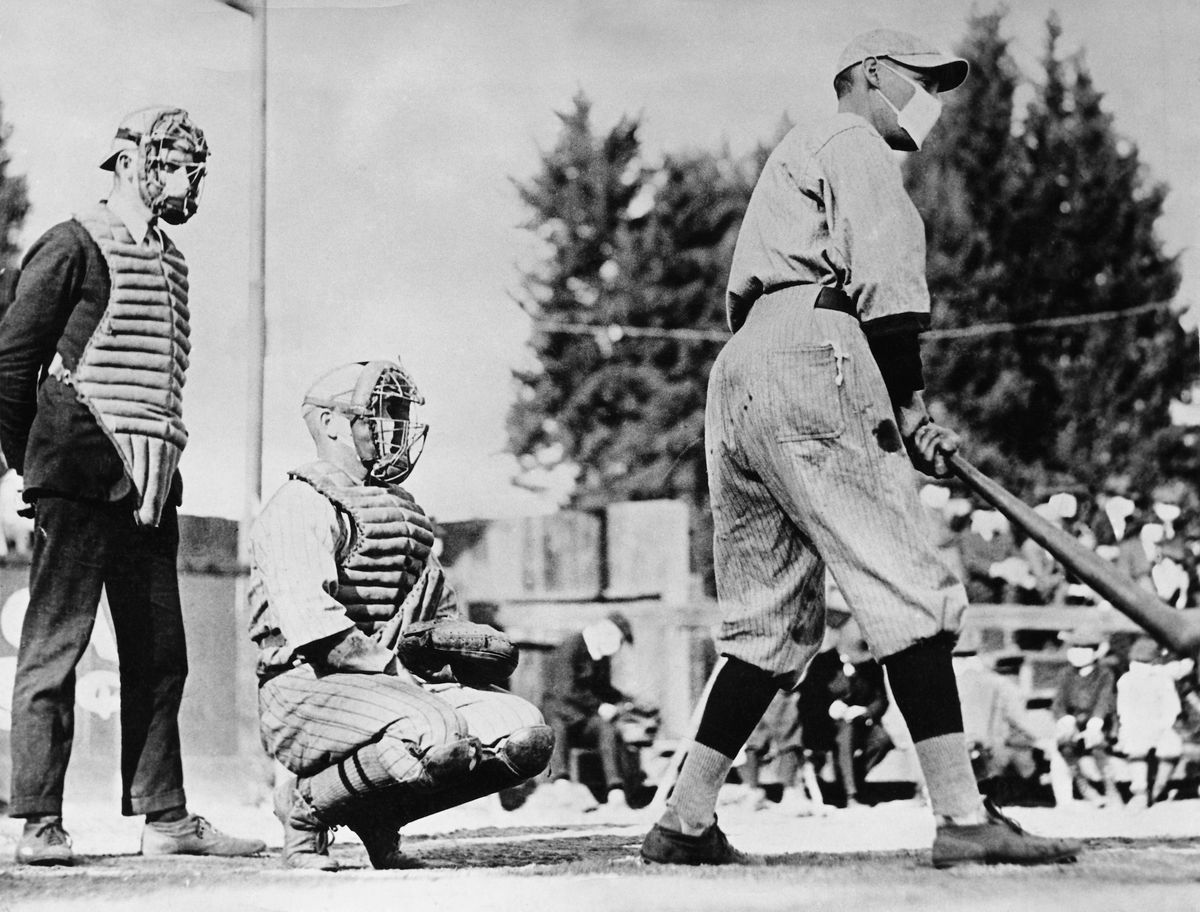 Batter steps in while wearing a mask during the 1918 Spanish flu pandemic. credits: GEORGE RINHART/CORBIS VIA GETTY IMAGES
 There’s a small engraving on the Stanley Cup which reads, “ 1919 - Montreal Canadians - Seattle Metropolitans - Series Not Completed.”
It’s the only inscription on the Cup that includes two teams and no champion.
Both teams suffered, but not on the ice. Players were hospitalized, the ice arena closed to the public, and a star player died. All of this due to the 1918 influenza pandemic.
The pandemic, otherwise known as the “Spanish flu,” had three waves: the first in the spring of 1918, the second in the fall of 1918, and the third in the spring of 1919, when the Stanley Cup was canceled.
Since the outbreak of COVID-19, epidemiologists, journalists, and historians have drawn comparisons from this pandemic to the one seen nearly a century ago.
The viruses are not the same, but some of their characteristics are strikingly similar.
Today, Dr. Anthony Fauci and other top health officials testified, via webcam, to the Senate Committee on Health, Education, Labor, and Pensions.
In the hearing, Sen. Elizabeth Warren had an exchange with Fauci about a second wave of coronavirus, and whether it seems, in Fauci’s words, “ inevitable.”
“If you do not do an adequate response, we will have the deleterious consequence of more infections and more deaths,” Fauci told Warren. “And that’s the reason why you quoted me, senator, quite correctly. Everything you said, and I will stand by that.”
This is not the first time Fauci has predicted a second wave returning to the US, just like the 1918 flu.
Currently, infections in states like New York, New Jersey, and Michigan are all slowing down.
U.S. infection rates this summer will likely look better than the spring. But we are not out of the woods yet.
A second wave is expected to come. Just like it did in 1918.
So, how is the sports world responding?
By scheduling NFL games, planning to restart the NHL season, and teeing up a MLB opening day during Fourth of July weekend.
Other international events, however, like the Olympics, Wimbleton, The Tour de France, and the Little League World Series have all been postponed for a year.
But if the nation’s top health officials believe a second wave is “inevitable,” why do the league commissioners plan for business as usual?
The answer is in the question. Business.
In fairness, some leagues may have time on their hands. The second wave is expected to come during flu season in the fall of 2020, or in the winter of 2021. But it could come sooner .
Owners, and some athletes, believe it’s their civic duty to open up sports. They believe it can establish some kind of “ healing” to a world ravaged by a modern plague.
Good luck.
As some leagues prepare to reopen, they should start acknowledging the “inevitable” threat of a second wave and provide a Covid-19 response plan if a season resumes.
“History doesn’t repeat itself but it often rhymes,” Mark Twain said. More than a century after the 1919 Stanley Cup, we’re still ready to play.
Why the UFC Released Undefeated Bantamweight Farid Basharat
Why the Milwaukee Brewers Are Built to Win the World Series


The Most Shocking WWE Moments Fans Never Saw Coming
- Cowboys vs. Packers Prediction: Best Bet for Sunday Night Football
- UFC Edmonton Best Bets, Predictions and Fight Picks
- Rays vs. Guardians Game 4 Best Player Props Betting Picks
- College Football Week 8 Best Bets: Ohio State, Alabama and More
- Joaquin Buckley Plummets From -300 Favorite to Underdog at UFC Edmonton
- WNBA Finals Picks: Dream, Valkyries and Gabby Williams Best Bets
- UFC Vegas 122: 5 Underdogs Drawing Sharp Money This Weekend