How Would You Rank The Top 5 BCS Teams From Their Blind Résumés?

Here's a fun little thought experiment, from MrSEC.com. Some assorted strength-of-schedule and margin-of-victory measures of the top five teams in the BCS standings, with the schools unnamed and in a random order:
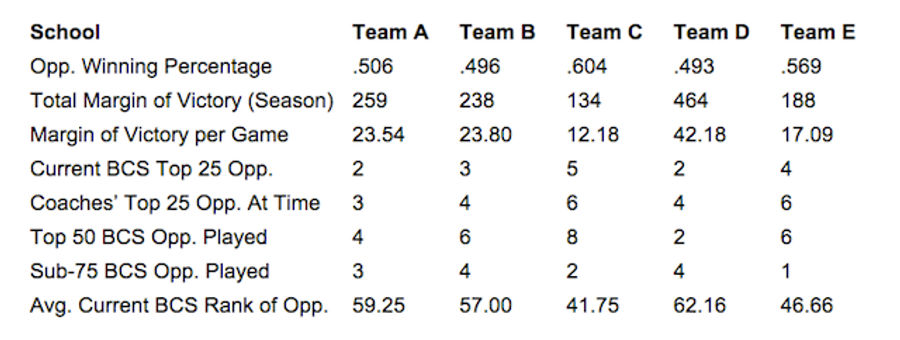
Can you figure out which school is which? MrSEC.com reveals the answers. More importantly, how would you rank the teams just based on this?
Yes, averaged numbers gloss over less tangible but still important standouts like signature wins or "my goodness, they won but still looked like hot garbage out there" games. But in my own blind rankings, I was shocked at how high I have Missouri, and how low I have Florida State. Here in the real world, despite beating almost all quality comers and playing above and beyond any realistic expectation, the Tigers could win the SEC and not make the championship game. The Seminoles, meanwhile, are in the BCS driver's seat, despite playing the weakest schedule by almost any measure—but blowing through it.
Fortuitous timing, then, for the release of this study led by an economist at Ohio State. (I know.) The study looks at decades of college football polling, and comes to the conclusion that voters fall victim to something called confirmatory bias.
"Confirmatory bias is the tendency of people to accept weak evidence if it affirms beliefs they already hold," Logan said.
What that means is that the best way to succeed in the polls is to live up to expectations. That sounds logical, as does the corollary that failing to meet expectations, no matter how high—say, Alabama losing for the first time in a calendar year, even if it was a last-second fluke to an excellent Auburn team—is punished by voters.
But the interesting part of the study is the finding that voters don't reward teams for exceeding expectations. Winning a presumed close game in a blowout offers no benefit. It pays to be as good as advertised, but nothing is gained by being even better.
To some extent, we know this inherently—compare the preseason Top 25 to the final polls, and each season is revealed as a war of attrition among top teams just trying not to lose. A weaker schedule makes an undefeated season more likely, and the study also notes that voters generally don't take strength of schedule into account.
Five Teams, Two Slots, One Test Of Blind Resumes [Mr. Sec] What Do Investors and College Football Pollsters Have In Common? [Newswise]
Related
How Caleb Williams’ Injury Could Change the Bears’ Season
UFC 331 Proves You Can Never Count Out the Underdog
The Harbaugh Factor Has Changed Everything for the Giants
3 MLB Best Bets for Sunday’s Regular-Season Stretch Run

MLB’s Expanded Playoffs Have Ruined the NL Wild Card Race

There's Another Online Poker Cheating Scandal Going Viral
Saturday MLB Picks: Two AL Playoff Contenders Worth Backing
- Week 3 College Football Picks: Betting LSU-Ole Miss and Other Key Matchups
- UFC 331 Underdog Pick: Why Brunno Ferreira Can Upset Edmen Shahbazyan
- UFC 331 Line Movement: The Championship Rematch Completely Flipped
- UFC 331 Betting Splits: Where the Sharp Money Is Landing This Weekend
- Blue Jays vs. Rangers Friday Sept. 18 Best Bets, Props, Predictions
- The Chicago Cubs Are the Best World Series Future in Baseball
- MLB Thursday Best Bets: 3 Picks for the Playoff Race