After Rome Fell, Europe's Barbarians Had To Figure Out How To Be Kings

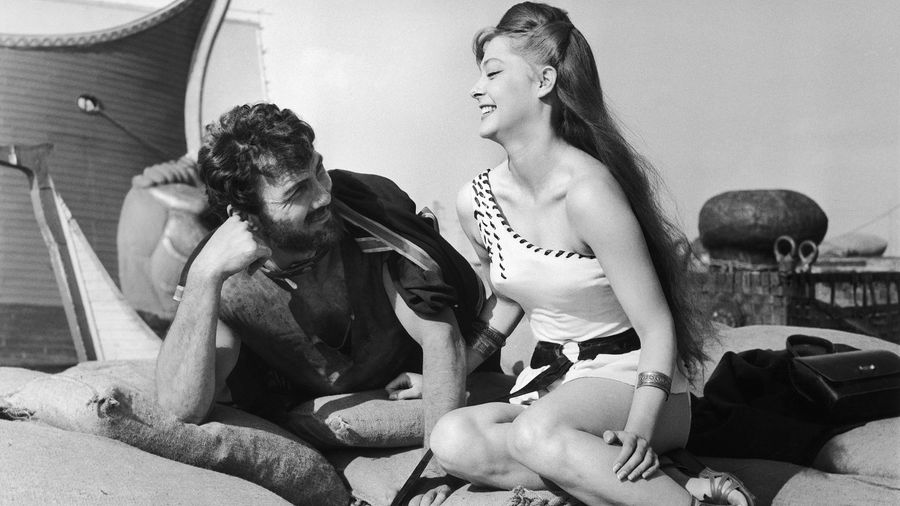 Well-known barbarian Jack Palance and Melody O’Brien enjoy a laugh while filming the documentary “Revak the Rebel.” Photo credit: Jim Pringle/ [object Object]
 Political structures and institutions—the bedrock of the systems that underpin our world and society—aren’t a given. They can and do evolve and strengthen, or, alternatively, crumble into nothingness. That’s one of many reasons the fall of the Roman Empire is a valuable example for us to bear in mind: All things are transitory. Nothing is destined to last forever, no matter how solid it may seem, not even an empire that had stood for half a millennium or more.
As the Roman Empire fell apart over the course of the fifth century, new political units—the barbarian kingdoms—rose up in what had once been its provinces. A patchwork of tiny territories ruled by native Romano-British aristocrats and Anglo-Saxon migrants and their descendants covered the island of Britain, while Visigoths, Franks, and Burgundians controlled present-day France. Spain had the Sueves in the distant, bleak northwest and the Visigoths in most of the rest of the peninsula. The Ostrogoths controlled a prosperous, resurgent Italy and the Vandals owned the rich North African coast from a kingdom centered around Carthage.
Each of these new kingdoms built on, transformed, neglected, or destroyed the political legacy of the Roman Empire in its own distinct ways. The Franks did things differently than the Ostrogoths, who were nothing like the Anglo-Saxons, while the Visigoths followed a path different than all of them. In this sense, the various emerging political units conducted a real-time experiment in the possibilities offered by the end of central Roman authority.
At the core of these new kingdoms was, naturally enough, the concept of kingship. This sounds fairly basic, especially considering the fact that the next 13 centuries of European history would be dominated by kings, but we shouldn’t forget that kingship was essentially a new phenomenon in post-Roman Europe. These new barbarian kings had to invent the institution, and to do that, they employed the ideological framework of Roman imperial rule with a hefty dose of military leadership and the mostly new concept of dynastic legitimacy. Kingship varied from place to place, largely depending on how much Roman legacy still existed to appropriate, ranging from the whole package in Ostrogothic Italy to practically none in Britain.
The same held true for the rest of Roman political and state structures. Taxation, the central interest and occupation of the late Roman Empire’s enormous bureaucracy and army, survived mostly intact in Italy and North Africa, but was gone from northern Gaul (France and Belgium) and Britain long before Frankish or Anglo-Saxon kings emerged. The Ostrogothic kings of Italy were very concerned with infrastructure and erecting buildings with their names on them; the Sueves of northwest Spain were substantially less interested in doing so.
I’m Patrick Wyman, and I just finished my PhD on the end of the Roman Empire. I always wished that more professional historians tried to talk to the general public, so that’s why I’m doing this podcast on the fall of Rome.
How and why did the legacy of the Roman Empire survive in some places, but not in others? Those are the central questions of this episode. Eventually, these structures and institutions disappeared practically everywhere, and the medieval Europe that emerged was more or less stateless for at least half a millennium. Written administration, sovereignty, and the administration of justice would have to be rebuilt from scratch.
If that sounds interesting to you, give this episode a listen, and if you have any questions just sound off in the comments below.
You can also listen on iTunes, Google Play, Soundcloud, and Stitcher.
Related


Three MLB Contenders That Need Answers Before It’s Too Late

Why Scottie Scheffler Is the Play on Sunday at The Masters



Why NFL's Proposed 18-Game Schedule Doesn't Make Sense

MLB Playoff Teams Off to Shocking Slow Starts in 2026


UFC 327 Picks: Prochazka vs Ulberg Predictions and Best Bets

- Top MLB Betting Picks: Why Pirates and Twins Offer Value Today
- NBA Picks Today: Best Bets, Odds & Predictions for Friday’s Full Slate
- The Masters Odds and Predictions: Top Picks for Augusta National
- Wednesday April 8th MLB Pitcher Props: Dylan Cease and Kyle Bradish Bet Picks
- MLB Picks Today: Best Bets for Diamondbacks vs Mets and Athletics vs Yankees
- Masters Betting Picks 2026: Best Value Bets Beyond Scottie Scheffler
- Best NBA Betting Picks and Predictions for Monday April 6th