Do The Olympics Really Screw The Best NHL Teams?

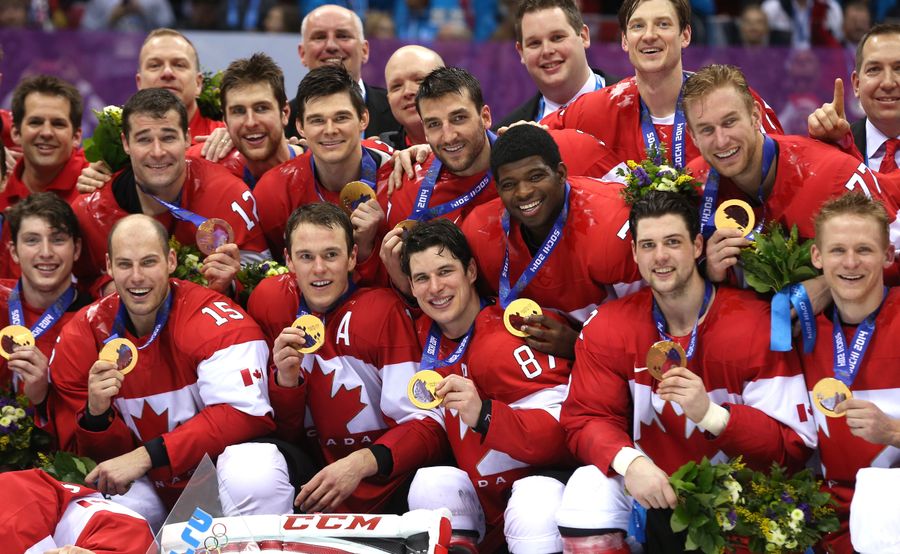
Since the Nagano Olympics in 1998, NHL players have played Olympic hockey, and NHL coaches have bitched about NHL players playing Olympic hockey. It punishes and best teams, with the best players, they say. But is there any evidence to actually back this up? Well, it's complicated.
The common complaint is that added games put players at increased risk of injury. Not much argument there, as John Tavares is out for the season, and several other NHL players suffered more minor injuries. The more players an NHL team puts onto international rosters, the more ping pong balls it has to pull up with a season-killing injury. But as far as the wider complaints about fatigue, travel, and the quality of play, there isn't a very compelling case.
This week, attention's shifted to a 2012 study that showed that, following past Olympics, NHL teams suffer a 0.088-goal per game decrease in goal differential for every player they send to the games. A little fiddling with the playoff picture and a glance at the roster will tell you that this could be important for teams like the Red Wings, who sent 10 players, and the Senators, who sent two. Over the remaining 20-odd games, this would come out to a swing 16-goal differential. But the thing is, goal differential in hockey is noisy for a number of reasons, not the least of which is the often random nature of empty-net goals in one-goal games.
So what's a better way? Maybe not strictly shot stats like Corsi or Fenwick, which are often used as a proxy for possession (and thereby fatigue), but which, like the empty net with goal differential, tend to become very noisy in games where one side is desperate to score a late goal. (One area we'd actually like to take a much closer look at is faceoff wins and turnover differentials before and after the games.)
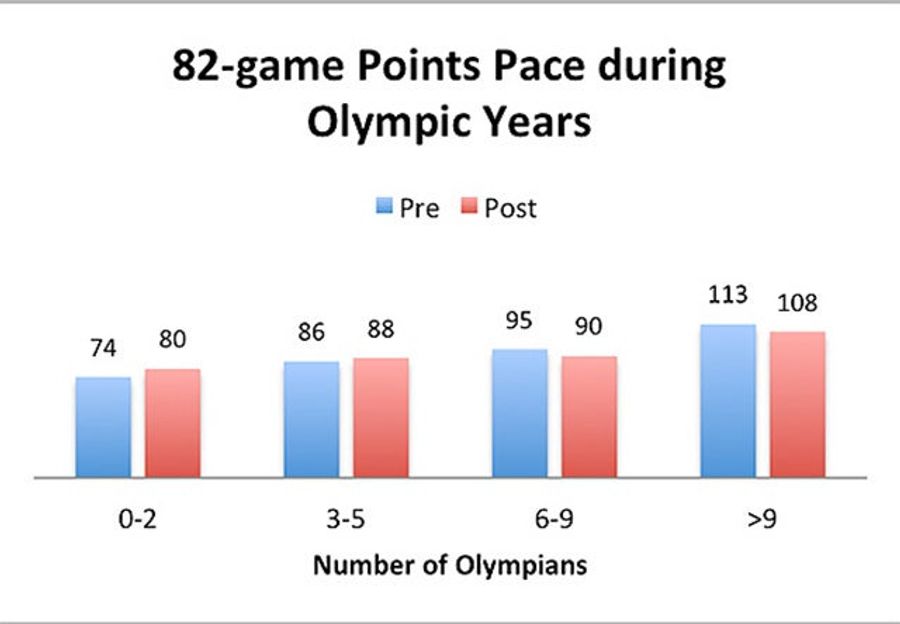
Chart: ESPN
The best method might be simple results-oriented point pace. Over at ESPN, Neil Greenberg looked at the last four Olympics, and found that teams do have a slight slowing in their pace as they send more players to the Olympics, but that the post-games pace for all teams were within their expected ranges. And simply having good players won out more often than not—teams with six to nine Olympians made the playoffs 70 percent of the time, and teams with 10+ made it 100 percent of the time.
So, it's a bit of a wash. The clear risk of injury at the Olympics makes them an obvious detriment to the teams sending more players. But as far as diminished results for the players who return intact, there isn't a whole lot here to suggest that they're any worse for wear.
Related



Biggest NBA Playoffs Concerns for Contenders Outside OKC






Five WWE Superstars in the Spotlight Ahead of Wrestlemania

Best NBA Betting Picks and Predictions for Monday April 6th
- National Championship Bet Pick: Why Michigan Has the Edge Over UConn
- UFC Vegas 115 Betting Picks: Moicano vs. Duncan Headlines April 4th Card
- NBA Betting Picks April 4th: Three Best Bets for Saturday's Slate
- Michigan vs. Arizona Bets: Wolverines Hold Edge in Final Four Showdown
- Best NBA Betting Picks Today: Friday April 3rd Expert Predictions
- MLB Pitcher Props Today: Best Baseball Bets for April 3rd
- MLB Picks Today: Brewers vs Rays and Reds vs Pirates Predictions