How Gary Bettman Built the Model MLB Owners Crave

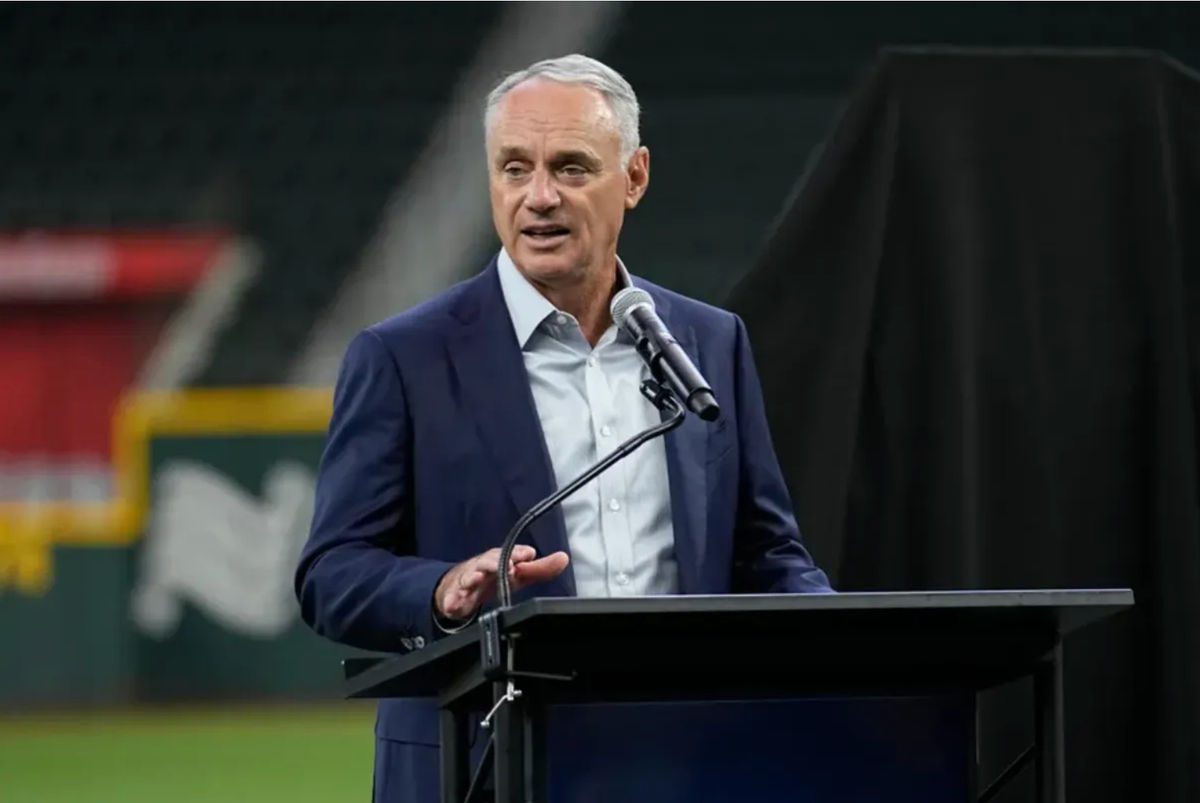 Rob Manfred source: AP
 You probably wouldn’t have to administer truth serum to Major League Baseball commissioner Rob Manfred and his 30 co-bosses to get them to admit their dream scenario is to one day run their sport like Gary Bettman runs the National Hockey League.
Bettman, of course, got his beloved salary cap by locking the players out for the entire 2004-05 season and breaking the union. For funsies, he did it again in 2012-13, when a 48-game season was salvaged at the last second. The last two CBAs have been negotiated without a lockout, because when there’s no position from which the employees have to negotiate, there’s no need to actually negotiate. Ain’t that (North) America!
The cap has minimized how much players can make (sorry, “provided cost certainty”). The highest-paid players during the 2003-04 season were Peter Forsberg and Jaromir Jagr, each of whom made $11 million. That’s more than $19 million in 2026 money, or more than $3 million more than what Edmonton Oilers center Leon Draisaitl is making as the NHL’s highest-paid player this season.
Every franchise is now worth at least $1 billion. The expansion fees went from $80 million for the Columbus Blue Jackets and Minnesota Wild at the turn of the century, to $500 million for the Vegas Golden Knights in 2017, to $650 million for the Seattle Kraken in 2021, to $2 BILLION if and when the league expands to 33 or 34 teams. (Spoiler alert: The league will expand to 33 or 34 or 36 teams.)
With Manfred talking openly of expanding to 32 teams whenever the next CBA is hammered out (don’t hold your breath!), you can see owners salivating over their future portfolios like Homer Simpson at an all-you-can-eat buffet.
The owner-friendly economics have also trickled down to the free agency calendar and the trade deadline, which are the two most popular non-game events in any sport. A hard cap that eliminates any Mystery Team willing to outbid the field makes for a condensed market and creates a signing frenzy because nobody wants to be left without a chair when the music stops.
A whopping 55 players signed free agent deals in the NHL from July 1–3 last year, including 52 on the first two days. Nobody was left waiting for the eve of training camp to see Brock Boeser, Vladislav Gavrikov, Mikael Granlund or Nikolaj Ehlers sign with someone.
Thanks largely to Manfred and the owners creating a problem that only they can fix with a different economic system, just 51 baseball free agents have signed this winter — a figure that includes eight players who performed overseas last season. The likes of Luis Arraez, Eugenio Suárez, Framber Valdez and future Hall of Famers Max Scherzer and Justin Verlander all remain unsigned, which is reminiscent of recent winters in which Pete Alonso, Alex Bregman, Blake Snell, Matt Chapman, Carlos Correa and Carlos Rodón lingered on the market into January, February or even March.
The NHL trade market has also heated up well in advance of the March 6 deadline. Much of that is due to the upcoming three-week Olympic break, which forces teams to evaluate themselves more honestly than they might otherwise — especially with lean playoff races and a clear batch of sellers.
Thanks to the cost certainty of the salary cap, teams don’t have to chase long-shot playoff berths in hopes of making a few extra bucks from home playoff dates. As a result, the Vancouver Canucks have been holding a fire sale for months, while the New York Rangers, Calgary Flames, New Jersey Devils and Columbus Blue Jackets have all made retooling or rebuilding trades.
It may not be a great year for the “salary cap equals parity” crowd, but hockey is nevertheless in the middle of a six-week stretch where fans are talking about the trades that have happened and the ones that might, all while watching the best players in the world face off in the Olympics.
Speaking of the Olympics, that’s another seemingly attainable dream for Manfred and his co-bosses. The 2028 Summer Olympics are scheduled for Los Angeles, and Manfred is hopeful he and the players union can reach an agreement allowing big leaguers to participate.
Maybe this NHL season offers a glimpse at what Major League Baseball could have in 2028: an extended midseason Olympic break, a flurry of trades beforehand, and a Hot Stove League that’s something other than ice cold — all with billion-dollar expansion payouts looming on the horizon.
All Manfred and his co-bosses have to do to get there is do what Bettman already did.
How Gary Bettman Built the Model MLB Owners Crave
UFC 325 Betting Preview: Three Bet Picks for Saturday Night
Three Trades the NBA Needs to Make Before the Deadline
- Rangers vs Islanders Jan. 28 NHL Betting Pick and Predictions
- College Basketball Picks Today: Nebraska vs. Michigan Headlines Loaded Slate
- Tuesday NHL Betting Picks: Expert Bets for Jan. 27th
- Best NBA Bets Today: Spread Picks and Player Props for Monday’s Games
- NFL Championship Weekend Picks: AFC & NFC Best Bets
- College Basketball Player Prop Bet Picks for Saturday, January 24th
- UFC 324 Preview and Best Bets: Sean O’Malley, and More