Mauricio Pochettino Isn’t Crazy for Thinking the U.S. Can Win the World Cup

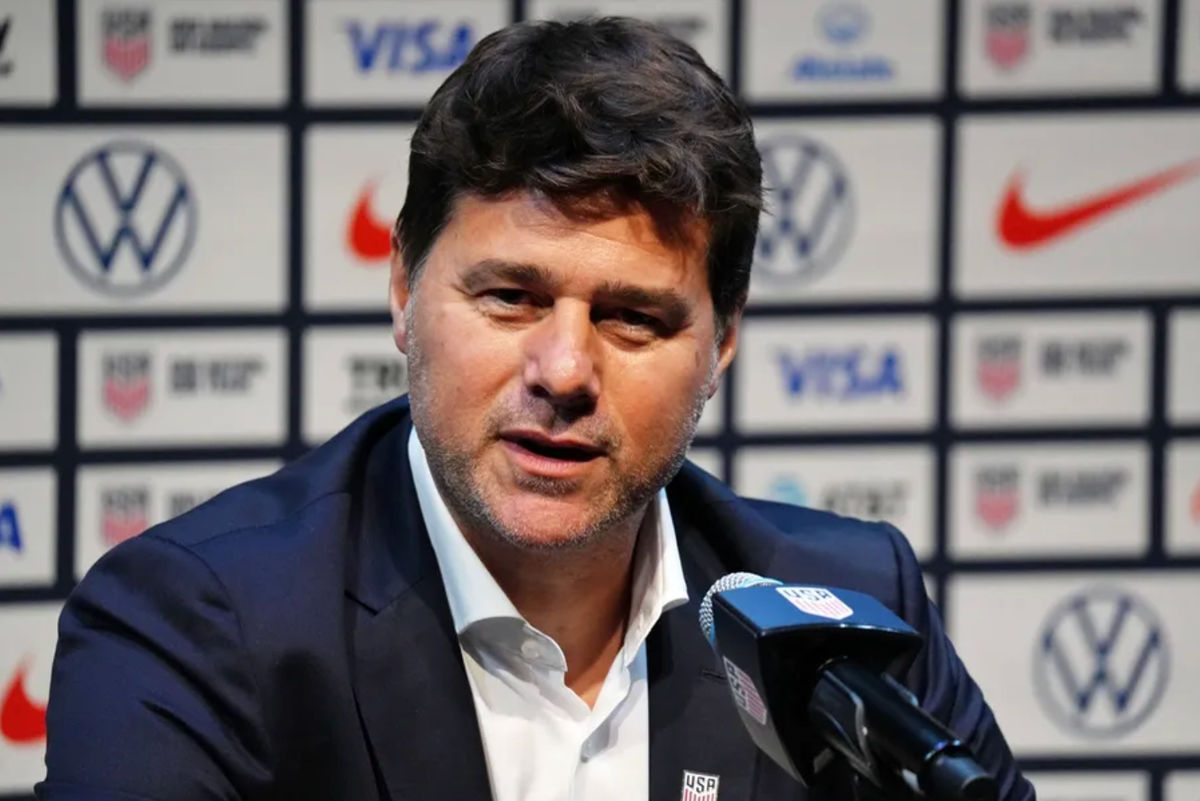 Sep 13, 2024; New York, New York, USA; United States men's national team head coach Mauricio Pochettino talks to the media during a press conference introducing him as the new head coach for the United States men's national team at Warner Bros. Discovery Hudson Center. Mandatory Credit: Lucas Boland-Imagn Images
 If anyone should know what’s realistic in world soccer, it’s Mauricio Pochettino.
Pochettino was a teenager when Diego Maradona famously guided his native Argentina to its second World Cup title in 1986. He went on to represent Argentina at the 2002 World Cup -- one of the Albiceleste’s more embarrassing showings -- before launching a managerial career that has featured stops at Tottenham Hotspur, Paris St.-Germain and Chelsea.
Now that he’s preparing the United States men’s national team to co-host the 2026 FIFA World Cup, he’s asking his players and their supporters to take the attitude that they are competing not only to perform well at the World Cup, but to win it. As proof of concept, he has even invoked the Miracle on Ice, the story of the 1980 USA Olympic Ice Hockey team that defeated the vaunted Soviets.
Despite Poch’s pedigree, Americans are skeptical, beleaguered after a difficult decade. There was the failure to qualify for the 2018 tournament in Russia. There were grandiose promises, average results, and embarrassing off-the-field scandals of the 2022 cycle. And Pochettino’s 2026 squad will come in without the test of World Cup qualifying and proof of their ability to achieve results in difficult competitive circumstances.
But after spending much of the last decade baying for the USSF to hire a globally proven manager, it’s time for Americans to buy into what that hire is selling. Because an American World Cup triumph -- while very unlikely -- isn’t as lunatical a concept as most believe.
Yes, only eight teams have won a World Cup. But that owes largely to the tournament’s infrequency rather than some sort of mystique that makes it impenetrable for underdogs. The 2026 World Cup is only the 23rd playing of the tournament. And the first 11 of the 22 featured 16 teams or fewer before FIFA began expanding to 24, 32 and now 48 sides.
There simply haven’t been that many opportunities -- mathematically speaking -- for the lack of an underdog triumph to suggest an underdog can’t do it.
And as the World Cup has expanded, we have seen an increase in unheralded sides playing as deep as the semifinals. From Sweden and Bulgaria in 1994, to South Korea and Turkey in 2002, to Morocco in 2022, there are signs the day of the longshot champion is coming.
As for whether the Americans possess the right mettle to be such a longshot? It’s impossible to know. But the USMNT began to look much better in October and November friendlies after Pochettino decided on a switch to a 3-4-3 shape. And his insistence on opening competition for virtually every roster spot has led to some revelations from new players and improved performances from old ones.
Then there’s Pochettino himself. Early on in his tenure, critics questioned whether he cared enough about the job, given the likelihood he returns to a top European gig after next summer.
But it’s that lack of concern for his USMNT future that also allows Pochettino to voice his huge dreams, when other USMNT bosses might choose to define success with a much lower bar. And it just might liberate him to make the kind of daring, unpredictable tactical moves needed to pull off the one or two huge upsets the U.S. will need to make a deep run.
Related

Five WWE Superstars in the Spotlight Ahead of Wrestlemania

Best NBA Betting Picks and Predictions for Monday April 6th
Five Early 2026 MLB Takes That Might Already Be True
- NBA Betting Picks April 4th: Three Best Bets for Saturday's Slate
- Michigan vs. Arizona Bets: Wolverines Hold Edge in Final Four Showdown
- Best NBA Betting Picks Today: Friday April 3rd Expert Predictions
- MLB Pitcher Props Today: Best Baseball Bets for April 3rd
- MLB Picks Today: Brewers vs Rays and Reds vs Pirates Predictions
- NBA Picks Today: Celtics vs Heat, Hawks vs Magic, Nuggets vs Jazz Bets
- MLB Best Bet Today: Los Angeles Angels vs Chicago Cubs Betting Pick