NCAA rule change would permit direct payment to athletes

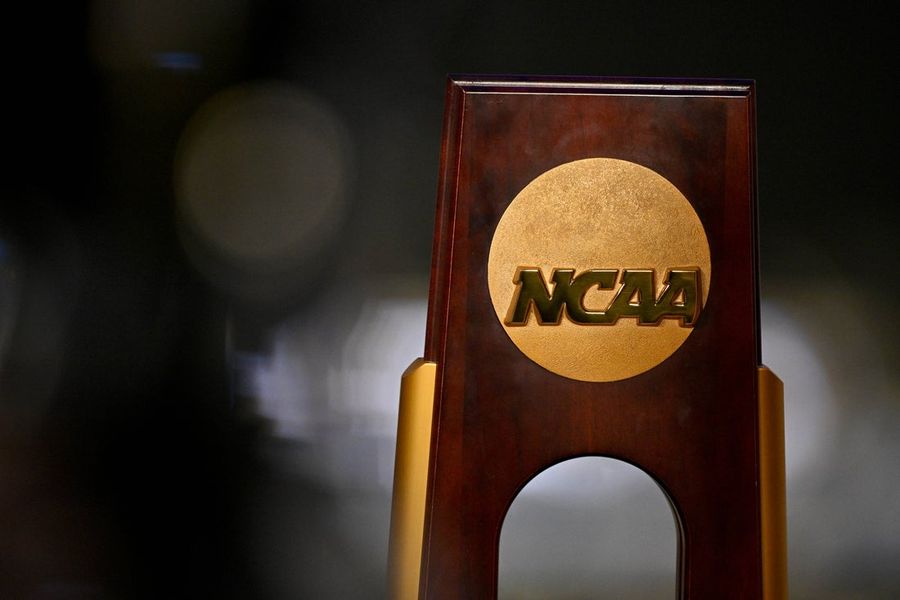 Apr 19, 2025; Fort Worth, TX, USA; A view of the NCAA logo and trophy before the 2025 Women's National Gymnastics Championship at Dickies Arena. Mandatory Credit: Jerome Miron-Imagn Images
 In a major move that would allow schools to start directly paying their athletes, the NCAA Division I Board of Directors proposed deleting 153 rules from its handbook as part of nine potential legislative changes at a Monday meeting.
The proposals are pending approval of the $2.8 billion House settlement reached last year of three separate antitrust cases against the NCAA and college sports' power conferences. The proposals include name image and likeness compensation and regulation, a change from scholarship limits to roster limits, eligibility standards and the creation of a legal entity to oversee enforcement of the updated athlete compensation rules in Division I.
If the settlement is approved, the NCAA said schools would have until June 15 to decide whether to opt in to provide benefits for the coming academic year, with the proposal slated to take effect July 1. Per the settlement, schools that opt in would begin sharing $20.5 million per year with its athletes beginning in August, ending many of the NCAA's longstanding rules of amateurism.
Per the NCAA, the elimination of those 153 rules is pending a decision from U.S. District Court Judge Claudia Wilken whether to finalize approval of the settlement. Wilken last year granted preliminary approval and appears poised to push it through.
"I think (the settlement) is worth pursuing and I think some of these things could be fixed if people tried to fix them, and that it would be worth their while to try to fix them," Wilken said previously.
Regarding roster limits -- a point of contention during last year's hearing -- replacing the existing scholarship limits would expand the amount of full scholarships that schools are allowed to offer. Per the NCAA, the legislation would double the scholarships available in women's sports. It would also lower the number of walk-ons or partial-scholarship opportunities in certain sports.
Also included among the proposals was an NIL clearinghouse and enforcement arm that operates outside the NCAA with "rules intended to bring clarity and stability to the NIL environment for all Division I schools."
The NCAA also proposed rules aiming to prevent schools from trying to circumvent the $20.5 million cap, requiring all players to disclose their NIL agreements if they are $600 or above. Any agreements between a third party outside of a school and a player would be subject to review.
Per the NCAA, the enforcement group would aim to "provide oversight for rules relating to the terms of the settlement, including third-party NIL and the annual benefits cap."
--Field Level Media
Related
Why None of These NBA Play-In Teams Are True Contenders




Biggest NBA Playoffs Concerns for Contenders Outside OKC
- Masters Betting Picks 2026: Best Value Bets Beyond Scottie Scheffler
- Best NBA Betting Picks and Predictions for Monday April 6th
- National Championship Bet Pick: Why Michigan Has the Edge Over UConn
- UFC Vegas 115 Betting Picks: Moicano vs. Duncan Headlines April 4th Card
- NBA Betting Picks April 4th: Three Best Bets for Saturday's Slate
- Michigan vs. Arizona Bets: Wolverines Hold Edge in Final Four Showdown
- Best NBA Betting Picks Today: Friday April 3rd Expert Predictions