"The Ball," From Soccer In Sun And Shadow

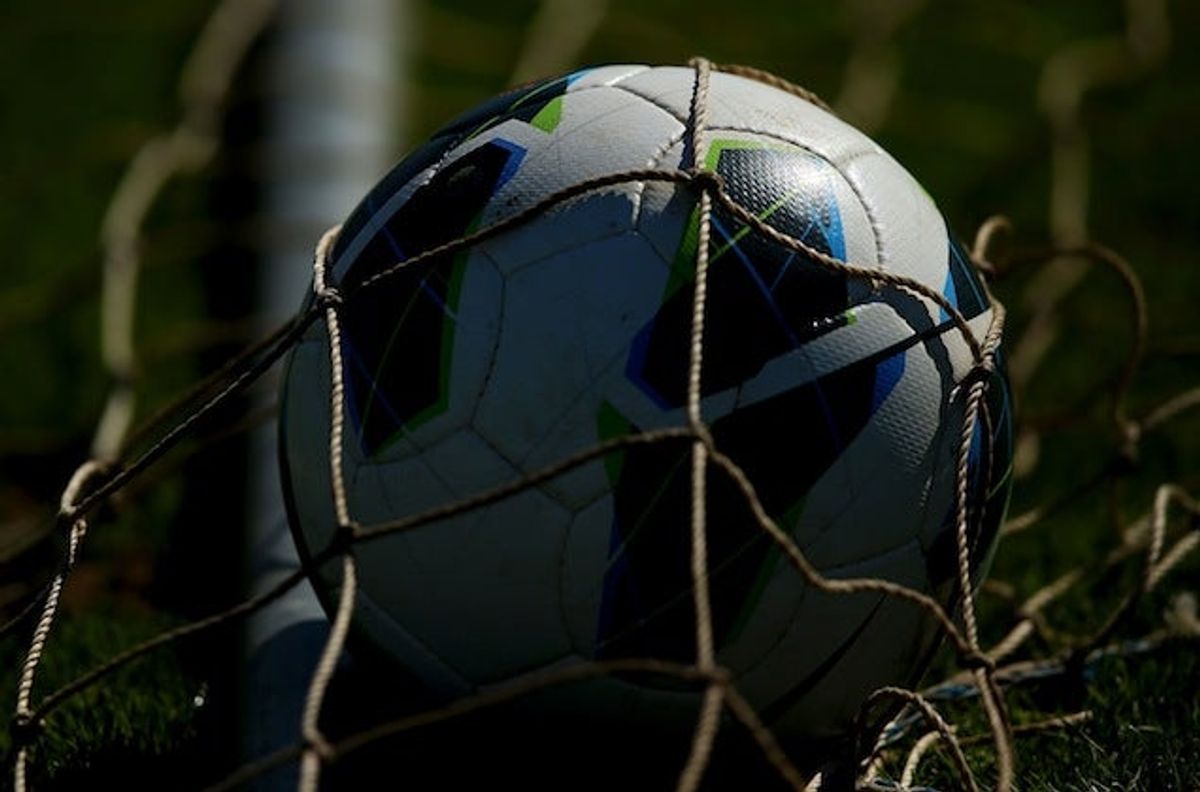
From Eduardo Galeano's classic, now available as an ebook. We'll have excerpts throughout the week.
The Chinese used a ball made of leather and filled with hemp. In the time of the Pharaohs the Egyptians used a ball made of straw or the husks of seeds, wrapped in colorful fabric. The Greeks and Romans used an ox bladder, inflated and sewn shut. Europeans of the Middle Ages and the Renaissance played with an oval-shaped ball filled with horsehair. In America the ball was made of rubber and bounced like nowhere else. The chroniclers of the Spanish Court tell how Hernán Cortés bounced a Mexican ball high in the air before the bulging eyes of Emperor Charles.
The rubber chamber, swollen with air and covered with leather, was born in the middle of the nineteenth century thanks to the genius of Charles Goodyear, an American from Connecticut. And long after that, thanks to the genius of Tossolini, Valbonesi, and Polo, three Argentines from Córdoba, the lace-free ball was born. They invented a chamber with a valve inflated by injection, and ever since the 1938 World Cup it has been possible to head the ball without getting hurt by the laces that once tied it together.
Until the middle of the twentieth century, the ball was brown. Then white. In our days it comes in different patterns of black on a white background. Now it has a waist of sixty centimeters and is dressed in polyurethane on polyethylene foam. Waterproof, it weighs less than a pound and travels more quickly than the old leather ball, which on rainy days barely moved.
They call it by many names: the sphere, the round, the tool, the globe, the balloon, the projectile. In Brazil no one doubts the ball is a woman. Brazilians call her pudgy, gorduchinha, or baby, menina, and they give her names like Maricota, Leonor, or Margarita.
Pelé kissed her in Maracanã when he scored his thousandth goal and Di Stéfano built her a monument in front of his house, a bronze ball with a plaque that says: Thanks, old girl.
She is loyal. In the final match of the 1930 World Cup, both teams insisted on playing with their own ball. Sage as Solomon, the referee decided that the first half would be played with the Argentine ball and the second with the Uruguayan ball. Argentina won the first half, and Uruguay the second. The ball can also be fickle, refusing to enter the goal because she changes her mind in midflight and curls away. You see, she is easily offended. She cannot stand getting kicked or hit out of spite. She insists on being caressed, kissed, lulled to sleep on the chest or the foot. She is proud, vain perhaps, and it is easy to understand why: she knows all too well that when she rises gracefully she brings joy to many a heart, and many a heart is crushed when she lands badly.
Excerpted from Soccer in Sun and Shadow. Copyright © 1997 by Eduardo Galeano and Mark Fried, translation. Published in paperback by Nation Books, 2013. Published in ebook by Open Road Media, 2014; available wherever ebooks are sold. By permission of Susan Bergholz Literary Services, New York City and Lamy, NM. All rights reserved.



Uros Medic’s 30-Second KO Puts UFC Welterweights on Notice
Sunday MLB Best Bets: Back Zack Wheeler and Shohei Ohtani

Dan Lanning Has Oregon on the Verge of Something Special
Three August Sports Events You Won’t Want to Miss


- White Sox vs. Rays Picks: Best Bets for Friday’s MLB Showdown
- WNBA Picks: Three Best Bets for Friday’s Fever, Wings and Storm Games
- Orioles vs. Tigers Bet Picks: Best Predictions for Tuesday July 28
- WNBA Picks Tuesday: Best Bets for Lynx, Fever and Aces
- Guardians vs. Reds Monday Prediction: Best Bets for the Battle of Ohio
- MLB Best Bets for Sunday's Rockies vs. Brewers, Yankees vs. Phillies
- UFC Abu Dhabi Best Bets: Top Picks for Ankalaev vs. Guskov Fight Night