Which Winter Olympic Sport Has The Biggest Athletes?

Originally published on Mode Analytics.
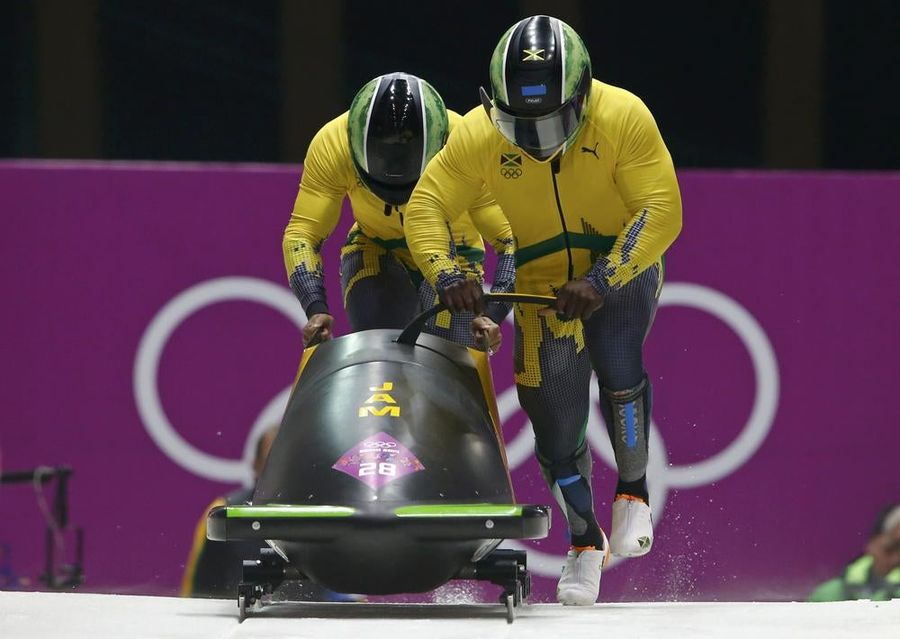
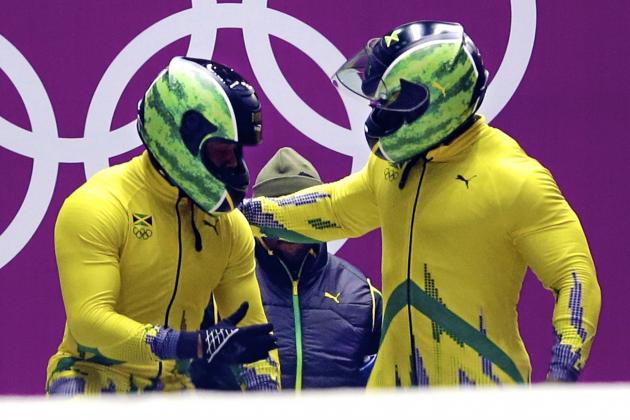
While watching the Sochi Olympics over the past two weeks, I couldn't help but notice the range of different athletes that compete. On the one hand, there's 15-year-old German ski jumper Gianina Ernst and 4'10" Canadian figure skater Meagan Duhamel. On the other hand, there's 55-year old alpine skier Hubertus Von Hohenlohe and 46-year old linebacker/Jamaican bobsledder Winston Watts.
The disparity got me wondering: How big and old are Winter Olympians? Which sports are older, heavier, and taller? How do differences in men's and women's ages, weights, and heights vary by sport?
The interactive graphic below explores these questions. It lets you view this year's Olympians' ages, weights, and heights by sport and by gender.
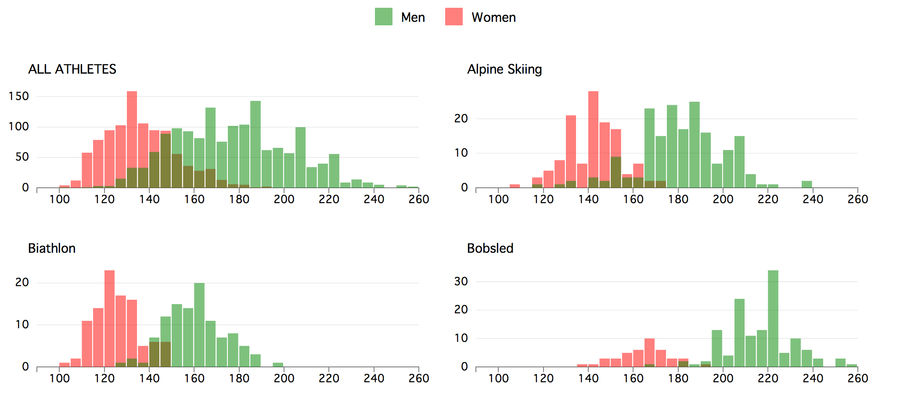
In no particular order, here are a few interesting findings from this data (note that women don't participate in Nordic Combined events, and weight data is unavailable for figure skaters and available for only a few curlers):
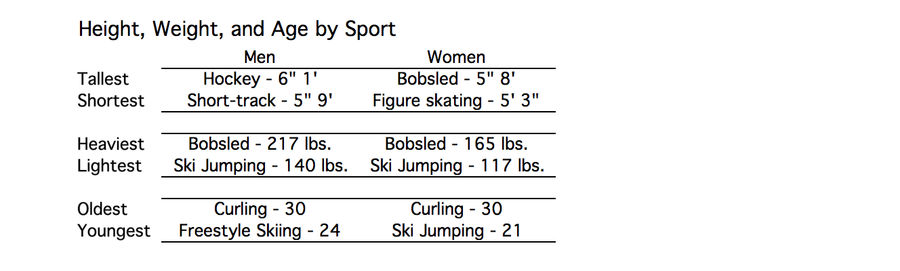
The table below shows the highest and lowest average weights, heights, and ages for this year's Olympic sports.
Curling has the widest age distribution for both men and women. Short-track skating and figure skating have the narrowest age distributions.
Height distributions are roughly equal across most sports.
Hockey has the widest weight distribution for women. Surprisingly, freestyle skiing has widest distribution for men.
The average female athlete is 25. The average male athlete is slightly older, at 26 and a half. However, the average female curler, speed-skater, snowboarder, and freestyle skier are all about half a year older than their average male counterparts.
The biggest average age gap between men and women is in ski jumping and hockey. In both these sports, the average man is about four years older than the average woman.
For both men and women, ski jumpers are lightest per inch of height. Female ski jumpers average 1.8 pounds per inch, and males average 2 pounds per inch. Bobsledders are the heaviest: Female bobsledders average 2.4 pounds per inch, and males average 3 pounds per inch.
This implies that a 5' 6" female ski jumper would weigh about 120 pounds, while a bobsledder would weight about 160 pounds. A 6' 0" male ski jumper would weigh around 145 pounds and a bobsledder would weight about 215 pounds.
Older athletes tend to be slightly heavier and taller, but the relationship isn't very strong.
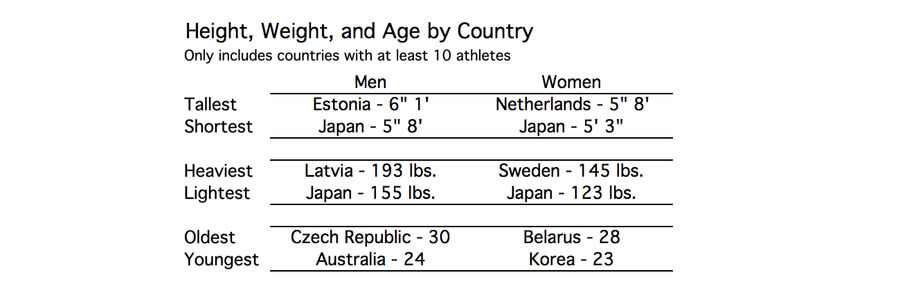
This table shows the highest and lowest average weights, heights, and ages by country. It only shows countries that have at least 10 athletes in their delegation. The results are a little less interesting than they appear on the surface, however, as each country's average athlete is largely determined by which sports the country tends to participate in the most.
Data
Data was collected from Sochi2014.com. Scripts for collecting data, visualization code, and the full dataset are available in this GitHub folder.
Benn Stancil is the chief analyst at Mode.

Why None of These NBA Play-In Teams Are True Contenders








Biggest NBA Playoffs Concerns for Contenders Outside OKC


- Masters Betting Picks 2026: Best Value Bets Beyond Scottie Scheffler
- Best NBA Betting Picks and Predictions for Monday April 6th
- National Championship Bet Pick: Why Michigan Has the Edge Over UConn
- UFC Vegas 115 Betting Picks: Moicano vs. Duncan Headlines April 4th Card
- NBA Betting Picks April 4th: Three Best Bets for Saturday's Slate
- Michigan vs. Arizona Bets: Wolverines Hold Edge in Final Four Showdown
- Best NBA Betting Picks Today: Friday April 3rd Expert Predictions