Which Teams In Each Sport Have The Biggest Home-Field Advantage?

 credits: Doug Pensinger | source: Getty
 Michael Lopez is the Director of Data and Analytics for the NFL, and is a statistics professor at Skidmore College. He runs the site StatsbyLopez, and in a series of posts is breaking down the findings of a forthcoming paper he’s written with a couple of colleagues. And this, my friends, is the good stuff.
The paper is titled “How Often Does the Best Team Win: A Unified Approach to Understanding Randomness in North American Sport,” with co-authors Gregory J. Matthews of Loyola Chicago and Benjamin S. Baumer of Smith College. It’ll be published in the Annals of Applied Statistics, and a pre-print of the manuscript can be read here. The methodology is too involved for me, but the gist of the research is self-evident in the paper’s title—as is the application. As Lopez notes, this has a ton of applications for betting on sports.
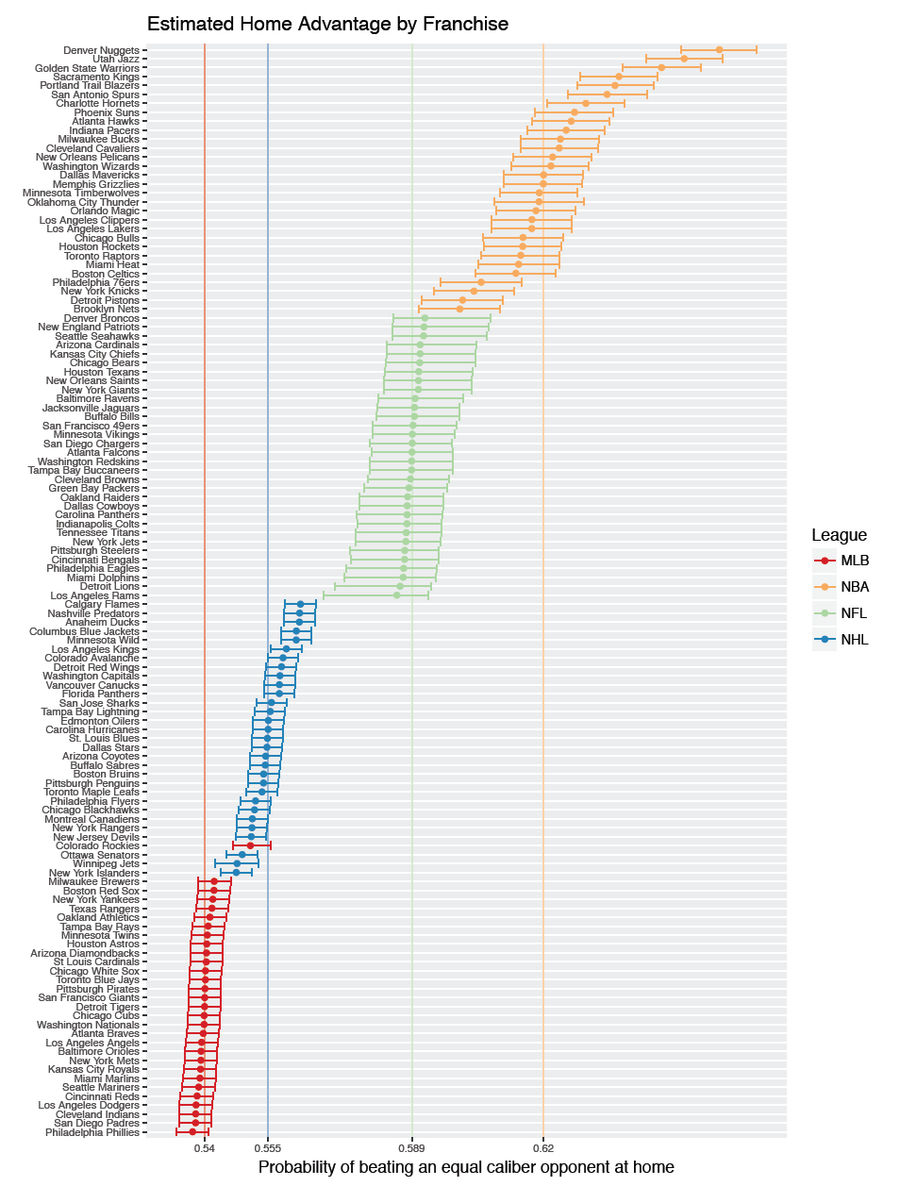
Part 3 in his series of posts breaking out the paper’s findings ran last month, and it’s all about home-field (or home-court or home-ice advantage.) He pulls out some of the interesting stuff in his post, but this graphic is truly striking.
 source: [object Object]
 Altitude matters. In every sport save hockey, the Denver team has that league’s biggest home-field advantage. (And Calgary, the NHL’s second-highest city at 3,400 feet, leads that list.)
And these are not negligible advantages. Lopez writes,
Take the NBA, where the difference between the best home advantage (Denver, Utah) and the worst (Brooklyn) is enormous. The estimates above average out to be roughly 2.5 extra wins per year, in expectation, that Denver and Utah get that Brooklyn doesn’t, just by virtue of where the teams play. Using back-of-envelope calculations with respect to the value of a win in the NBA, the home advantage for Denver and Utah is worth about $5 million annually. This is incredible, particularly given that the marginal value of a win for Denver and Utah (good but not great teams, traditionally) is likely higher.
The other most striking thing visualized here is how home-field advantage varies by sport. Why does it matter so much in basketball and so little in baseball? What is it about those sports—or those stadiums and arenas—that make these numbers so consistent? This is not a new finding, has indeed been repeated in many studies, but researchers still don’t entirely grasp the factors that go into the differences between sports. There are a ton of theories, and I’m sure you have your own, but this stuff is fascinating to me.
All of this said: None of this is going to help you get rich betting on sports. Any angle you can possibly conceive of, oddsmakers have already taken into account.
Related




Los Angeles Chargers Shouldn’t Resist Justin Herbert Trade

5 Fights to Make After UFC Vegas 112

Brewers vs. Dodgers Game 3 Predictions, Picks and Odds


The 5-0 49ers Are Finally Getting the Respect They Deserve

Jorge Masvidal Makes $100K Pick to Beat Islam Makhachev

Dana White's Contender Series Week 10 Predictions and Picks
- Bills vs. Rams Odds, Prediction and Best Bet for MNF
- Three Longshot NFL Futures Worth Betting in Week 5
- Falcons vs. Ravens Odds, Prediction and Best Bet for Sunday Night Football
- White Sox vs. Guardians ALDS Game 5 Betting Pick
- UFC Vegas 122 Betting Odds: The Biggest Line Moves Before Allen vs. Duncan
- UFC Vegas 122 Picks and Predictions: Three Bets for Allen vs. Duncan
- College Football Week 6 Bets: Three Picks for Saturday’s Biggest Games