Joey Aguilar Eligibility Ruling Is a Win for College Football

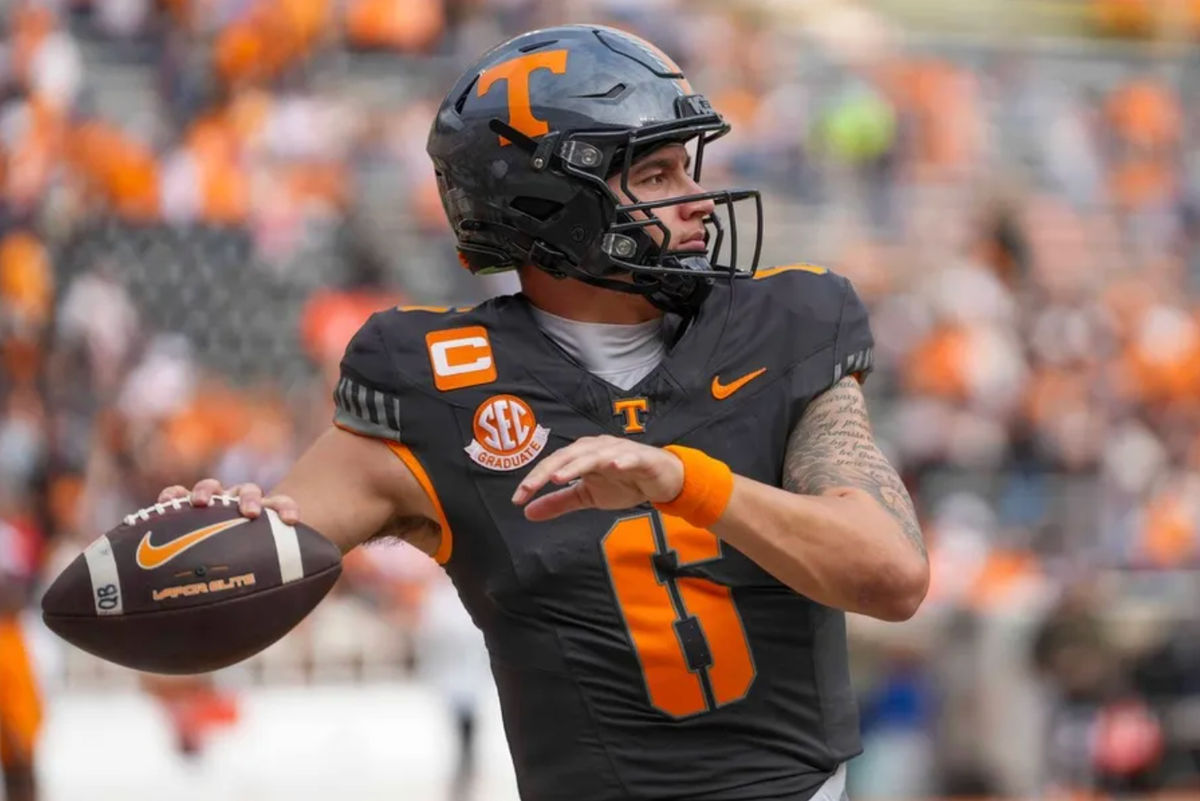 Tennessee quarterback Joey Aguilar (6) warm-ups before a NCAA football game between Tennessee Volunteers and New Mexico State Aggies at Neyland Stadium in Knoxville, Tenn., on Nov. 15, 2025.
 Quite often in this modern era of college football, it feels like the NCAA has lost the plot.
So many of the recent changes to the sport -- such as the transfer portal, NIL and revenue sharing -- are long overdue modern updates which have helped put some well-deserved power back in the players’ hands.
The NCAA, though, has refused to enforce or take a stand on issues that have arisen from these changes -- things like tampering, exceeding the roster salary cap and the like -- insisting that it is the government’s job to establish these guardrails.
Thankfully, the NCAA hasn’t totally given up on what really matters in college football: the first word in the sport’s name.
The NCAA secured a big win in court last week with the ruling that Tennessee quarterback Joey Aguilar would not be receiving an extra year of eligibility.
Thankfully, logic won out and Aguilar, who turns 25 this summer, won’t be back for his eighth season in college football.
His argument for one more year was an extension of Diego Pavia’s case last season which got him an additional year of eligibility. Pavia argued, with Aguilar and a host of other college football players joining the lawsuit, that years played at junior college shouldn’t count against Division I eligibility.
There’s many reasons why this argument doesn’t hold water but probably the biggest is...the second word in junior college.
The injunction that allowed Pavia to play last season was a net positive because of what he brought to the 2025 season as a Heisman finalist who led Vanderbilt to its first 10-win season in program history.
It also set a dangerous precedent, one which clearly made Aguilar think he could similarly get an extra year.
In theory, I’m ok with the occasional additional year of eligibility. When granted, they are basically always connected to players who have missed extensive time to injuries throughout their careers and whose pro prospects are low because of their injury history and age.
That doesn’t track with Aguilar’s path. He redshirted in 2019 at City College of San Francisco before the 2020 season was canceled due to the COVID-19 pandemic. He then transferred to another JUCO program, Diablo Valley, playing in 16 games over the 2021-22 seasons.
After that, he hopped to the FBS level with a transfer to App State, where he started 25 games over two seasons there, missing minimal time.
The Pavia injunction made Aguilar eligible for the 2025 season so he landed at Tennessee after originally transferring to UCLA for what was essentially his bonus year.
It was an extremely successful season. He started all 14 games, racking up 3,565 passing yards and 24 touchdowns. He led the Southeastern Conference in passing yards during the regular season.
But once again, it was a full season competition -- Aguilar’s fourth at the collegiate level with 10-plus games and fifth with six or more. That’s a full career and then some.
So it’s a relief the NCAA fought the case in court and even more that the Tennessee state judge sided with the organization over the local athlete.
Don’t get my point twisted: Player empowerment is good for college sports.
But with that power comes responsibilities. Among them, the responsibility of realizing when it’s time to move on to the next stage of football and/or life.
Related







- Best NBA Betting Picks and Predictions for Monday April 6th
- National Championship Bet Pick: Why Michigan Has the Edge Over UConn
- UFC Vegas 115 Betting Picks: Moicano vs. Duncan Headlines April 4th Card
- NBA Betting Picks April 4th: Three Best Bets for Saturday's Slate
- Michigan vs. Arizona Bets: Wolverines Hold Edge in Final Four Showdown
- Best NBA Betting Picks Today: Friday April 3rd Expert Predictions
- MLB Pitcher Props Today: Best Baseball Bets for April 3rd