Judge Rules USWNT Must Abide By No-Strike Clause

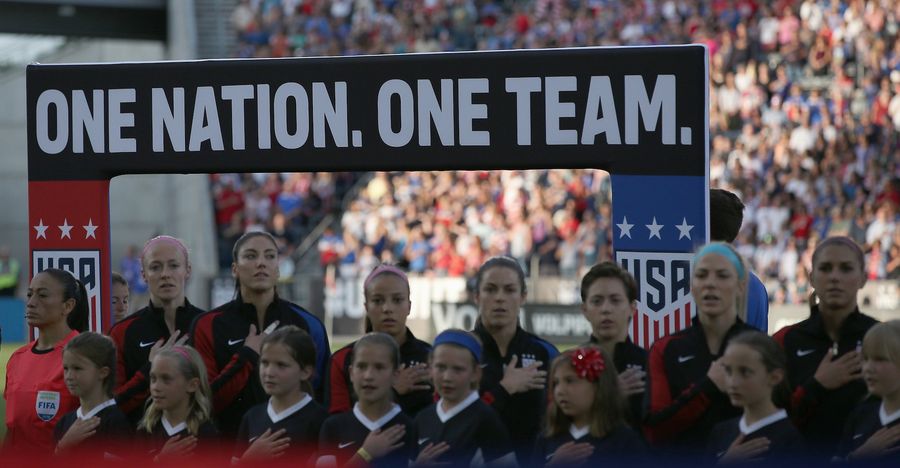 Photo via Doug Pennsinger/ [object Object]
 A federal judge ruled Friday that the United States Women’s National Team is bound by a no-strike clause, ruling out the possibility of a strike before or during the upcoming Rio Olympics.
In late 2015, the new USWNT Players Association executive director asserted that the agreement between the USWNT and the United States Soccer Federation would soon expire, freeing the players to strike for higher wages and other improved conditions (though he never explicitly said they would strike). The freedom to strike on the eve of the second most important women’s soccer tournament would presumably have given the players increased leverage.
In response, U.S. Soccer sued the USWNT, asking the court to rule that the two had a valid collective bargaining agreement. U.S. Soccer argued that the CBA consisted of the 2005 CBA, as well as a memorandum of understanding that partially modified it. The 2005 CBA has a no-strike clause, which is unmodified by the MOU, leading U.S. Soccer to conclude that the players cannot strike until the MOU expires, in December.
The players made a two-fold argument: that their previous executive director didn’t have the authority to negotiate on their behalf with U.S. Soccer, and that the agreement only consisted of the MOU, and not the unmodified terms of the 2005 CBA as well. The judge easily swatted away the first argument, and ruled that the second held no water because it was quite clear that the MOU was “intended to be supplemented by external documents”:
The text of the MOU, moreover, evinces substantial gaps that demonstrate that it was intended to be supplemented by external documents. The MOU, for instance, makes extensive use of the terms “floater,” “tier I player,” “tier II player,” and “tier III player,” which are not defined in the MOU (but are defined in the 2005 CBA). Similarly, the MOU provides that “US Soccer may but is not required to request an additional 5 sponsor appearances by Players per year.” (Dkt. 43-14). The MOU, however, never defines what a sponsor appearance is or how many sponsor appearances a player is expected to engage in annually absent such a request. (Again, the answer to those questions may be found in the 2005 CBA). Moreover, multiple rights under the MOU are defined by the express incorporation of the 2005 CBA.
The players’ wage discrimination case in front of the Equal Employment Opportunity Commission, however, is still ongoing.
[ AP]
You can read Judge Sharon Johnson Coleman’s full opinion below.
Three MLB Contenders That Need Answers Before It’s Too Late

Why Scottie Scheffler Is the Play on Sunday at The Masters
Why NFL's Proposed 18-Game Schedule Doesn't Make Sense
MLB Playoff Teams Off to Shocking Slow Starts in 2026
- Top MLB Betting Picks: Why Pirates and Twins Offer Value Today
- NBA Picks Today: Best Bets, Odds & Predictions for Friday’s Full Slate
- The Masters Odds and Predictions: Top Picks for Augusta National
- Wednesday April 8th MLB Pitcher Props: Dylan Cease and Kyle Bradish Bet Picks
- MLB Picks Today: Best Bets for Diamondbacks vs Mets and Athletics vs Yankees
- Masters Betting Picks 2026: Best Value Bets Beyond Scottie Scheffler
- Best NBA Betting Picks and Predictions for Monday April 6th