Pro Cycling's Most Harrowing Race Is A Day In Hell

![Photo via [object Object]](https://images.deadspin.com/tr:w-1200,fo-auto/p4rnxzpcvtc7iakq0omp.jpg) Photo via [object Object]
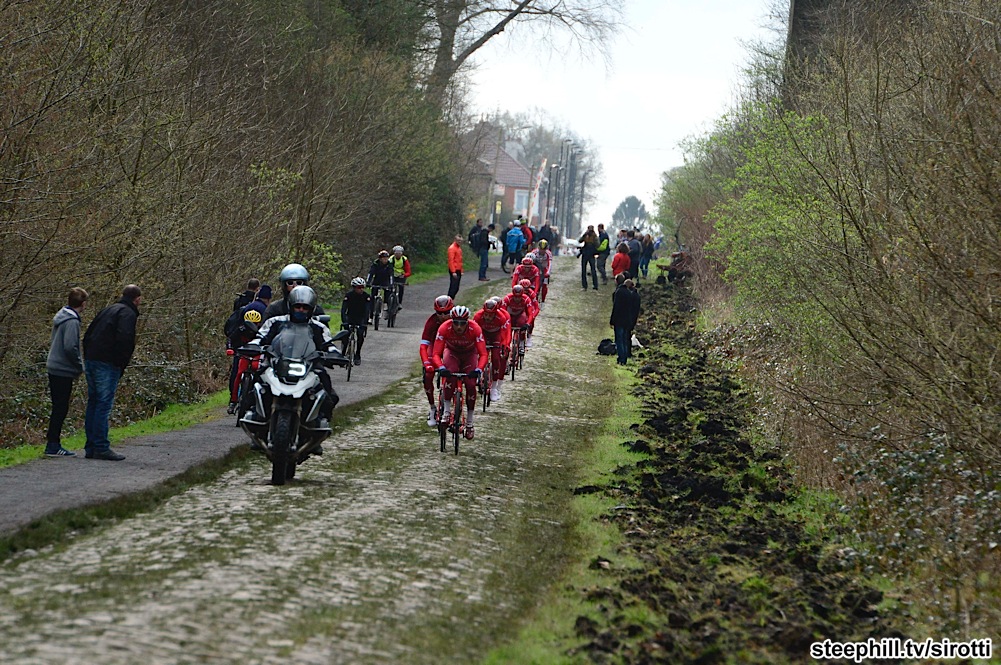
Photo via [object Object] You can’t drive your car over the cobbled roads of Northern France. They’re jagged anachronisms from a past era of transportation, and the only vehicles that still traverse them are tractors and, one Sunday a year, hundreds of professional cyclists. The 114th running of Paris-Roubaix will take place tomorrow, and whoever wins will have to conquer 53 kilometers of the most openly antagonistic roads in cycling. Legendary French journalist Jacques Goddet famously referred to the race as “the last great folly of cycle racing.”
Paris-Roubaix wraps up a two-week stretch of cobbled racing, and its stones are the harshest in the region. Cobbles obviously shake your bones and rattle your skull, but the hidden problem they pose is their slipperiness. When it’s a dry day (as it will be tomorrow), a thin film of dust covers their surface, and you can fall with the slightest twitch. Conquering the cobbles is about focus as much as power. The roads in that part of France are incredibly narrow, and if you pick the wrong line, you fall. The sneaky solution would be to simply ride in the dirt next to the cobbles, but organizers drive farm equipment over the sides of the road to cut off that option. Every cobbled sector is preceded by a mad dash for position, as hundreds of riders have to funnel into a three-wide opening.
The race is known as the “Hell of the North” not for its cobbles, but for the destruction Northern France suffered during World War I. Some of the worst trench warfare took place in and around Ypres, Somme, and Lille, towns that the race had passed through. L’Auto first used the word “hell” when describing the post-war terrain that the race passed through in 1919:
We enter into the centre of the battlefield. There’s not a tree, everything is flattened! Not a square meter that has not been hurled upside down. There’s one shell hole after another. The only things that stand out in this churned earth are the crosses with their ribbons in blue, white and red. It is hell!
Riders who make it over the cobbles and into the velodrome in Roubaix seem genuinely changed by the experience. This before-and-after video that Blanco made a few years back captures the harrowing experience of riding the cobbles pretty succinctly.
Cycling lends itself well to cinematization, so its most arduous race in the pro cycling calendar has naturally inspired its fair share of works. There have been goofy documentations of Paris-Roubaix, like , but by far the best and most famous is Jørgen Leth’s A Sunday In Hell, which chronicles the 1976 race. Hell follows the principle actors from the day before the race all the way through to the finish. Film historian Peter Cowie called it “Arguably the best film ever made about professional cycling.” Some enterprising cycling fan uploaded the movie in its entirety to YouTube, and you should watch it.
Hell is filmed like a war movie. It begins with Francesco Moser’s mechanic cleaning his bike with monastic focus for a long, meditative three minutes. Leth lingers on the mechanic’s work and a few other mundanities of pre-race preparations only to contrast them with the chaos of the actual racing. You have to see the mechanic toiling away on a bike he knows will get torn to shreds to feel the stakes of Paris-Roubaix.
The peloton doesn’t actually touch any cobbles for about 100 kilometers. The race’s profile doesn’t look topographically intimidating, but it’s backloaded with cobbled sections all the way until the last kilometer of racing into Roubaix. Leth builds up to the first cobbled sector like he’s negotiating the reveal of a monster in a horror movie. A choir chants “Pariiiiiiis Roubaaaaix!” over the narrator while the peloton enjoys its last bit of easy riding, as if to soften you up before the ass-kicking you are about to witness.
“This is where hell begins,” the narrator grimly notes as the riders first bounce their way onto the cobblestones. The low quality film is a true bounty here, as you can scarcely make out a motorbike from a team car from a cyclist in all the dust that the procession kicks up. Men fall, and Leth lingers on their gashes and hollowed out expressions, then kicks back to the front of the race after noting that “the weak are being left behind.”
What really makes Hell stand out, however, isn’t its treatment of the brutal so much as its balancing act with the mundane. There are long sequences of bored fans playing cards on a picnic blanket while they wait for the race to swing by. The first hour out of Paris is held up by a demonstration, and we get to watch as the peloton slowly snakes its way through a mass of pissed off Frenchmen. The protestors drop their Very Serious intentions when they all stop chanting to mob a bemused Bernard Thévenet, who won the 1975 Tour de France. Eddy Merckx passes through without so much as a glance at the demonstrators, and uses the delay to adjust his saddle.
When the race finally gets cooking, the soundtrack lurches back and forth between the simmering whine of a violin and the pounding of war drums. We see slow motion footage of Walter Godefroot rattling over the cobblestones and motorcycles crashing as they struggle to negotiate the roads. Leth is buddies with Lars Von Trier, and he too films long takes of people in pain. A pre-race favorite, Freddy Maertens, crashes out and Hell lingers on his frustration as he slumps into the medical car. “Here lies Freddy Maertens,” the narrator grimly notes, before moving on to another crash.
I’m not going to spoil who wins, but the film ends with a montage of close-ups of the pained expressions of the losers as they wash the dust off their faces in the famous showers of the Roubaix velodrome. Leth cuts back and forth between showing the exhaustion and spiritual drain of those who lost and the joyfulness of the winner. It’s nearly heartbreaking, having to watch the riders who just missed out on winning the sprint sit there and watch the winner wax cheerfully, but no other work has captured the agony and ecstasy of bike racing quite like A Sunday In Hell does.
MLB Postseason Race Is Heating Up With Two Weeks to Go


3 Fighters Who Stood Out on Saturday’s UFC Noche Card


Dana White’s Contender Series Week 6: Full Fight Card Picks

College Football Top 25: Biggest Questions After Week 2

6 NHL Youngsters Who Could Break Out in 2026-27

- Monday Night Football Week 1 Bet Picks for Broncos vs. Chiefs
- Cowboys vs. Giants Prediction: Back Dallas to Score Big on Sunday Night Football
- Sunday MLB Best Bets: Phillies and Astros Highlight Two Top Picks
- Noche UFC Betting Picks: Jean Silva, Tommy McMillen and More
- Saturday Sep. 12 MLB Expert Betting Picks as Playoff Pushes Intensify
- Noche UFC Line Movement Report: Significant Odds Swings for Saturday
- Noche UFC Best Bets: Two KO Picks Worth Targeting