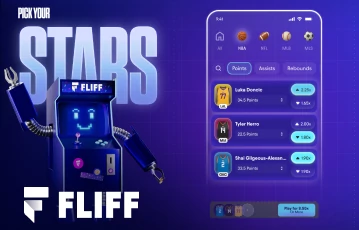
Fliff’s new Superstars product frames daily fantasy around players competing against each other in pooled contests rather than against the platform itself. Entries consist of selecting two or more athletes and choosing over/under statistical projections, with payouts determined by multipliers and placement within guaranteed prize pools. The format includes “Max Play” and “Flex Play” options that mirror pick’em-style gameplay while maintaining a peer-to-peer structure.
At launch, Superstars has rolled out across multiple states and is positioned as Fliff’s formal entry into real-money DFS using P2P contest pools. The footprint and product positioning align with broader industry trends toward pool-based DFS offerings seen at Underdog and PrizePicks.
Peer-to-peer DFS is fundamentally about players matching wits with other players. Instead of a house setting odds or acting as the counterparty, users enter contests where prize pools are funded by entries and distributed by rank or contest rules. That structure shifts the focus to lineup construction, projection accuracy, and contest selection rather than beating a house edge.
In practice, P2P DFS often uses familiar contest types—head-to-heads, 50/50s, and pooled tournaments. Head-to-heads pay nearly double minus rake to the higher score, while 50/50s reward the top half of entrants, emphasizing “high-floor” lineup builds over boom-or-bust approaches. These formats are popular with players seeking transparent math and direct competition.
First, agency and transparency: players know they’re competing against other entries, not hidden margins, and they can choose contest sizes and structures that match their risk tolerance. Many value the ability to diversify across multiple opponents, reducing variance and relying more on consistent projection work.
Second, the social and strategic appeal: P2P formats reward reading the field, anticipating common roster constructions, and finding contrarian—but not reckless—angles. For experienced DFS users, that game-theory layer is part of the draw, especially in smaller pools where opponent tendencies matter.
Superstars packages these P2P mechanics in a streamlined pick’em interface—selecting over/under stats, tracking leaderboards in real time, and sharing guaranteed prize pools. For existing fantasy players, the learning curve is minimal, and for casual users, the entry steps are straightforward.
Whether Superstars captures sustained share will hinge on contest liquidity, payout transparency, and user experience. Still, the move underscores how P2P DFS—head-to-heads, 50/50s, and pooled pick’ems—has become the default route for operators aiming to emphasize competition among users rather than house-banked play.