There’s been a lot of buzz around prediction markets lately, and the Kalshi vs Robinhood debate keeps popping up.
Both let you trade on real-world outcomes, but the way they do it, and who they’re best for, couldn’t be more different.
In this article, we’ll take a proper look at how Kalshi and Robinhood stack up. Not just what they offer, but how they feel to use.
We’ll compare their fees, market depth, availability, and who might get the most out of each site. If you’re wanting to know which one suits you the most, you’re in the right place.
Before getting into the details, here’s a quick comparison to set the stage:
| Feature | Kalshi | Robinhood |
|---|---|---|
| Platform Type | Event-contract exchange | Brokerage with prediction contracts |
| Market Focus | Prediction markets only | Stocks, crypto, options + predictions |
| Market Variety | Wide and niche (politics, macro, more) | Focused (sports, macro, politics) |
| Fees (Per Contract) | Variable: ~$0.01–$0.02 | Flat $0.02 |
| Availability | 140+ countries | US-only (for prediction contracts) |
If you’ve never used a prediction market before, don’t worry, it’s a lot more straightforward than it sounds. Both Kalshi and Robinhood use the same core mechanic of yes/no contracts that pay out $1 if you’re right and $0 if you’re wrong.
But, as mentioned in our Kalshi vs Polymarket: which app is better review, the way you interact with those markets can feel different depending on the app.
It doesn’t matter if you’re on Kalshi or Robinhood, the structure is the same. You’re buying into a $1 contract based on a specific outcome, like inflation, elections, or sports results.
You decide whether you think the answer to that outcome is “Yes” or “No.” For example, let’s say there’s a contract asking: Will inflation be above 4.0% this month? If you buy “Yes” at $0.40, and you’re correct, you get $1. If you’re wrong, you lose that $0.40.
The price you pay is the market’s real-time estimate of the odds. So a contract priced at $0.70 means the crowd thinks there’s a 70% chance of that outcome.
You’re not locked in either. You can sell before the market settles if things change or if you want to lock in a profit early. That makes these contracts feel more like dynamic trades than simple yes-or-no bets.
Some players are in it for the strategy. They want to hedge against inflation, policy decisions, or market shocks. Others just enjoy turning their news-following habits into something more interactive.
Unlike traditional sportsbooks, there’s no “house” setting the lines, which makes prediction markets legal.
The price of each contract is based purely on supply and demand. That gives the whole experience a very different feel. It’s more market-driven than odds-driven, and for a lot of people, that’s a huge part of the appeal.
This is where the biggest difference between Kalshi vs Robinhood shows up.
One site gives you a ton of niche options, the other sticks with big, attention-grabbing events.
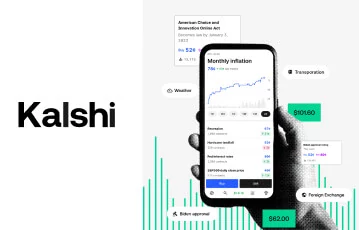
Kalshi lets you trade on a huge variety of events, from Fed rate decisions and inflation reports to sports outcomes, tech IPOs, and even climate metrics. Markets are constantly rotating based on current news.
Examples we’ve seen include:
If you like following macroeconomics, political cycles, or emerging tech, Kalshi’s market catalogue feels more like a newsfeed than a bet slip.
Robinhood’s approach is narrower but more familiar. You’ll typically see contracts around:
This kind of curation is more simple and headline-driven. If you’re just looking for 4-5 interesting predictions a week, it works. But you won’t find niche or long-tail questions like you would on Kalshi.
Both sites keep costs low, especially compared to traditional sportsbooks or CFD-style trading. But the way they structure their fees is a little different.
Robinhood charges $0.02 per contract, no matter what. That breaks down to:
There’s no guessing or tiered pricing, which makes it really easy to calculate your break-even point.
Kalshi charges between $0.01 and $0.02 per contract, depending on how much you’re trading and the contract price. Larger orders get capped, so high-volume users may pay slightly less overall, but it’s not quite as predictable.
If you’re trading casually, you probably won’t notice a huge difference between Kalshi vs Robinhood. But if you’re doing high-frequency trades, Kalshi’s fee model might edge out Robinhood on value.
Even though both sites are built around the same core product, who can use them varies quite a bit.
As of October 2025, Kalshi is available in over 140 countries. You just need to be 18+ and pass identity verification.
Everyone trades in the same global pool, and markets are open 24/7. However, Kalshi does note that some local laws may restrict usage in certain regions, so it’s worth checking depending on where you live.
Prediction markets inside Robinhood are only available to US users who:
This part really comes down to what kind of trader you are. One site feels more like a focused terminal, while the other leans into one-app convenience.
Kalshi’s web and mobile apps are designed around prediction contracts. You get:
If you’re active and want to place multiple trades or monitor prices in real-time, Kalshi gives you more tools to work with.
Robinhood’s event contracts are fully integrated with the rest of the app. You can:
It’s definitely mobile-first, and the interface is streamlined, but you won’t find detailed charts or market depth. It’s best for quick picks, not deep trading sessions.
This isn’t financial advice, but based on how both prediction market sites work, some scenarios naturally lean toward one or the other.
You’re in it for the prediction markets specifically. You want access to niche macro, political, climate questions, or just want a more in-depth site with a focus on data and trading flexibility. Kalshi is especially appealing if you’re following economic trends and like trading real-world news like CPI, tech launches, or policy deadlines.
You’re already using Robinhood for investing. You like the idea of making quick prediction trades inside the same app where you hold stocks or crypto. You prefer a simple flat fee, and you’re mostly interested in big topics, like the Fed, elections, or sports. Robinhood isn’t as deep, but it’s ridiculously easy to use, especially if you’re not planning to make dozens of trades per week.
So Kalshi vs Robinhood, which is better? Well, Kalshi and Robinhood both let you trade real-world predictions, but they’re built for different types of players.
Kalshi is for people who want depth, variety, and a site built around forecasting. Robinhood is for those who want to make occasional prediction trades inside an app they already use for investing.
Both sites come with low fees and regulated structures, but the experience couldn’t be more different once you’re inside.
Use the sign-up banners on this page if you’re ready to check out either site.
Loading …