We found Kalshi trading fees on every contract traded. Rather than a fixed rate, Kalshi charges you based on your contract price. The fees are high for contracts priced at 50¢ and low for contracts priced at 1¢ or 99¢.
These fees apply to all prediction markets and may even vary for special events. In this guide, we’ll walk you through Kalshi’s fee structure and explain how fees apply to your contract orders.
You’ll also see the fees applied to deposits and withdrawals, along with the specific payment methods that incur this fees. Continue reading to learn more about Kalshi.
After reviewing the Kalshi fee structure, here’s a summary of our pros and cons:
During our review, we noticed that Kalshi’s trading fees per contract are calculated based on the contract price itself. We observed that contracts priced at 1¢- 5¢ or 95¢- 99¢ have the lowest fees. However, mid-priced contracts between 40¢ and 60¢, especially 50¢, are the most expensive.
The reason for this is that contracts in the 50¢ zone represent the market’s uncertainty about an event happening. As the price approaches 0 or 1¢, the outcome becomes more obvious, reducing the fee.
Below is a summary of the Kalshi fees structure:
As explained earlier, the Kalshi fees per contract in 2025 are based on the contract’s price. Also, trading fees may vary by market, especially during special events such as awards, elections, or large sporting championships.
Now, there are two types of trading fees you’ll notice on the Kalshi app and site: taker fees and maker fees.
The Kalshi taker fees apply when you buy or sell contracts at the current market price. You’ll be charged immediately when your order fills.
Kalshi maker fees apply when your orders aren’t matched immediately and are left as resting orders on the order book. Basically, it applies only to limit orders, which are placed when you’re not ready to purchase contracts at the current market price.
You won’t be charged until the trade is executed, and there’s no fee for canceling a resting order. Notably, maker fees are lower than taker fees.
Kalshi transaction fees are based on the payment method used. ACH bank transfers and wire deposits don’t incur any fees, but debit card deposits include a 2% processing fee. That means if you fund your wallet with $100 using a debit card, your cash balance will be $98.
For Kalshi withdrawal fees, ACH and wire withdrawals don’t incur any fee, but debit card withdrawals incur a 2% processing fee. Generally, Kalshi doesn’t charge you for crypto deposits or withdrawals, but its third-party payment processor might. In this case, you’ll be notified.
From our checks, fees don’t apply once your Kalshi contracts have been settled. Once your contract resolves to $1 or $0, no fee will be added. Kalshi doesn’t take a revenue cut from your winnings.
Here’s a quick recap on the types of Kalshi fees:
| Trading fees (taker and maker fees) | Depends on the contract price |
| Transaction fees | 2% processing fees for debit card deposits and withdrawals |
| Settlement fees | None |
For starters, you won’t encounter Kalshi sports betting predictions like those of traditional sportsbooks. That’s because Kalshi is a federal regulated exchange that allows you to trade on whether an event will or won’t happen.
Your predictions revolve around purchasing event contracts structured on “Yes” or “No” positions, unlike traditional sports wagering.
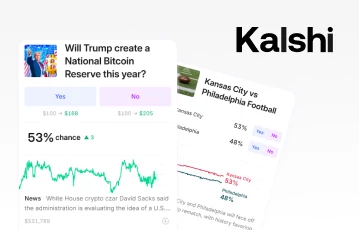
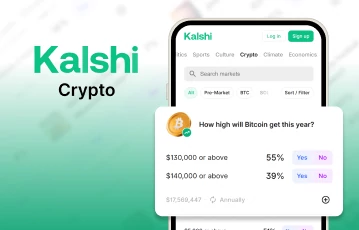
Each contract pays $1 if the event occurs and $0 if it doesn’t. Contract prices range from 1¢ to 99¢ and reflect the market’s perceived probability. For example, if a contract is priced at 85¢, the market thinks there’s an 85% probability of the event happening.
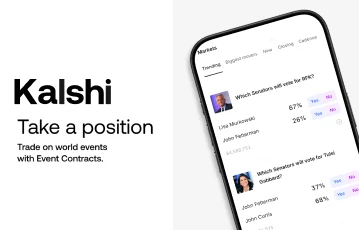
The prediction markets cover sports, technology, climate, pop culture, economics, political events, and more. These markets are structured as simple Yes-or-No questions, such as “Will X win the presidential election?” or “Will X become the Governor of a certain state?”
You can’t classify these examples as Kalshi election betting because each contract is treated as a financial derivative regulated by the Commodity Futures Trading Commission (CFTC).
Plus, the prices aren’t set by the exchange like traditional sportsbook odds, but instead depend on market activity from other traders.
For instance, if many traders believe an event will occur, the demand for “Yes” contracts increases and vice versa. This peer-to-peer format is what sets it apart from sportsbooks.
As we traded Kalshi event contracts, we picked up some helpful tips for keeping costs lower in our trading activities. Below are some of our expert tips:
We noticed that Kalshi contracts priced around 40¢- 60¢, particularly 50¢, tend to have higher fees. If the market is undecided, it’s better to wait for the price to shift toward more obvious outcomes before placing orders.
Rather than placing quick orders on Kalshi contracts, consider limit orders. Limit orders resting on the order book are often charged at marker fee rates, which are lower than those for instant orders.
Kalshi charges fees when funding your wallet or withdrawing your winnings. However, these fees only apply to debit card deposits and withdrawals. ACH deposits and withdrawals don’t incur any processing fees, which makes them more reliable.
From our guide, you’ll see that Kalshi does apply fees for prediction markets. These fees are attached to every contract order placed, whether you’re trading on sports, politics, or culture markets.
They are calculated based on the contract price and may vary due to specific market events.
Rest assured that Kalshi won’t charge you extra once your contract settles. Other Kalshi fees include debit card deposit and withdrawals, which incurs a 2% processing fee. However, transactions made via ACH and wire transfer don’t incur any fees.
Once you understand its fee structure, you can enjoy trading on your favorite events. To get started, click the on-page banners to sign up at Kalshi.
Yes. Kalshi applies a trading fee for your event contracts. These fees are calculated using the contract price itself.
No, Kalshi doesn’t charge settlement fees. If your contract settles at $0 or $1, the payout is made with no hidden charges.
Yes. Kalshi deposit fees apply to debit card deposits. You’ll pay a 2% processing fee on any deposit made with a US debit card.
Loading …