If you are thinking of joining Kalshi, then you’ll be keen to know how Kalshi payouts work, and take it from us, there’s plenty to learn. We’ll go back to the basics briefly before we get onto more technical topics.
One thing we did establish is that this brand has various incentives, including a sign up bonus, which we’ll explore. But first we’ll discuss the event contracts on offer, the payment methods you can use, and Kalshi’s fee structure, before moving on to some of the relevant terms and conditions you need to know about.
We apologise if you already have prior experience with prediction markets, but we like to have all bases covered, which means that we try to make things completely clear to anyone who is completely new to trading event contracts too.
Kalshi’s prediction markets fall into six main categories:
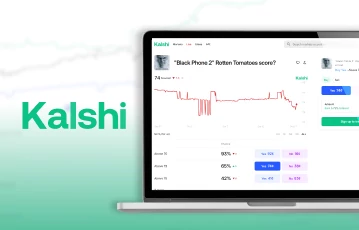
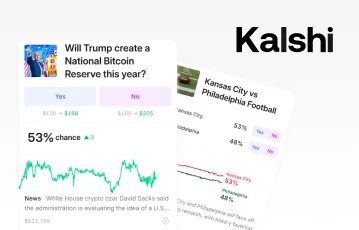
However, as you explore the site you will quickly see that there are numerous sub-divisions within those. For example, under ‘Politics’, you’ll find that elections are in a specific section. Here is an example of what a Kalshi market chart looks like.
In very simple terms, all of Kalshi’s event contracts only have two outcomes. Many are defined as a question, with a Yes or No answer, while others have Over or Under options.
For each you’ll see two percentages assigned, which total 100%. Each represents the probability of the event happening, based on the opinion of all users who have purchased a contract.
A trending event contract poses the question “More tech layoffs in 2026 than 2025?” The current probabilities show 88% Yes, 12% No. Depending on your opinion, you can ‘Buy’ a Yes contract for $0.88, or a No contract for $0.12.
Each contract has an end date, and once the official outcome is confirmed, winning contracts each receive $1, less Kalshi’s fees, which we’ll discuss later in this guide.
Kalshi is one of the few prediction market sites to offer any kind of bonus or incentive. The first one you’ll encounter is the Kalshi sign up bonus. Following registration, you’ll need to make a deposit via debit card or ACH bank transfer.
The minimum deposit at Kalshi is $10, but there’s no upper limit, so you are free to deposit more if you want. When you’ve traded $10 worth of contracts, you’ll automatically receive $10 of bonus credit, which you must use within 30 days.
Kalshi doesn’t have a promotions page, or similar. However, we were quite impressed by some of the other incentives we found tucked away in the Help Center, and we’re sure you will be too.
As we mentioned in our main Kalshi reviews, this is effectively Kalshi’s version of a loyalty program, as the rewards you receive are based on your trading activity for each calendar month.
We didn’t spend enough time on Kalshi to receive any rewards, but we do know that the brand assigns a variable ‘reward pool’ every month, and the amount you’ll receive is calculated as a percentage of the total volume.
For example, if the reward pool was $500, and you traded a total of 10%, your reward would be $50. While most trades are eligible, event contracts below $0.03, or above $0.97 won’t be included. In addition, the maximum reward per contract is capped at $0.005.
When you’re logged in at Kalshi, you can access a unique referral link in your account area, which you can send to friends you think might be interested in signing up.
If your referred friend goes on to open an account, once they have traded at least $10 of event contracts, you’ll both receive a $25 bonus. However, the bonus is not withdrawable, it can only be used to facilitate further trading.
The referral program does have certain limitations, notably that the maximum you can receive is capped at $1,000. However, that amount represents 40 successful referrals, which provides plenty of scope.
If you are observant and technically-minded, then you may be interested to learn more about this unique Kalshi program.
As a brand Kalshi is very keen to preserve the integrity of its prediction markets, by ensuring that the information provided for each event contract is both transparent and correct.
| Bug impact | Potential reward | Example |
|---|---|---|
| Minor | $25 to $100 | Aesthetics e.g. unmatched images, typos etc. |
| Moderate | $100 to $250 | T&Cs missing e.g. end date |
| Severe | $250 to $1,000+ | Issues causing unfair trading e.g. contradictions |
The examples we’ve shown are fairly generic, as the list of potential ‘bugs’ listed on the Kalshi site, and their impact is somewhat lengthy. However, you should get an idea of the scope. As you’d expect, there are some rules you need to follow if you identify a bug.
First you’ll need to document the event contract, describe the bug, and take screenshots. Then send a report using Kalshi’s ‘bug bounty form’. Kalshi will review your report, and contact you in due course. In the interim, you must not discuss the issue you found with anyone other than Kalshi representatives.
Now you know more about Kalshi works, we’ll move onto how your final payout is calculated. The first thing to know is that if your prediction is incorrect, then you lose your initial investment.
For the purpose of clarity, we’ll go back to our earlier example to explain what happens if you make a correct prediction:
“More tech layoffs in 2026 than 2025?” which at that point was 88% Yes, 12% No. Whichever side you chose, if your prediction was correct, your payout would be $1. The difference would reflect in the profit you made on the contract. For Yes, it would be $0.12, for No it would be $0.88.
The stated probabilities at the time of purchase are not fixed. In fact, it’s extremely unlikely that the probabilities would remain the same from the time that you purchased a contract, to the time it ends.
Prediction markets are dynamic. As more people buy and sell contracts, or external events affect opinions the probabilities will change multiple times, which is something you can track easily on Kalshi’s graphs.
In essence, this means you can just as easily lose money on an event contract as you can gain it.
Another factor to consider regarding your final payout for a winning contract is Kalshi’s fees. Unlike some brands offering prediction markets that apply a standard fee percentage (typically 2%) to every winning event contract, Kalshi calculates each one separately.
For the benefit of those who are mathematically minded, this is the formula Kalshi uses to work out the fees at the end of each contract.
Fees = (0.07 x C x P x (1P))
P = the final contract price in $
C = the total number of contracts for that event
In real terms, the fees deducted from a winning event contract range from around 1.2% up to 3
Although this may not be of interest to you, we felt a quick mention of the Kalshi ‘Combo Builder’ feature would be in order. This is only available in certain prediction market categories, mainly sports and entertainment.
Using the Combo Builder you can add multiple event contracts for a single event. When you use this feature, you must use the Request For Quote (RFQ) system to get a price for your contract.
In terms of payout, each prediction you add represents a single event contract. If any contract fails, your payout is zero. However, if all contracts are successful, your payout is multiplied.
As you can see, we weren’t exaggerating when we said there was a lot to learn about Kalshi payouts, as there’s more to know than meets the eye. But that isn’t to say Kalshi isn’t fair and reasonable. In fact, the brand goes out of its way to be transparent about how its prediction markets work, and provides all of the information you could possibly need to understand any given event contract.
We are also satisfied that Kalshi operates in accordance with CTFC regulations, and otherwise have our recommendation. So, if you feel that Kalshi is the right fit for you, you can use the link on our page banners to start exploring the site today.
As things stand currently, you can legally use Kalshi in all 50 US states. However, it is worth bearing in mind that prediction markets are a relatively new trading product, and accessibility may change in the future.
Yes. Kalshi is a CTFC-regulated trading exchange that specializes in prediction markets. The brand offers event contracts in various categories that include sports, politics, culture, crypto, economics and climate.
In simple terms, every Kalshi event contract is representative of a real world event, where there are just two outcomes. Each outcome has an assigned probability determined by market sentiment. Each correctly-predicted event contract pays out $1.
The minimum age to sign up at Kalshi is currently set at 18 years for all US states. In order to ensure all users meet that requirement, Kalshi implements KYC verification, which requires you to provide your SSN and upload a valid photo-ID document.
Yes. Kalshi offers new traders a $10 bonus subject to passing KYC checks, depositing $10, and subsequently trading $10 of event contracts. The bonus is added to your account as on-site credits, which you must use within 30 days.
Loading …