Sports betting on Kalshi isn’t technically available, but you can trade on sports prediction markets, which is similar but has notable differences.
As with traditional betting, you must make a correct prediction to win a payout.
However, you can’t put money on the outcome at fixed odds offered by the site.
Instead, you can trade by buying or selling one of the two outcomes.
As a result, you need an even number of counterparts for it to work. Rather than betting, it’s classed as a financial activity and is regulated by the CFTC and Federal law.
Now that we’ve explained how the site works in detail, here’s a summary of the pros and cons:
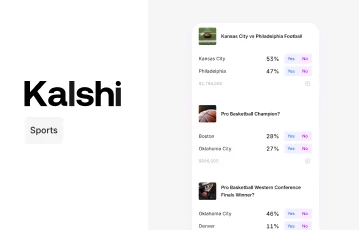
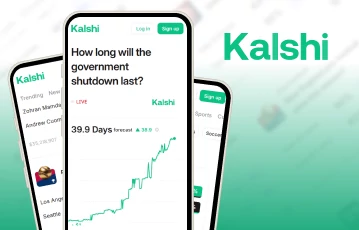
The Kalshi app provides a platform where you can trade on the outcome of future events, including sports. However, it is distinctly different from traditional sports betting in several ways, as we will explain.
Like with sports betting, there are winning and losing outcomes, and you need to make a correct prediction to win a payout.
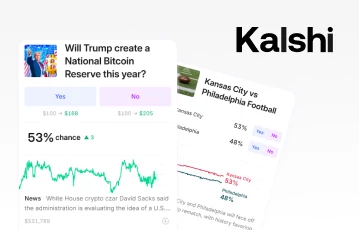
However, rather than fixed odds, you can trade on outcomes based on their market prices, which are determined by the probability, or “chance” of the outcome coming to pass.
On a sportsbook site, it doesn’t matter where the money goes. If 1,000 people bet on the Bills to beat the Patriots and only one person were to bet on the Patriots, that wouldn’t necessarily matter.
The sportsbook sets the odds and adds a commission, so it makes its money anyhow. Albeit one side might be an overall losing result depending on the number of bets and weight of money placed.
On Kalshi, both sides of the outcomes must be traded evenly for the prediction market to work. For example, if you bought 50 shares for the Bills to win, that would need to be balanced out by someone buying 50 for them to lose (or the Patriots to win).
All Kalshi event contracts follow a simple model where you can buy a “Yes” or “No” share for a prediction market. For example, if you’re an NBA fan, here’s the main NBA championship prediction market:
| 💯 Chance | ✅ Yes | ❌ No | |
|---|---|---|---|
| Atlanta: | 57% | $0.59 | $0.42 |
| New York J: | 43% | $0.43 | $0.58 |
Below the prediction market, you will always find a “Rules Summary” that defines how the market can be resolved. In the above case, the top row would be resolved as a “Yes” if Atlanta were to win the game and a “No” if they were to lose. For the bottom row, the opposite would be true: “Yes” if the Jets win and “No” if they lose.
Here’s a simple real-world example that is actually a real market live on Kalshi right now:
When it comes to buying shares for a sports prediction market on this site, you have two options:
Shares are priced between $0.01 and $0.99, and the market usually opens by reflecting the percentage like-for-like. For example, if the market opens with the “Chance” at 70%, the “Yes” share price will start at $0.70 and the “No” at $0.30. However, as you can see in the example above, the prices often move slightly based on trading activity and trader opinion, among other things.
When it comes to purchasing your shares, there are two ways to do it:
Let’s say that Atlanta wins and the market resolves to a “Yes”, this is what would happen to the share prices:
Therefore, if you’d bought “Yes” shares for $0.59, you’d get a $0.41 profit on each share ($1.00 – $0.59). Had you bought “No” shares, you’d lose your entire outlay.
As we have established, Kalshi doesn’t set and juice the odds to make a profit, as it isn’t a sportsbook and doesn’t offer betting. So how does it make money?
It makes money by charging a small fee based on the number of contracts that you purchase and the expected profit. You can find out more about the exact Kalshi fees structure here, but you can usually expect to pay up to 3.5% on your trades.
You can get lower fees on some sports prediction markets if you become a “Maker” on a sports prediction market. You become a maker when you place an order on a prediction market that isn’t yet matched. If no one takes shares on the counter market, you will pay no fee at all. If they do, you’ll pay a reduced Maker fee.
At the time of writing, trading on sports prediction markets at Kalshi is legal to US residents aged 18+ in all 50 states. This is because it’s classed as a financial activity, and is therefore regulated by the CFTC and governed by federal law.
Traditional sportsbooks, on the other hand, are regulated by individual state gambling authorities and state governments through state laws. Therefore, they need a licence in each individual state where they wish to operate. Kalshi does not.
However, we should caveat this by pointing out that things are moving fast. To keep up with the latest Kalshi sports prediction news for legislative updates.
| 🇺🇸 Legal in the US: | Yes |
|---|---|
| ✅ Number of legal states: | 50 |
| 🔞 Age limit: | 18+ |
| 📝 Licesning and regulation: | CTFC |
Here are some of the features and aspects of the site that are notable:
As well as simple win/lose prediction markets for sports games, you can also find spreads, futures, and alternative markets, such as “Who will be the next permanent Tampa Bay coach.”
Besides sports, you can also trade on futures outcomes on politics, the economy, weather, and more.
Like financial trading and stock market apps, each prediction market has an interactive linear graph displaying the movement since it opened.
Kalshi has some solid communication tools where you can share ideas with other users and even build your own markets to see if other people will buy the opposing outcomes.
There’s a large database of API documents that can help you learn about prediction markets and execute your trades.
In conclusion, Kalshi is a trading platform that is changing the way we participate in sports. You can buy a “Yes” or “No” position for future outcomes on sports and other prediction markets.
If your predictions are correct, you’ll win a payout. If not, you’ll lose your initial outlay, just like you would with traditional sports betting. However, the key difference is that the chance and trading prices are set by the market. They are not fixed odds that are set by Kalshi.
As a result, the site doesn’t make money off of your predictions directly by adding a commission. Instead, they charge a fee based on your expected profit should the prediction be correct.
If you would like to try out Kalshi sports prediction markets yourself, you can start by tapping the banners on this page.
Kalshi works by allowing you to buy shares in sports outcomes. For example, if the market was “Will the Nets beat the Knicks?”. You could buy shares on the “Yes” outcome if you thought the Nets would win. If the Nets went on to win the game, the market would resolve as a “Yes”, and you’d get $1.00 for every share you purchased.
No, you cannot engage in sports or election betting at Kalshi. Instead, you can buy shares for sports outcomes on prediction markets and receive a payout if your predictions are correct. However, this activity is considered financial trading, rather than gambling.
At the time of writing, it is legal for adults aged 18+ in all 50 states to trade on sports prediction markets at Kalshi. As it’s classed as a financial activity, it’s regulated by the CFTC and governed by federal law. This differs from traditional sportsbooks, which are subject to state laws and gambling regulations.
Loading …