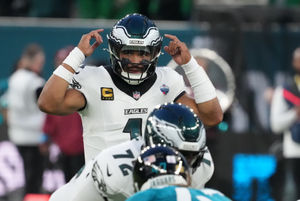
On the same day that Kalshi’s Monday Night Football market on the Eagles at Bears matchup attracted more than $150 million in notional trading volume, AGA President & CEO Bill Miller proclaimed that “the best days of prediction markets are behind us.”
Speaking at the 2026 Global Gaming Expo in Las Vegas, the American Gaming Association’s leader echoed a sentiment that, despite record-breaking prediction market trading volume, is shared by numerous industry observers and legal experts.
The direct quote was shared on X Monday afternoon by Indian Gaming Association (IGA) Conference Chair Victor Rocha. Both the IGA and the AGA have brought a laser-focused approach to combating prediction market platforms throughout the 2026 calendar year.
According to the majority of state attorneys general, tribal authorities, and state gaming officials, prediction market sports contracts are sports bets “in disguise” that have bypassed state gambling laws and siphoned roughly $1.5 billion in tax revenue from states.
The AGA’s opposition to CFTC-regulated prediction market platforms is well documented. Prediction market industry observers will not be surprised that AGA chief Bill Miller offered a negative public “take” on federally regulated exchanges that offer sports contracts during Monday’s G2E appearance.
However, there are a number of measurable indicators that point to a difficult path for the continued growth of prediction markets in 2027 and beyond.
Kalshi’s prediction market sports contracts are now geofenced in multiple jurisdictions, including three tribal casino properties located in California. Kalshi’s sports-based event contracts are similarly geo-restricted in the states of Massachusetts, Nevada, Michigan, and Washington, with more geographical blocks anticipated before the end of 2026.
Although the Third Circuit ruled in favor of Kalshi earlier this year, the prediction exchange is in the midst of a state and federal court “losing streak” that can only be remedied by a potential landmark Supreme Court ruling next year or in 2028. Until that time (and there’s no certainty that SCOTUS will rule in favor of prediction markets), exchanges like Kalshi appear to be on a collision course with additional state-sponsored blockages, bolstered by recent Ninth Circuit and Sixth Circuit rulings.
High-profile settlements with former Congressman George Santos and former White House teleprompter operator Gabriel Perez are unrelated to Kalshi’s sports contracts. Yet they have exposed niche “mention” and “appearance” markets as highly susceptible products that are vulnerable to manipulation, even when they are federally regulated. Just one week ago, a Wall Street Journal investigation created a cloud of suspicion around Kalshi’s perpetual futures markets (perps). Kalshi has since responded that the trades highlighted by the WSJ form part of its liquidity provider program.
The presumably imminent arrival of non-sports institutional margin trading is already accounted for. Add to that the fact that most CFTC-regulated prediction markets are already available to the vast majority of Americans aged 18+ and have largely escaped state taxation up to this point, the way forward for continued prediction market growth has two potential paths:
However, neither of the two scenarios listed above seems plausible to some legal experts. An eventual Supreme Court ruling that backs federal preemption could still spell trouble for prediction market sports contracts. Meanwhile, there appears to be just as much congressional opposition to prediction markets as (if not more) support for federally regulated sports event contracts.
Loading …