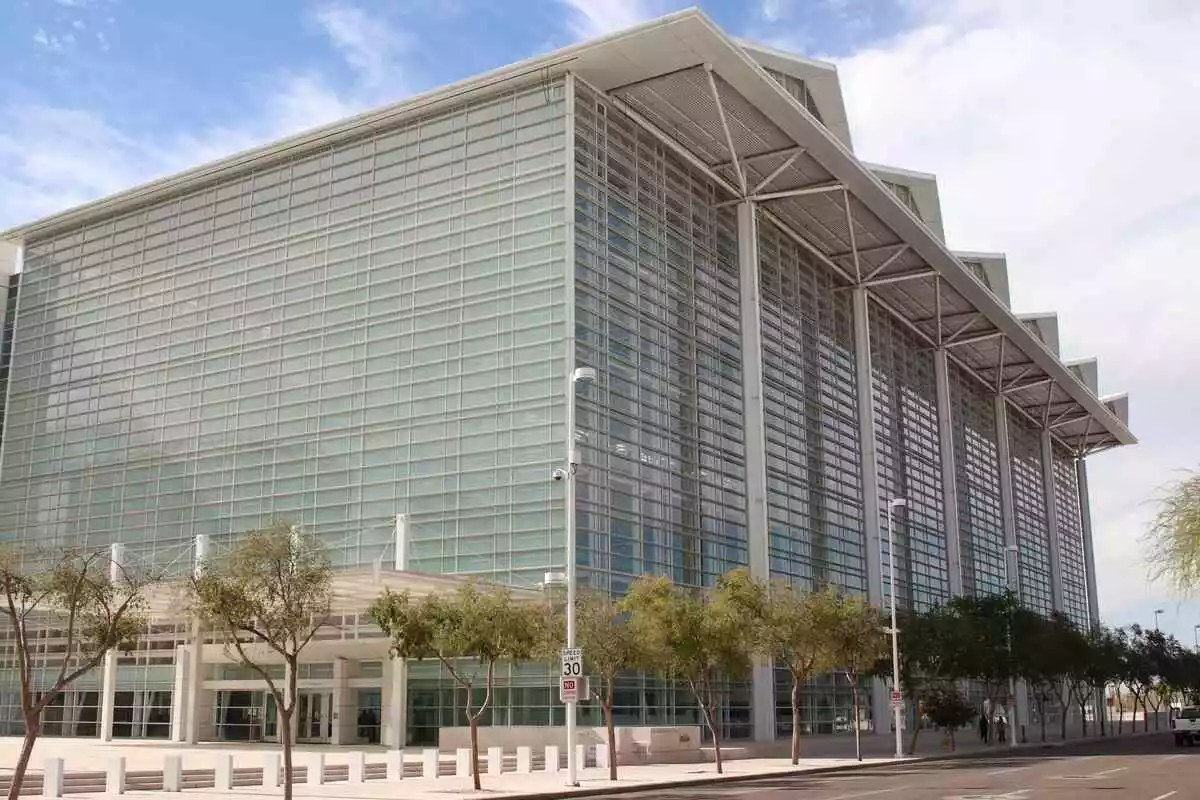
On Tuesday, the US District Court for the District of Arizona (Phoenix) ruled that prediction market exchanges like Kalshi fall under exclusive federal jurisdiction. The court’s conclusion halts Arizona’s criminal case (which includes 20 misdemeanors) against Kalshi. The state sought enforcement action on the grounds that Kalshi offers illegal election betting and unlicensed gambling to AZ residents.
The court’s determined that federal authority, specifically the Commodity Futures Trading Commission, preempts state laws over the regulation of prediction markets. “Here, the Court concludes that federal law preempts state gambling laws insofar as they seek to regulate derivatives exchanged on markets regulated by the CFTC,” according to the Arizona District Court ruling.
READ: Full Arizona District Court Ruling, Kalshi v. Johnson (May 5, 2026)
CFTC Chairman Mike Selig applauded the court’s ruling Tuesday afternoon. US District Judge Michael T. Liburdi’s decision “reaffirms what we all know: the CFTC has full jurisdiction over prediction markets,” stated the chairman in a social media post.
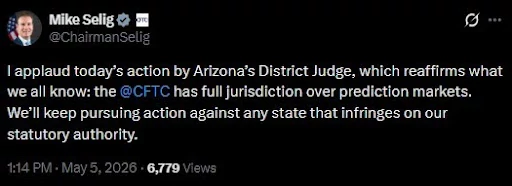
Source: CFTC Chairman Mike Selig, post on X – May 5, 2026
The chairman’s promise to continue “pursuing action” against states that attempt to block prediction markets by imposing their own gambling laws is consistent with recent CFTC activity. The federal agency filed a legal complaint against New York on April 24th.
A few days later, it brought a similar suit against Wisconsin. In both instances, the CFTC is suing to protect its “exclusive jurisdiction” to regulate the activity of prediction markets. At present, the CFTC has related pending litigation against Connecticut, Illinois, and Arizona.
Coinbase VP of Legal Ryan VanGrack likewise took to social media to commend the Arizona District Court’s finding on Tuesday. VanGrack, who is also the Global Head of Litigation at Coinbase, outlined six major points that the court’s ruling established:
Source: Ryan VanGrack, post on X – May 5, 2026
Despite Tuesday’s legal victory for prediction market exchanges, the regulatory issue tied to whether products are categorized as “event contracts” or “bets” could make its way to the US Supreme Court once appeals have been exhausted. Neither states nor the CFTC appear to be backing down in their pursuit of legal mandates regarding how exchanges like Kalshi, Polymarket, Coinbase, and others should be regulated.
As of now, Polymarket and Kallshi are available to customers throughout the United States. Their event contracts can be legally traded by residents who are at least 18 years of age.
Loading …