CFTC chairman Mike Selig sat down with WIRED Magazine Friday to discuss how the federal agency is turning to artificial intelligence in its continued efforts to thwart insider trading on prediction market exchanges. During the interview, which took place at the corporate offices of the Commodity Futures Trading Commission in Washington DC, Selig alluded to new AI tools that are coming online as insider traders become more sophisticated.
“You’ve got so much data,” the chairman told WIRED. “When we feed it into AI, we get really great information. It can help us understand things, like where we might want to investigate, or when we might need to send a subpoena to a trader.”
Selig’s comments come less than a month following the arrest of a US Army special forces soldier who is accused of using classified intel to illegally profit from US military action in Venezuela this past December. According to the DOJ, the alleged criminal used a VPN to access Polymarket’s international exchange and turn a profit exceeding $409,000 on Venezuela-based predictions, including the removal of then-head of state Nicolás Maduro.
Prediction market apps that currently operate in the United States (or eventually plan to open their exchanges to public access) are moving quickly to enhance in-app security features. Earlier this month, Kalshi announced enhanced customer protection measures including 2FA (two-factor authentication) along with other controls to prevent minors from accessing accounts.
A recent security update by Polymarket banned ghost trade accounts, and Kalshi suspended the accounts of three political hopefuls back in April for what the exchange labeled as “political insider trading.”
However, each exchange has its own rules regarding trading activity, including the use of AI “agents” on their respective platforms. During the Robinhood Q1-2026 earnings call, CEO Vlad Tenev said that the company soon expects “billions” of agents to be trading on the app.
Finding a balance between the rigid, private intel aspect of enforcement and the trading community is one obstacle that prediction markets are currently facing. A recent study by Wall Street Journal investigative reporters Sam Kessler and Alexander Osipovich found several potential conflicts of interest among Polymarket community arbitrators.
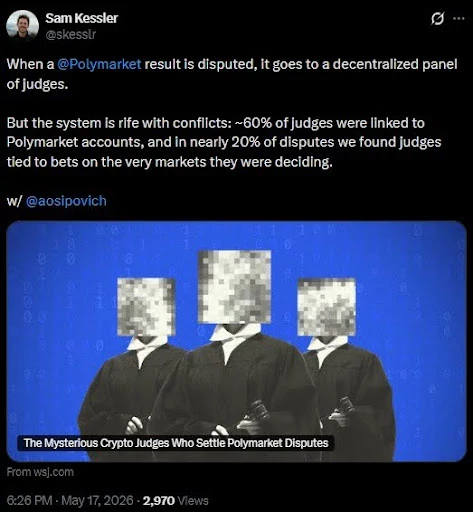
SOURCE: Sam Kessler ‘X’ account (May 17, 2026)
The WSJ article, published over the weekend, brings into question how much overall influence Polymarket account holders should have, and whether they should be allowed to form part of any “decentralized panel” of arbitrators. It’s also noteworthy that at least some of the markets responsible for a large portion of user-based settlement controversies will not be offered in the US once the exchange opens its virtual doors for public access.
In the meantime, CFTC chairman Mike Selig remains consistent in his belief that insider traders on prediction market platforms will be detected. “We’re going to find them, and we’re going to bring actions,” Selig reaffirmed Friday.
Loading …