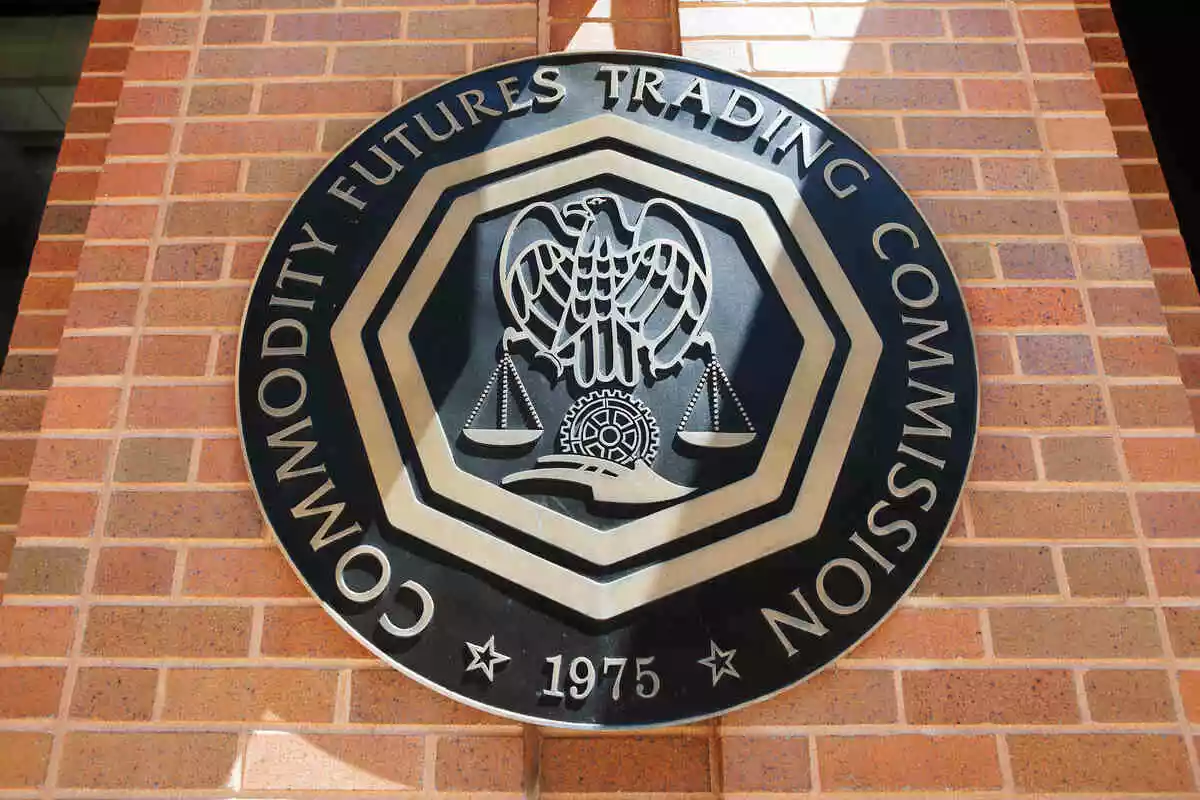
On Friday afternoon, the Commodity Futures Trading Commission (CFTC), headed by Chairman Mike Selig, countersued the state of New York over how prediction market exchanges should be regulated. In an official statement released April 24th, the federal agency criticized states for attempting to interfere with federal oversight of prediction market apps that currently operate within the United States.
“New York is the latest state to ignore federal law and decades of precedent by seeking to enforce state gambling laws against CFTC-registered exchanges,” said Chairman Selig. “New York is the latest state to ignore federal law and decades of precedent by seeking to enforce state gambling laws against CFTC-registered exchanges.”
Selig is referring to a civil lawsuit filed by New York Attorney General Letitia James last week. The state-based legal complaints in New York seek a combined $3.4B in compensatory damages from Coinbase and Gemini for offering “illegal gambling.”
In an April 24th social media communication posted on X, Chairman Selig argues that the Commodity Futures Trading Organization holds “exclusive jurisdiction” over how prediction market exchanges are regulated. Citing “decades of precedent,” the CFTC says states that attempt to enforce their own gambling laws and regulations are ignoring federal law.
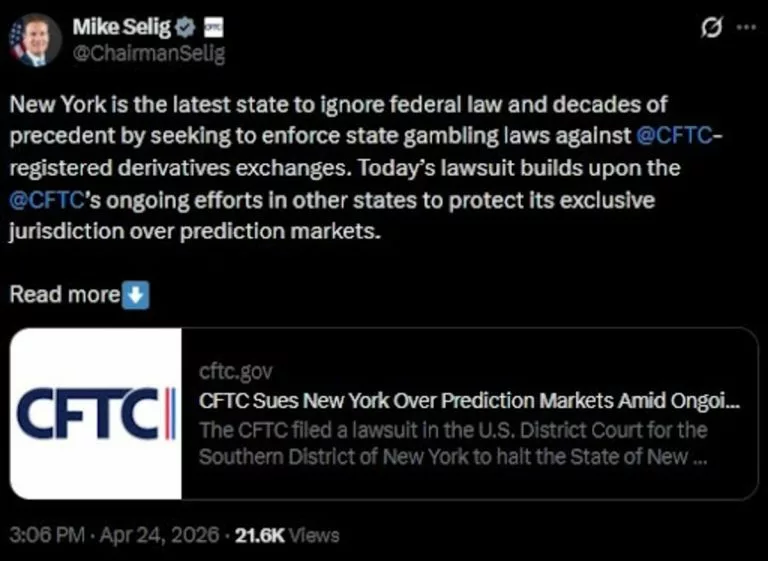
SOURCE: CFTC Chairman Mike Selig, April 24, 2026 – posted on X
Selig’s post and the CFTC’s legal action came in the same week that Kalshi fined and suspended the accounts of three congressional candidates for “political insider trading.” It’s also noteworthy that this week marks the launch of perpetual futures markets, also known as “perps,” for Kalshi users located in the US.
On Thursday, April 23rd, Wisconsin became the latest state to sue prediction market exchanges, including Kalshi, Polymarket, Crypto-com, Coinbase, and Robinhood. In the suit, Wisconsin AG Josh Kaul says that prediction markets use the term “event contracts” as a “fig leaf” to disguise their illegal sports betting activity.
However, popular exchanges that have become a go-to for American traders throughout the country remain adamant that they don’t offer “sports betting” to their users. That view has been corroborated by the CFTC via public testimony and, most recently, through its legal action filed Friday in the US District Court for the Southern District of New York.
Since prediction markets allegedly generate roughly 90% of their US-based fees from event contracts tied to sports contests (see Page 7 of Wisconsin’s formal complaint), the difference between the terms “sports bets” and “event contracts” is more than a benign distinction. Which is why some legal experts believe the legal battle revolving around prediction markets is ultimately destined for the Supreme Court of the United States (SCOTUS).
Loading …