Minnesota lawmakers sent a shockwave throughout the prediction markets industry Wednesday, passing a statewide prediction market ban with broad-stroke enforcement measures. If signed by Governor Tim Walz, the law would (as of Saturday, August 1st) make overnight felons out of prediction market platforms along with the payment processors, advertisers, and third-party market makers that collaborate with event contract exchanges.
READ: Minnesota SF 4760 House Journal (updated May 12, 2026)
Although SF 4760 takes aim at prediction markets and not online poker, the bill is reminiscent to the 2006 UIGEA with two key exceptions:
The outright ban on prediction market activity within the state of Minnesota is part of an omnibus public safety bill that’s attached to numerous other legislative initiatives.
The definition of prediction markets provided by Article 8 of Minnesota SF 4760 is sweeping. It includes, specifically, athletic events, eSports contests, any game of cards or dice, elections, legal actions, global and domestic affairs, elections, the weather, casualty events, awards ceremonies, and whether a certain person or group will make a particular statement. The qualifying factor, according to the bill, is that “the parties to the contract agree to a gain or loss by one to the other of money, property, or benefit.”
Furthermore, Minnesota SF 4760 stipulates that “a person is guilty of a felony if…” that individual is involved in the operation of a prediction market platform, or takes part in payment processing, advertising, or market making related to prediction market activity.
The clause pertaining to market making [Article 8, Section 4, Subdivision 2, Subsection 3, Part iii] is of note due to recent public acknowledgements by regulated sportsbooks FanDuel and DraftKings that third-party market making on prediction market exchanges now forms a part of their respective business structures.
SEE: Flutter Q1-2026 Earnings Call (May 6, 2026)
Currently, Minnesota is one of the dwindling number of states that have yet to regulate online or retail sports betting. Instead, Minnesota hosts just under two dozen tribal, land-based casinos that offer a mixture of video-based reels, bingo, pull tabs, poker, and “banking” card games such as blackjack, Pai Gow, and Caribbean Stud.
Minnesota SF 4760 is in direct conflict with the official stance of the Commodity Futures Trading Commission, which claims “exclusive jurisdiction” over prediction markets. At present, the CFTC has pending legal action against the states of New York, Wisconsin, Arizona, Illinois, and Connecticut.
Earlier this week, CFTC chairman Mike Selig announced that the federal agency had filed an amicus brief in Kalshi’s ongoing lawsuit against the Ohio Casino Control Commission.
If recent history is any indication, one could reasonably assume that legal actions to counter the Minnesota prediction market ban (which could be signed into law by Governor Tim Walz as early as this week) may be filed on behalf of platforms and the CFTC. A May 13th report by Yahoo! News confirms that assumption, while stating that there is enough support for the omnibus public safety bill to override any potential veto by the governor.
Social media activity representing both sides of the argument, for and against Minnesota SF 4760, was posted Wednesday on the ‘X’ platform. Kalshi’s head of communications Elisabeth Diana called the legislation “peak hypocrisy.”
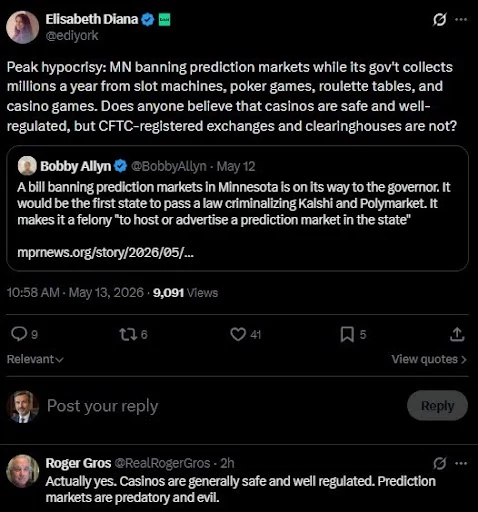
Source: ‘X’ accounts of Elisabeth Diana and Roger Gros (May 13, 2026)
Roger Gros, who is editor at large for GGB Magazine (a syndicated publication sponsored by the American Gaming Association), posted his own opinion that “prediction markets are predatory and evil,” a stance that aligns with recent statements by the AGA.
Loading …