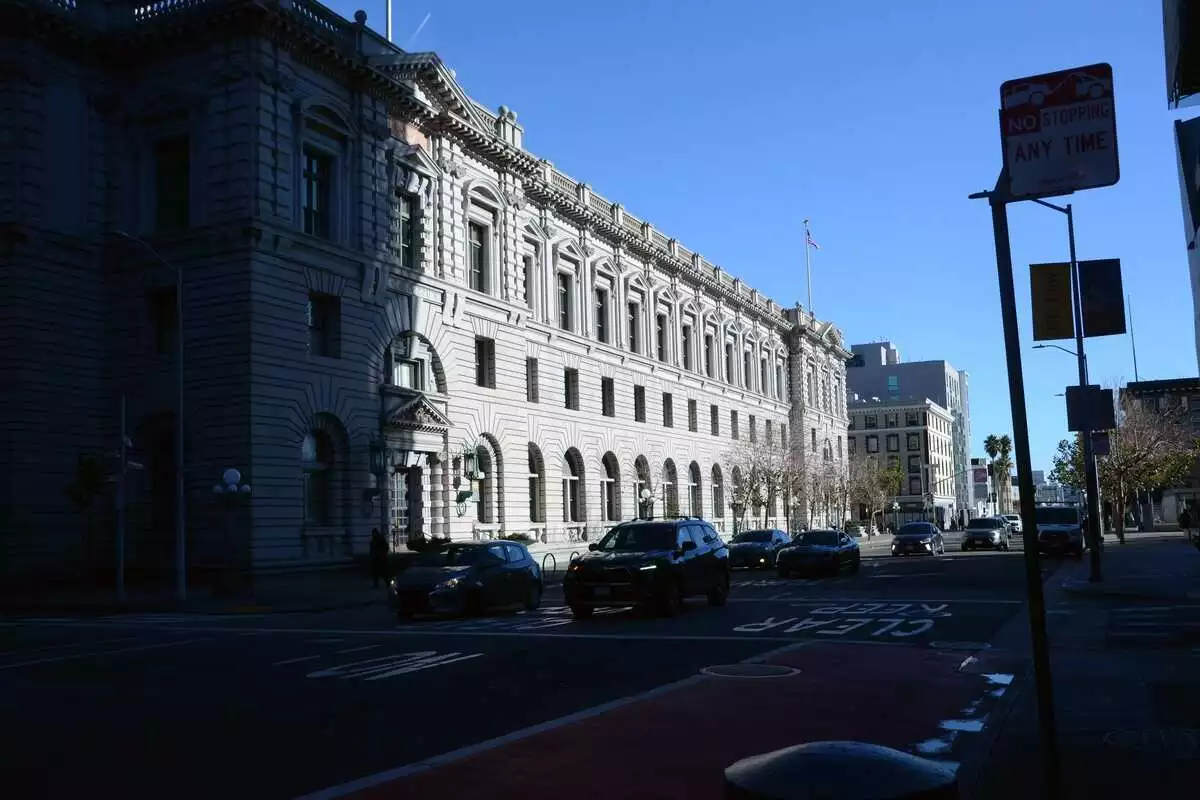
On Thursday, the US Court of Appeals for the Ninth Circuit (San Francisco) rejected bids by prediction market apps Kalshi and Polymarket to move their defense against the states of Nevada and Washington to federal court. The denial of the platforms’ motion to stay the lower court’s remand orders was issued by a three-judge panel, and essentially clears the way for WA and NV to pursue their respective legal actions in state courts.
The decision, in the short-term, means that Washington and Nevada will continue to enforce statewide bans on the exchanges’ sports-related contracts as well as election forecasts. While Polymarket still hasn’t launched to the public within the US, Kalshi relies on its public availability throughout the country to provide much needed liquidity for its numerous trading markets. Kalshi’s services are, at present, limited in roughly one-fifth of US state jurisdictions as legal battles continue.
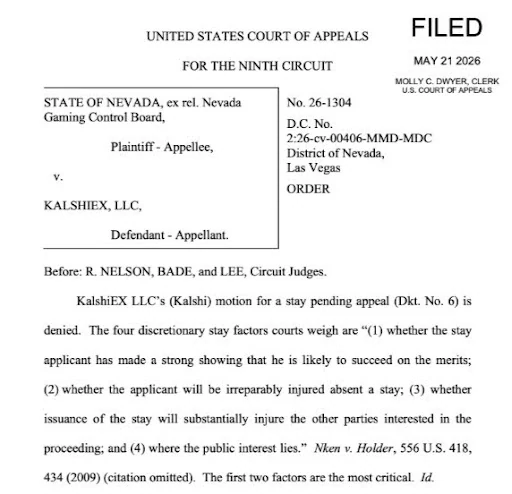
SOURCE: Dustin Gouker ‘X’ account (May 21, 2026)
While prediction markets technically fall under federal oversight, via the Commodity Futures Trading Commission, states are arguing that, sports-related contracts specifically, amount to illegal and/or unauthorized sports bets. Many legal experts believe that state courts are more likely to rule in favor of state and tribal gaming authorities whereas federal courts may be inclined to recognize the CFTC’s claim of exclusive jurisdiction over prediction markets.
Prediction markets have faced a whirlwind of legal activity in recent weeks as the arguments between the CFTC and exchanges against state and tribal gaming interests collide in public view. In May 2026 alone, prediction market legal and legislative news has been updating on a near-daily basis.
Most recently, the CFTC has sued Minnesota over its prediction markets ban, a legal filing that resulted from the state legislature passage of SF 4760, which makes it a felony to operate or collaborate with prediction market apps as of August 1st. Separately, prediction markets have come under fire on Capitol Hill as the Senate Commerce Committee decides how to move forward on potential legislation.
The latest denial by the Ninth Circuit makes Kalshi and Polymarket more vulnerable to state-based civil enforcement brought by Nevada and Washington – two states that have aggressively pursued the blockage of sports-related contracts. The back-and-forth battle between exchanges and their detractors is likely headed to the Supreme Court (if the Justices ultimately decide to hear one or more cases).
Prediction markets use peer-to-peer trades to facilitate activity on their apps, which makes them heavily reliant on liquidity in order to attract enough interest in specific markets. This is different from the business model of state-regulated sportsbook apps, in which customers place wagers against the “house.”
The widespread availability of Kalshi across the country allows it to obtain a massive amount of trading volume, which in turn sparks more user interest and activity. If the exchange is forced to further geo-fence or limit its products, the popularity of many markets could suffer significant liquidity crunches as market makers become more scarce and pricing fluctuations become more prominent.
A heavily marginalized, ring-fenced market may not be immediately apparent for a casual forecaster looking to buy $2 worth of “yes/no” contracts on a game’s outcome. However, large volume traders will probably “go offshore” if there aren’t enough peer-to-peer customers ready to gobble up buy/sell offers in an instant.
Loading …