The Confessions Of An NBA Scorekeeper

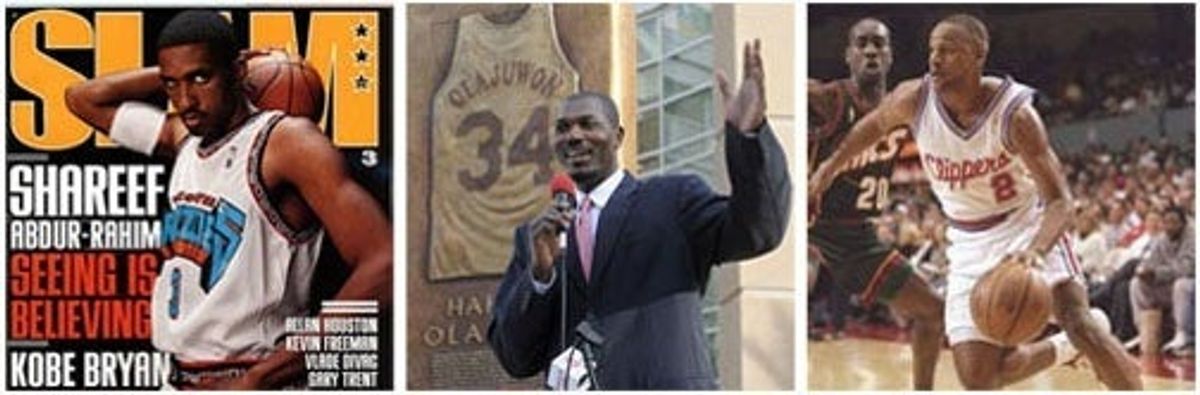
"I went into the NBA as bright-eyed and bushy-tailed as I could get," Alex says. "I loved the game. I didn't want to taint it." Of course, that was before Alex did all those "bad, bad, bad" things.
Not long ago, we brought you the story of a stat-padding NBA scorekeeper who, one day in 1997, awarded 23 assists to Lakers guard Nick Van Exel, mostly for the hell of it. That was Alex. (He is now an officer in the Navy and asks that I not use his last name.) From 1995 to 1998, he headed up the Vancouver Grizzlies' stat crew. Alex is a numbers guy, and he came at the job from the perspective of someone who spent his childhood, as he says, "recreating baseball games with Dungeons and Dragons dice and baseball cards." So it was particularly galling for him to find that the seemingly cold and objective NBA box score was, on many nights, a self-serving fiction, subject to so much artful embroidery and deliberate manipulation that one might reasonably conclude that the boys from Enron were sitting courtside, counting dimes.
"I wanted the numbers to be meaningful and accurate, and I knew they weren't," Alex says, a lesson he soon came to know firsthand. "I was good at making them inaccurate."
Alex was hired by the expansion Grizzlies in 1995 while still in school in Ontario, where he kept score for his college team. That offseason, the NBA was in the process of switching over to a computerized stat-keeping system, and at some point during the summer, Alex found himself at a training seminar in Detroit with the rest of the league's stat crews.
"That was my first exposure to the subjectivity of NBA statistics," he says. "I had come from the ivory tower where everything was straightforward. ... In Detroit, they'd show us a little video clip, and we'd enter it on our computer. That's a basket, no assist or whatever. Everyone around me would be giving assists. I was like, 'Really?' The dude passed it to a guy on the wing, who did a headfake, took two dribbles and made a jumper. And that's an assist?"
Alex quickly found that a scorekeeper is given broad discretion over two categories: assists and blocks (steals and rebounds are also open to some interpretation, though not a lot). "In the NBA, an assist is a pass leading directly to a basket," he says. "That's inherently subjective. What does that really mean in practice? The definition is massively variable according to who you talk to. The Jazz guys were pretty open about their liberalities. ... John Stockton averaged 10 assists. Is that legit? It's legit because they entered it. If he's another guy, would he get 10? Probably not."
The bias is plain to see. Just look at the home-road splits. Last season, home teams leaguewide scored 101.58 points per game; road teams, 98.32. That's to be expected: Teams play better at home. What's surprising is that assists and blocks rise disproportionately for home teams — assists by nearly 8 percent, blocks by more than 15 percent. Last year's Nuggets averaged 25 assists at home, only 19.4 on the road. They recorded 7.3 blocks per game at home and just 4.7 outside Denver. (Hell, Chris Andersen swatted 117 shots in 38 games at home against only 58 blocks in 33 games on the road. It was as if he stepped into the Pepsi Center and suddenly turned into Larry Nance.) The reason? People like Alex.
* * *
In Vancouver, Alex ran the stat crew, which is usually a two- or three-person operation (and always the responsibility of the home team). Alex was the caller, which meant that he'd call out the game to someone tapping feverishly away at his computer and rarely even glancing at the floor. "I would sit there, and I would call out things like, 'Field goal, miss, Bryon Russell, 18-footer from the elbow.'" He'd note "location, shot type, whether it was missed or made, assisted if necessary, blocked if necessary," and all this information would coalesce into a box score that would wind up, in shrunken agate type, in your morning newspaper. The process allows for what Alex calls "two points of failure — the guy subjectively seeing the action on the floor and then calling it out to the inputters." Errors, deliberate or otherwise, weren't easily corrected, given the NBA's growing desire for "immediacy over accuracy" in the Internet age.
His first season in Vancouver, Alex was admittedly "very liberal," especially with his assists. At home, the Grizzlies — who, in those early days, essentially served as the league's discard pile — assisted on 67 percent of their field goals where league average for home teams was 63 percent (these numbers were crunched by a user on the APBRmetrics forum); on the road, that figure was just over 56 percent (league average for away teams was 59 percent). "It wasn't as though we had a player like Chris Paul or Mark Jackson or Magic Johnson, and we wanted to help that one player," he says. "It was a function of the impression I'd gotten from talking to other scorekeepers that assists were like candy and we handed them out." He grew stingier over time; by his third and final season with the Grizzlies, the team's share of assisted field goals was edging toward league average.
Certain players, Alex says, "got a lot of help." Look, for instance, at Shareef Abdur-Rahim's splits. Abdur-Rahim was the Grizzlies' first-round pick in 1996, No. 3 overall, and a great deal of the franchise's future was resting on his liquid, almost preternaturally cool game. To go by the box score his first two years, he was a different player in his own stadium. Here he is in 1996-97:

Note that he recorded 50 steals in Vancouver and 29 elsewhere, and that he blocked more than three times as many shots at home as he did on the road. Today, as he calls up the numbers on his computer, Alex laughs. He sounds almost embarrassed. "The blocks," he says, "are atrocious."
Here's Abdur-Rahim in his second year:

The steals leveled off, but he still got more blocks at home (53 to 23) and now more assists as well (133 to 80).
"He was probably the only guy who got a massive benefit," Alex says, though he also directs me to the home-road rebounding splits for Bryant Reeves, the massive 7-footer who couldn't be bothered to grab anything that wasn't under a sneeze guard. "The way to get a guy extra rebounds," Alex says, "is if a shot goes up and someone tips it and someone else recovers it, you can give it to either one. Rodman would get those all the time. Most callers will give it to the guy who actually gets possession. But that doesn't mean a caller can't give it to someone in a scrum who tipped it. What if Byron Scott retrieves it? Byron Scott doesn't need the rebound."
The guy who grew up making games out of Dungeons and Dragons dice and baseball cards was still freely mixing fantasy and reality. It was his job now.
* * *
On Dec. 13, 1995, the Grizzlies hosted the Houston Rockets, who were coming off their second straight NBA championship and still had Hakeem Olajuwon doing his Arthur Murray routine in the post. The Rockets won by 11. Have a look at the box score. "There will be something that jumps out at you fairly quickly," Alex says.
It's Olajuwon's line, a tidy 15-14-10:

"It's the one incident that stands out in my mind," Alex says. "That was the only time I was ordered to do something."
As Alex remembers it now, Olajuwon had a double-double with nine blocks at some point during the fourth quarter. "Someone in management came to me and said, basically, Thou shalt give Hakeem Olajuwon a triple-double. Come hell or high water, he's getting a triple-double. I'm like, uh, OK." The Grizzlies had small monitors on which they kept a running box score. Anyone could see if someone was closing in on a milestone. "If a guy is in vicinity of a record, people are tracking those things. I know those things," Alex says. "If a guy has an eight-game streak of getting 10 rebounds, I'll know that. Am I gonna help that? Probably." The Rockets game, though, "was the one time someone said, 'You'll do this.' And I did." (For the record, Alex is reasonably certain that the 10th block was legitimate. "If he got a bullshit block," he says, "it probably happened before the 10th one.")
He won't say who issued the commandment, other than that it was someone in basketball operations who helped compile statistical packets for the media. "It was a mid-level guy, not a GM or an assistant GM," he says. Alex believes the suit was acting on his own initiative, though the habit of fudging statistics upward was practically an organizational, if not leaguewide, imperative. "When you get a triple-double, that dramatically increases the potential of our game being shown on ESPN. 'Here are some highlights of Olajuwon, and oh, by the way, they happen to be in Vancouver.' A team like ours was getting zero national media coverage. There's some value in that, even if someone is lighting us up, for marketing and longterm growth."
Alex was new to the game, however, and the request pissed him off. "I was immature," he says, "I was 20-21 years old, and some dude was telling me I needed to do something."
Which is perhaps why, a little more than a year later, with Nick Van Exel and the Lakers in town, Alex decided to act out. "I was sort of disgruntled," he says. "I loved the game. I don't want the numbers to be meaningless, and I felt they were becoming meaningless because of how stats were kept. So I decided, I'm gonna do this totally immature thing and see what happens. It was childish. The Lakers are in town. We're gonna lose. Fuck it. He's getting a shitload of assists." If you were to watch the game today, you'd see some "comically bad assists." Alex's fingerprints are all over the box score. He gave Van Exel everything. "Van Exel would pass from the top of the three-point line to someone on the wing who'd hold the ball for five seconds, dribble, then make a move to the basket. Assist, Van Exel."
No one noticed. From his chair, Alex could hear the legendary broadcaster Chick Hearn calling the game. Van Exel's having a great game! He's moving the ball exceptionally well! And in the next day's writeups, Van Exel was of course the hero. Alex thought, What the fuck?
"This is a bad analogy, but it's like a husband cheating on a wife in such a way as to guarantee he's going to be caught," Alex says. "There's nothing to justify it. It was stupid. And there were no consequences." He figured he'd at least get scolded. He wasn't. In fact, a management guy congratulated him. The game was sure to get on SportsCenter now.
* * *
Everyone cooked the books, and the tendency, by and large, was to overcount — with a few notable exceptions. "Why would you underrerport? The only reason is to make your players look bad," Alex says. "Normally, you wouldn't want to do that. If the players look good, they're more likely to be All-Stars and generate trade value. You don't want to undervalue your own assets. But if you're a stupid franchise, and you don't intend to make deals, and you want to depress your own players' signability — well, which franchise is stupid enough to do that?"
In the latter half of the 1990s, the Clippers held down their own players' assists with an almost suspicious regularity. Between 1987 and 2009, home teams assisted on 61.8 percent of their field goals; away teams, 58.3 percent — a gap of 3.5 percentage points in favor of the home squads. Year after year, the Clippers reversed the trend. In 1996, the Clips' scorekeepers credited the team with assists on 47 percent of its field goals (with only Pooh Richardson averaging more than five assists per game); in other arenas, the same Clippers team assisted on 60 percent of its field goals, a difference of 13 percentage points. No team since 1987 has underreported its own assists by a larger margin. Second-largest: The Clippers in 1999, with a difference of 12.2 percentage points. Third-largest: The Clippers in 1998, at 12.1 points. Fifth-largest: The Clippers in 1997, at 9.1 points.
"The numbers are huge," Alex says. "It's pretty amazing. This is total conjecture. But do I think someone from management went to them and said, 'You need to underrerport stats'? There's no way — even with an organization as dysfunctional as the Clippers. That would expose them to civil liability, if they're intentionally diminishing the market for a player — that's almost criminal. But if someone goes to a statistician and says, 'We're being way too liberal on steals, blocks and assists,' that's probably legitimate. You can define that as, 'We want the numbers to be correct.' But as a practical consequence, your own players look worse on paper."
The question, ultimately, is whether this really matters to anyone beyond the people who had the misfortune of playing for the Clippers in the 1990s and those handful of figure filberts who've dedicated themselves to building a science on the whims of a few people sitting courtside. It certainly doesn't matter to the NBA.
"Teams have a legitimate, vested interest in stats being inflated, just like the league does," Alex says. "Ten assists is way more interesting than eight assists. As humans, those are more appealing and interesting numbers. The NBA benefits and every team benefits from bigger, flashier numbers."
In the end, the league has little incentive to address the issue, even now, in this tight-assed, post-Donaghy era, when the NBA wants desperately to convince you there are no magnets in the pinball machine. And so the scorekeepers will continue doing the professional equivalent of rolling their Dungeons and Dragons dice, perhaps saying, "Fuck it" now and again and giving a guy a shitload of assists, mostly for the hell of it, and Chris Andersen will go on looking like Larry Nance every Nuggets homestand. The NBA: Where Fudging Happens. "It is," as Alex says, "an entertainment thing."
* * *
EARLIER: An Assist For Nick Van Exel: How An NBA Scorekeeper Cooked The Books
Related

Most of the Hands on This Poker Site Were Played by Bots
Guardians vs. Rays ALCS Game 6 Best Betting Picks
Rays vs. Guardians Game 5 Predictions: Best Bets for ALCS
- Cowboys vs. Packers Prediction: Best Bet for Sunday Night Football
- UFC Edmonton Best Bets, Predictions and Fight Picks
- Rays vs. Guardians Game 4 Best Player Props Betting Picks
- College Football Week 8 Best Bets: Ohio State, Alabama and More
- Joaquin Buckley Plummets From -300 Favorite to Underdog at UFC Edmonton
- WNBA Finals Picks: Dream, Valkyries and Gabby Williams Best Bets
- UFC Vegas 122: 5 Underdogs Drawing Sharp Money This Weekend