The Thunder Are A Matchup Nightmare For Copy Editors. So Is The Heat.

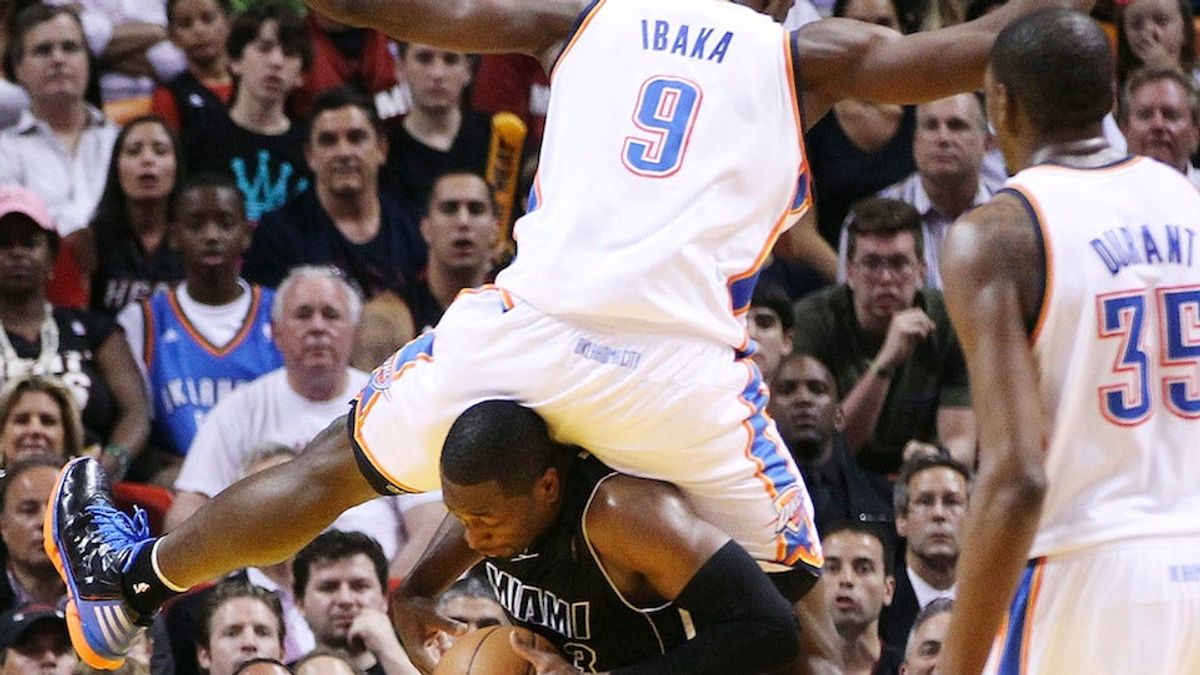
Tonight's tipoff between the Oklahoma City Thunder and the Miami Heat is a milestone for American pro sports. For the first time, a major championship is pitting two teams whose names are mass nouns rather than ordinary plurals. The naming fad that gave us the Heat and the Orlando Magic at the end of the '80s has at last, thanks to the late adopters in Oklahoma City, fully conquered the NBA's showcase event.
So besides torturing Seattle and Cleveland fans, the Heat-Thunder showdown is torturing the language. The reason the mass-noun names sounded trendy and different is that they don't fit the normal grammatical tradition of American sports. The Bulls were better than the Sonics. The Spurs were better than the Nets. But is the Heat going to beat the Thunder? Or ARE the Thunder going to beat the Heat?
British English just treats all team names—mass nouns, collective nouns, singular nouns—as plurals: Arsenal are the superior side in this one. In American English, this makes you sound like a poncy rock critic: Pavement are the most important band since Wire.
But strict formal verb agreement gets into trouble, too: The Thunder is relying on its fresh legs? When the Jazz or the Magic made the finals against plural-named foes, it was still possible to write around the problems. Now, we're stuck. Here's a passage from the New York Times:
"Well, we never thought that we were supposed to wait our turn," said Durant, to the question of whether the Thunder were ready to book a place in the finals opposite the winner of the East's Boston-Miami series. "We always wanted to go and take everything."
But until the ball was thrown up, they couldn't possibly know how they would respond to the magnitude of the night. Coach Scott Brooks said he had never allowed the Thunder to use their youth as an excuse, a means of rationalizing defeat with the understanding there would be many more chances to come.
He insisted this game had been approached like any other, with the caveat that the Thunder was typically "an excitable group" under any conditions.
So there's "the Thunder were ready" (possibly influenced by the "whether" in the sentence), and the Thunder using "their youth," and then "the Thunder was." The Times website also offers " Thunder Helps OKC Heal From 1995 Explosion" (on a Reuters story) and " Heat Beat Celtics to Reach NBA Final."
Sports Illustrated seems to be going with the full plural: "the Heat have"; "the Thunder are." The Daily Oklahoman and the Miami Herald each use the singular.
So what's it going to be? HEAT OUTLAST THUNDER? THUNDER BREAKS HEAT? I asked John McIntyre, the former Baltimore Sun copy chief and current language blogger, if he had any insight into handling the Finals matchup.
Though I'm not qualified to hold forth on sports, I think you're right that a plural verb with a singular team name will look odd, or at least British, to American readers. "Heat outlasts Thunder" is going to look more natural. Since a case can be made for either usage, and style rules are inherently arbitrary anyhow, I think you should pick the choice with which you are most comfortable and follow it consistently.
Settled. We'll call Miami "LeBron James" and Oklahoma City "the Sonics."
Photo via AP.
Related

Ole Miss' CFP Hopes Take a Hit After Loss to Texas

Why Tyrese Maxey Is the Key to the Sixers’ Success

Seahawks vs. Chiefs Betting Pick: SNF Best Bets

Why Did Netflix Mike Tyson Docuseries Omit His Last Fight?
- Rays vs. Brewers Prediction: Why Tampa Bay Can Steal Game 2 on the Road
- UFC 333 Betting Lines Are Tightening Across a Wide-Open Fight Card
- UFC 333 Betting Splits: Where the Sharp Money Is Landing This Weekend
- NBA Best Bets Today: Pacers, Grizzlies and Trail Blazers Picks
- College Football Week 8 Best Betting Picks, Predictions
- World Series Game 1 Predictions: Rays vs. Brewers Picks and Best Bets
- UFC 333 Predictions: Best Bets for Volkov, Keita and Murzakanov