How Paralympians Cheat By Injuring Themselves

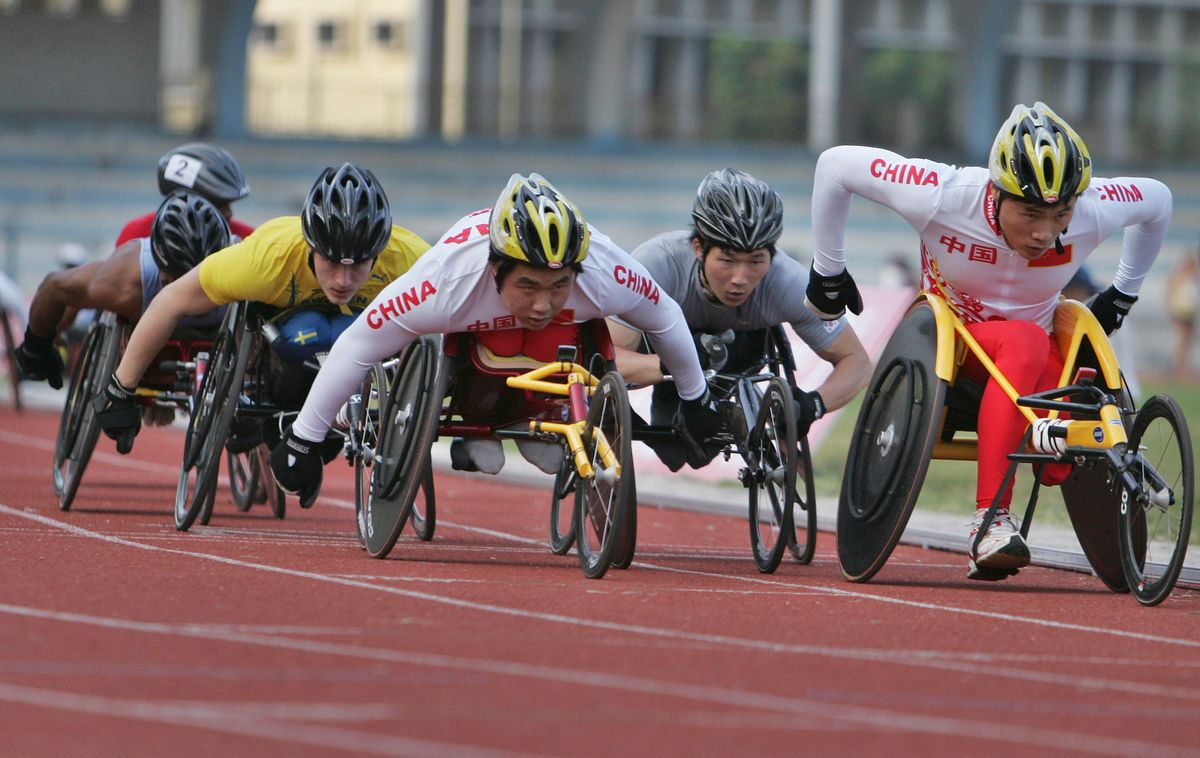
The Paralympics are legitimately inspiring— check this promo and you'll be ready to run through a wall—but they are, at the end of the day, athletes. For all the feel-good stories, they're just looking to win. And that means for the Paralympic Games what it's meant for every competition since the dawn of time: cheating.
Paralympians dope too; that's no surprise. But there's another tactic, called "boosting," that's not available to able-bodied athletes. A BBC report brings attention to the practice that takes advantage of the athlete's own sympathetic nervous system to gain an edge.
Here's how it works. In "normal" folks' bodies, athletic activity naturally raised blood pressure and heart rate. We take this for granted—when we run, our hearts beat faster. That's the body's way of shunting more oxygen to active muscles—an all-natural performance enhancer, so to speak. But for some Paralympians with spinal injuries, their bodies don't react this way. The messages from the muscles to the brain, telling it to turn up the juice, don't get through.
Enter boosting. A paraplegic may not be able to feel or control their bodies below the waist, but the brain can still sense and act upon trauma. By causing pain to a lower extremity, the athletes activate alternate pathways to the brain, giving themselves boosts in blood pressure and heart rate they wouldn't otherwise be able to tap into. From a 2009 WADA report:
Athletes with spinal cord injuries can voluntarily induce autonomic dysreflexia prior to or during the event in order to enhance their performance. The nociceptive stimuli commonly used to induce this reflex are: (i) over-distending the bladder, (ii) sitting on sharp objects, and (iii) use of tight leg straps. This procedure, which is commonly referred to as ‘boosting', is usually done one or two hours before the actual event for the reflex to be fully effective. It is postulated that the elevated blood pressure in the dysreflexic condition enhances the cardiovascular and hormonal responses, thereby improving performance.
What are some self-inflicted injuries athletes have turned to?
• A Canadian climber tells the BBC he's experimented with administering electric shocks to his body, to jumpstart his autonomic nervous system. "I took it a notch further by using an electrical stimulus on my leg," he says, "my toe and even my testicles."
• The same climber also talks about clipping off his catheter, in order to not let his bladder drain. You know how it physically hurts when you really, really need to go to the bathroom? That's pain enough to stimulate the boosting response.
• A British journalists says he's heard of athletes going to far as to break their own toes with a blow from a small hammer.
• Other methods include using uncomfortably tight straps bound around the legs, sitting on a sharp pin, or even sharply twisting their own testicles.
Remember, the athletes can't feel the pain, but their bodies know it's there and reflexively react. How common is it? In a survey of 60 Paralympians at the 2008 Beijing games, 10 of them admitted to boosting.
Paralympic cheating is a thornier issue than doping. Because spinal injuries vary in severity, athletes whose heart rates are naturally raised by exercise compete directly against ones whose don't. This isn't a cyclist doping for an advantage over his competitors—in many cases, a Paralympian boosts just to get to the same baseline as the person in the starting blocks next to them.
It's also dangerous. Autonomic dysreflexia is classified as a medical emergency, with patients usually requiring a drug cocktail to get their bodies under control. It can lead to strokes, seizures, and hemorrhages, as well as shaving those extra hundredths of a second off their times. Boosting has been banned by the International Paralympic Committee since 1994, but it's impossible to test for and nearly impossible to catch.
Paralympic athletes who harm themselves to perform better [BBC]







Brian Flores Is Making Life Miserable for Vikings Opponents

Guardians vs. White Sox Game 4 Bet Picks, Prop Bets

The Yankees’ 17-Year Title Drought Is on Hal Steinbrenner
- Guardians vs. White Sox Game 4 Bet Picks, Prop Bets
- Buccaneers vs. Cowboys Odds, Prediction and Best Bet for TNF
- Milwaukee Brewers vs. San Diego Padres Game 4 Betting Picks
- WNBA Playoff Bet Picks: Aces, Valkyries, Liberty and Dream Predictions
- MLB Playoff Picks for Wednesday: HR Props, ML Picks and More
- Milwaukee Brewers vs. San Diego Padres Game 3 Bet Picks and Predictions
- Dana White’s Contender Series Week 9 Predictions: Picks for Every Fight