Why We Expect Black Football Players To Return From Injury Faster Than White Players

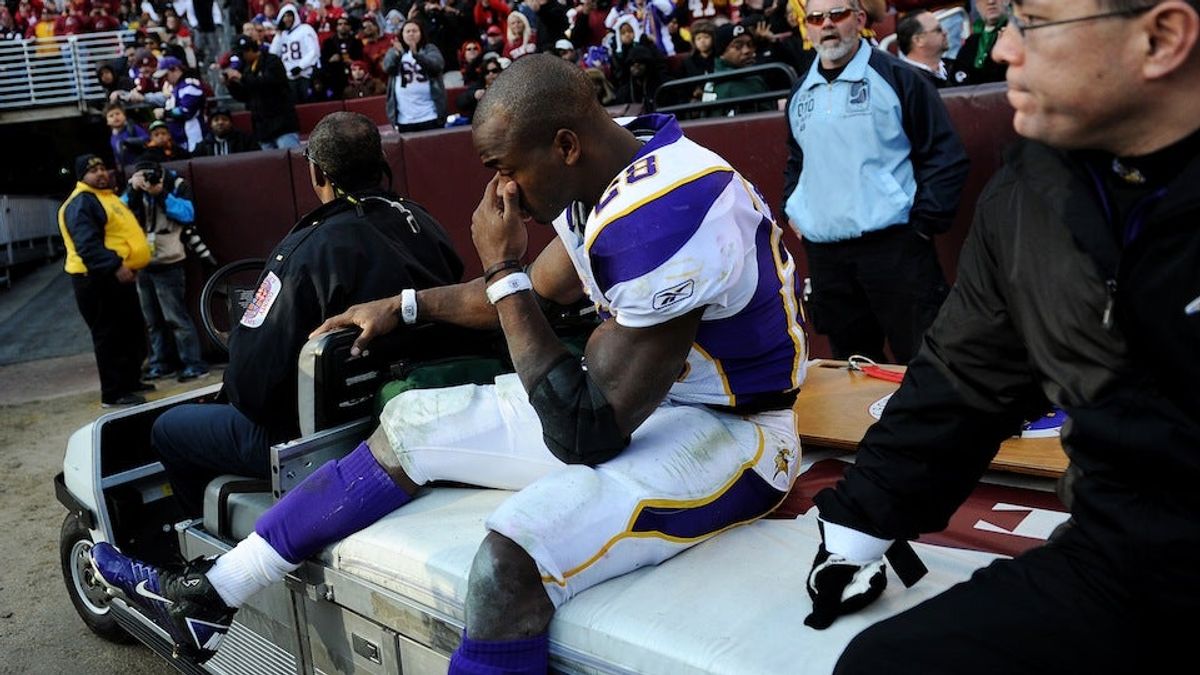
There's an intriguing study published today in the peer-reviewed journal PLOS ONE, called "Racial Bias in Perceptions of Others' Pain." Researchers from the University of Virginia and Northwestern University examined NFL injury reports over two seasons, and noticed something unexpected: black players were expected to return from injury sooner than their white counterparts.
The researchers compiled all official NFL injury reports, filed by the teams, for the 2010 and 2011 seasons. (A full chart of injuries by type can be seen here, and it's interesting enough in its own right. Knees and ankles are far and away the most affected body parts, with lower body injuries making up four of the top five. Head injuries come in 14th, with just 131 instances over two seasons. Things like stingers and back spasms, which would keep the average person in bed and immobile, are almost never listed as valid injuries.)
After controlling for injury type, position, age, and number of years of NFL experience, one variable remained: race. On the injury report scale of "doubtful," "questionable," and "probable," black players were significantly more likely than white players to be predicted to suit up next game. The study doesn't find that they necessarily played more—only that their team expected them to.
Why? That's the question this study attempts to answer. In a series of experiments, researchers showed participants a series of injuries, then asked them to rate how much it would hurt them, on a numerical scale. They were then shown photos of both white and black people, and asked how much the same injuries would hurt these "targets." These experiments, conducted with laymen, nursing students, and registered nurses, of all races, showed consistently that participants believed black people feel quantitatively less pain than white people.
(Actual pain measurements show this isn't the case, obviously.)
Through further experiments, researchers found that the bias wasn't rooted in race alone, but rather perceptions of social status tied in with skin color. "Participants assumed that the Black target was less privileged and faced more hardship than the White target," the study's authors write, and that harder life presumably shields them from things like physical pain.
Like any study, there are nits to be picked. NFL injury reports are notoriously used as gamesmanship, and there are a host of possible factors to be taken into account. But one anomaly points suggests that the researchers are on to something here. Only two types of injuries showed no correlation between a player's race and his next-game status: Concussions and unspecified "illnesses." These are the two conditions that have nothing to do with pain tolerance.
Racial Bias in Perceptions of Others' Pain [PLOS ONE]







- Seattle Seahawks vs. Denver Broncos TNF Betting Pick
- Brewers vs. Dodgers Game 3 Predictions, Picks and Odds
- Dana White's Contender Series Week 10 Predictions and Picks
- Guardians vs. Rays Game 2 Prediction: Picks, Odds and Best Bets
- Bills vs. Rams Odds, Prediction and Best Bet for MNF
- Three Longshot NFL Futures Worth Betting in Week 5
- Falcons vs. Ravens Odds, Prediction and Best Bet for Sunday Night Football