The Big Ten Is On The Move: Updating Our Conference Realignment Maps!

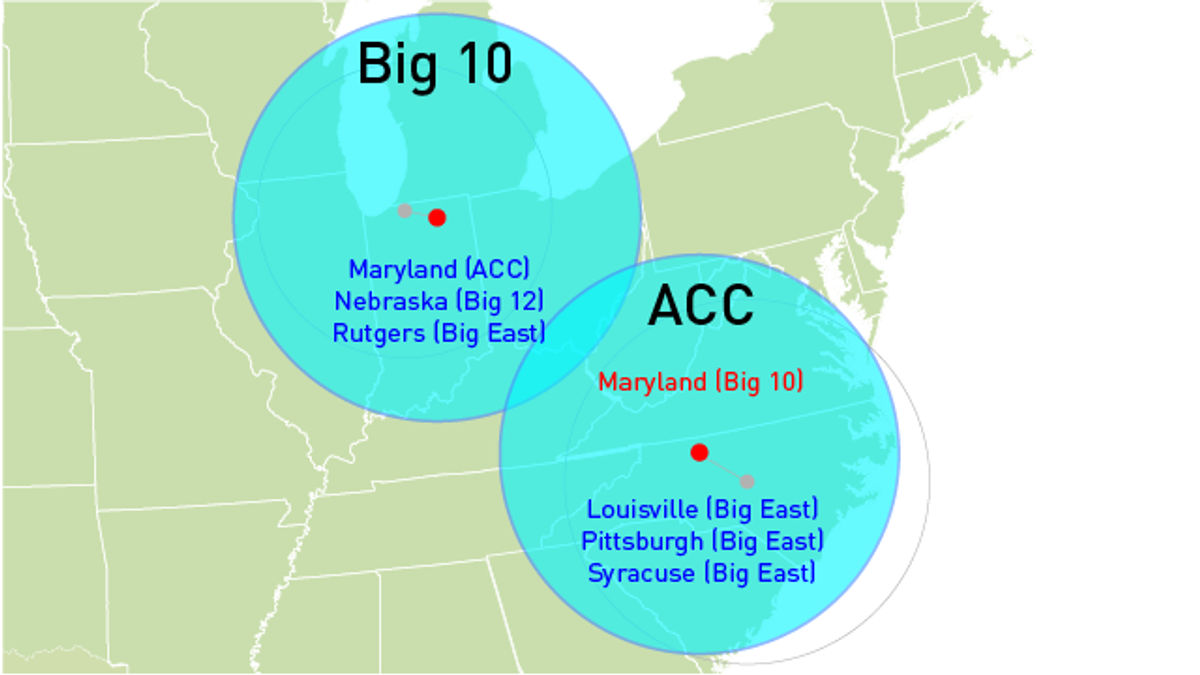
When we last checked in a month ago, it seemed the dust was finally settling after a period of bizarre college football reafuckinglignment. Pretty much everyone had made major moves except the Big Ten, a distinctly Midwestern conference that seemed happy to pretty much stay put.
Well, so much for staying put. On November 19th, the Big Ten announced it was adding Maryland, and it picked up Rutgers the next day. This led to a (brief) chain reaction in which the Big East grabbed Tulane and East Carolina, followed by the ACC snagging Louisville just this morning.
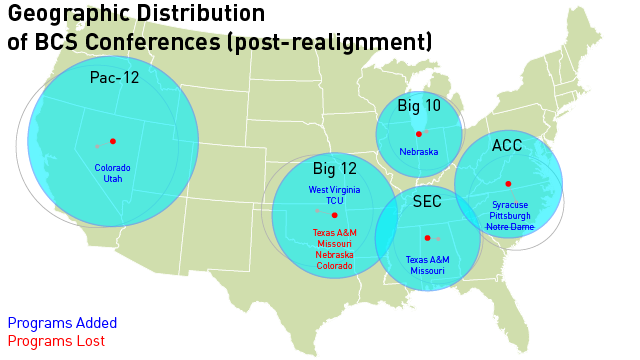
Let's take a look at what this all means, geographically. As a reminder, in the maps below the red dot represents the geographic midpoint of the conference's programs, and the blue circle represents the average distance of the schools from this midpoint. This means that the circle is an approximation of the conference's "compactness," not that every program will actually fall within the radius.
Here's where these three conferences were as of 2010:
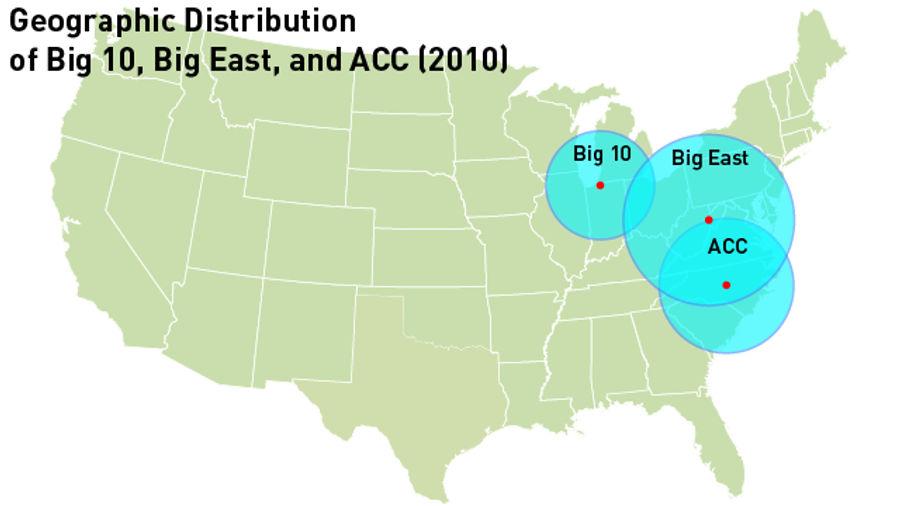
The Big Ten was the most compact by a fair amount, even when compared to the SEC, Big 12, and Pac-12. The Big East, which had added South Florida in 2005, was a bit more spread out, but definitely still rooted in the Northeast.
After these recent developments, here's how the ACC and the Big Ten will look by 2015:
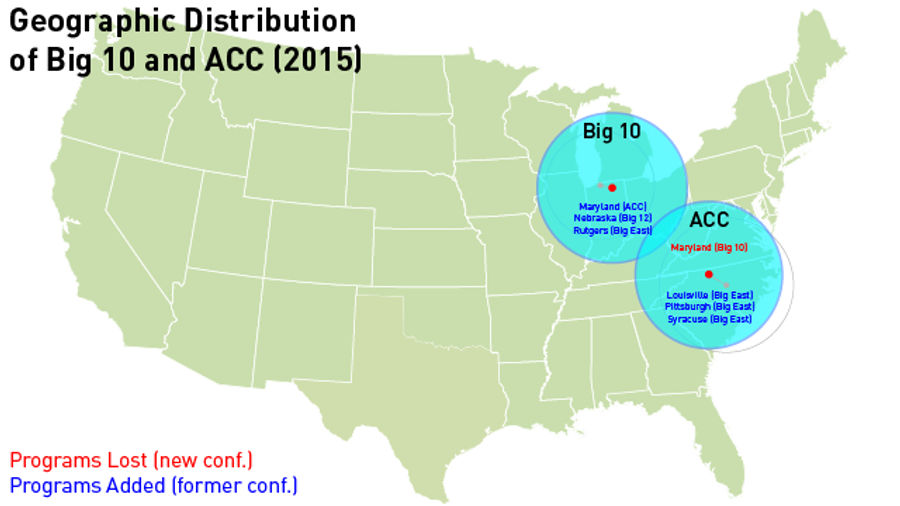
Much like the Big 12 and the SEC, these conferences are moving right at each other, competing for valuable television markets in the Midwest and Mid-Atlantic. The ACC shifted 63 miles to the northwest, while the Big Ten shifted 46 miles to the southeast and expanded by 38 percent. By 2015, the ACC, SEC, and Big Ten will almost be identically compact, with an average "distance from center" of 278, 279, and 283 miles respectively. As a bonus, the new geographic midpoint of the Big Ten will be in a very pretty spot.
Now let's take a look at the continued decay of the Big "East":
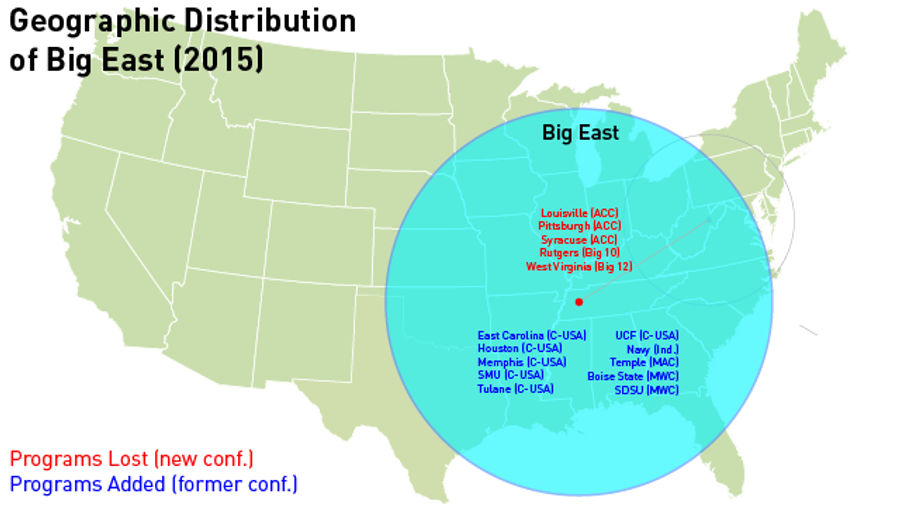
While doing research for this map, I stumbled across this depressing article from February. Key takeaway No. 1: The commissioner of Conference USA was pretty sure that the Big East was going to stop pillaging them after Memphis (having already snagged UCF, SMU, and Houston). Key takeaway No. 2: Memphis's move to the Big East was in large part due to Rick Pitino, who wanted to hold onto college basketball competitiveness.
The Big East just grabbed two more C-USA teams. By 2015, 62 percent of Big East football schools will be schools that were in C-USA in 2005, and that percentage could go even higher if the recently added Western programs jump ship and rejoin the MWC. Rick Pitino has defected to the basketball-rich ACC. The geographic center of the Big "East" is now in Milan, Tenn.
Stayed tuned for a new update in early 2013, when the Big East is expected to add Hawaii, University of Alaska-Fairbanks, and University of Guam.
Related










- World Series Game 1 Predictions: Rays vs. Brewers Picks and Best Bets
- UFC 333 Predictions: Best Bets for Volkov, Keita and Murzakanov
- UFC 333 Underdog Pick: Why Dominick Reyes Is Worth a Bet
- World Series Predictions: 3 Best Bets for Brewers vs. Rays
- Bears vs. Patriots Thursday Night Football Week 7 Betting Picks
- Guardians vs. Rays ALCS Game 6 Best Betting Picks
- Commanders vs. 49ers Picks: Best Bet for Monday Night Football