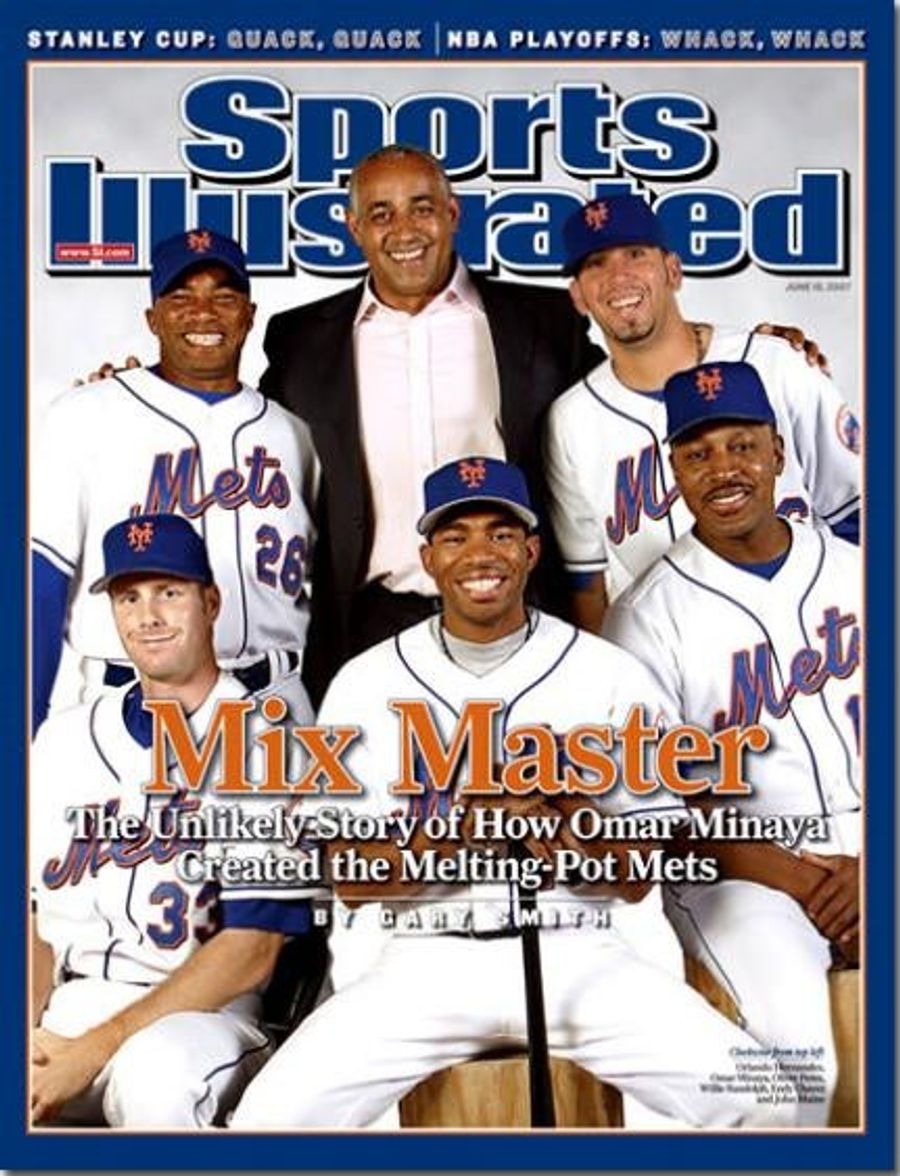
<![CDATA[Deadspin: from the si vault]]> http://tags.deadspin.com/assets/base/img/thumbs140x140/deadspin.com.png <![CDATA[Deadspin: from the si vault]]> http://deadspin.com/tag/fromthesivault http://deadspin.com/tag/fromthesivault <![CDATA[Omar Minaya: Mix Master No More]]> It was just two years ago that Omar Minaya was a Sports Illustrated cover boy and subject of a fawning profile in which he was referred to simply as O. As in: Oh my, how things have changed.

Start with the cover, a portrait of the so-called Melting-Pot Mets, commandeered by Omar Teodoro Antonio Minaya y Sanchez. Or, O. Joining him on newsstands everywhere were Orlando Hernandez, Endy Chavez, John Maine, Oliver Perez and Willie Randolph. Three have since left the Mets, and the besuited gentleman in the middle may be next on the outbound train. "He's this close to being out of baseball," Jeff Wilpon told Newsday's Wallace Mathews today today.

After all, Tony Bernazard — the yin to Minaya's yang — was recently the instigator in a Binghamton brawl, but with his reaction, Minaya managed to make himself the villain. ("Too wide-eyed, too trusting?" Gary Smith wrote of Minaya. "Well, here's his narrow eyes, Tony Bernazard, the vice president of player development from Puerto Rico who squinted down O two years ago when he wanted to bring Sosa to the Mets.")

Most of Smith's flattering profile of Minaya analyzes his childhood and inability to snag a G.M. job. There are times, however, when Smith delves into Minaya's psyche through the lens of miniscule anecdotes. Back in 2007, when Minaya walked around with a hat that simply read RELAX, it seemed quaint and adorable and, hey, look, the oh-so-metropolitan Mets are winning and it's all because O is as inclusive as a circle, round and smooth, like a ring of trust. In hindsight, those same details seem strange. After Monday, they're eerily foreboding.

The tide had shifted. Teams were hiring Ivy League grads to be their G.M.'s, lawyers and businessmen and statmongers who'd never hit fungoes to a flock of skinny 16-year-olds and picked out the weed that would bloom five years later. O's frustration grew. "Look, if you want paperwork, I'm not your guy," he'd tell his inquisitors. "I see the job in bigger terms. Paperwork, that's false hustle. It takes away creativity. People who are into paperwork are into covering their asses, so if things go wrong they can point to all the work they did. They're thinking more about failure than success. The more paperwork the opposition does, the better my chances are. Know what I'm sayin'?"

O awoke at four each morning, arrived at five, worked till 10 at night. Lunch? Wolf down a salad from the players' spread. Dinner? Order in sandwiches. The phones sizzled, O looking for help, help looking for O. The office buzzed like mayflies with 24 hours to live. But O trusted tomorrow. The trust spread. "He energized everyone," says his farm director, Adam Wogan. "You wanted to do it for Omar. You'd run through a wall for him."

O twitched and turned down the job. It took one more year of misery for Mets owner Fred Wilpon—his team's clubhouse divided, its credibility with fans and free agents shredded—to call back. "We've become irrelevant in New York City," Wilpon told O in September 2004. "You've got to come home."

"What's the job?" asked O, wary.

"Everything," said Wilpon. "I just want Omar to be Omar."

O's heart raced. "Let's talk as soon as the season's over," he said.

Of course, this is all just another example of that pesky SI cover jinx. No one ever said it's effective immediately.

The Story Of O [Sports Illustrated]
Mets haven't fired Minaya? [Newsday]
EARLIER: Minaya Sort Of Apologizes
EARLIER: Mets Season Descends Further Into Farce

]]>
http://deadspin.com/index.php?op=postcommentfeed&postId=5325592&view=rss&microfeed=true
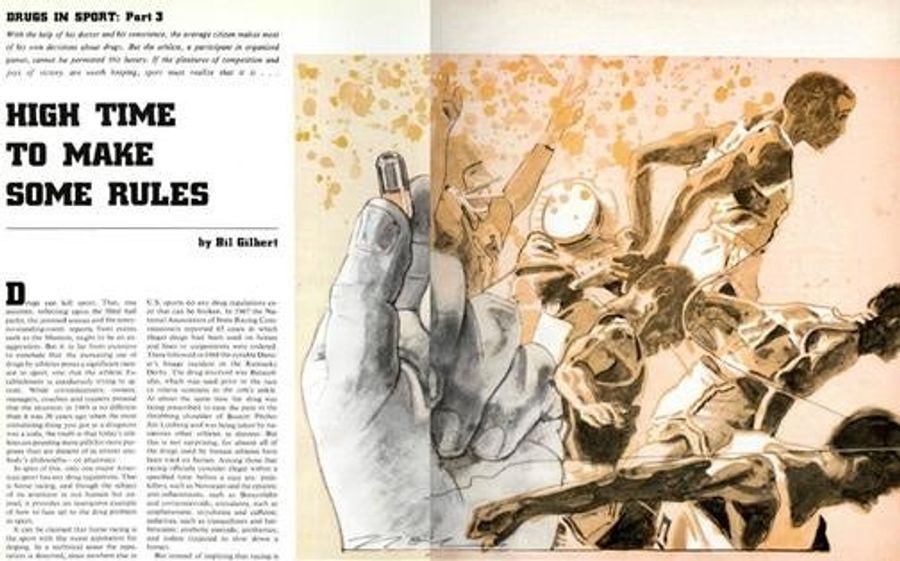
<![CDATA[How Leagues Learned To Stop Loving And Worry About Steroids]]> The peril of steroids, like the Internet, wasn't apparent 40 years ago when Sports Illustrated published a prescient story about PEDs. In retrospect now, with steroids as dangerous as the Internet is real, professional sports appear more oblivious than ever.

Back in the 1960s, there were already rumblings about how steroids could fundamentally impact sports. Horse racing banned doping, but other major sports ignored the growing epidemic; steroids were the least of anyone's drug concerns. The sporting folks of 1969 pretended "the most stimulating thing you got at a drugstore was a soda," but the truth was that athletes were "popping pills for more purposes than are dreamt in almost anybody's philosophy — or pharmacy." Remember: 1969, not 1998.

The sports magazine of record, therefore, refused to let sporting organizations spew their peace and love and happiness drivel. What followed was Bil Gilbert's 4,500-word lesson in persuasion. He didn't have to depict the league owners in tie-dye. They did that without any artificial help.

• Warren Giles, president of the National Baseball League, says that there is nothing in the rules about prohibition of drug use. "Nothing has ever come to my attention that would require a special ruling. It never has come up, and I don't think it ever will." (He would do well to check the locker rooms of a few of his teams before a game and watch who swallows what.)

• "The American League has no rules regarding pep pills, painkillers, etc. Baseball players don't use those types of things," says the league's executive assistant, Bob Holbrook.

• Professional football: "We have rules on gambling, etc., but none on medical matters," says NFL-AFL Publicity Director Don Weiss. "These are left to the club physicians and the club trainers in both leagues."

• Says the American Basketball Association: "A player should not do anything which is detrimental to the best interests of the club, of the ABA or of pro sports. He must always remain in good condition."

• "We have no written rules on the subject of drugs," says Haskell Cohen, for 17 years the National Basketball Association publicity director. "The league does not interfere with individual club trainers."

• National Hockey League officials say they do not recall ever issuing any statement or laying down rules about the use of drugs. Ken McKenzie-now publisher of The Hockey News and longtime NHL publicity director-says, "I can honestly say that in my 17 years with the NHL, I never heard any talk about drugs."

• "Responding to your request for verbatim rules and policies of the NCAA and NAIA on the use of pep pills, weight builders, painkillers, etc., neither organization has any formal rules or stated policy on this matter. The NCAA says it relies on trainers and team physicians to protect the welfare of its athletes. The NAIA says no need has arisen for formal rules or policy statements," reports a Kansas City correspondent.

• Howard Grubbs, executive secretary of the Southwest Conference: "We don't have any regulations on drugs, alcoholic beverages or anything. That's up to the individual schools."

• William E. (Pinky) Newell, trainer at Purdue University and for 16 years the executive secretary of the National Athletic Trainers Association: "All trainers are very much opposed to the use of drugs, but as an association no policies have been made or initiated or directed to anyone at all because this is a medical problem."

• From the minutes of the May 20, 1967 meeting of the team physicians of the Pacific Eight Conference: "We recommend that the conference adopt a policy endorsing the American Medical Association Committee on the Medical Aspects of Sports" suggestions on drug usage in athletics, particularly with reference to banning the use of pep pills, anabolic steroids and any other artificial aids which hopefully and supposedly improve performance." The resolution was not acted upon.

• A letter dated Dec. 1, 1967 from Edwin J. Holman, director of the AMA's Department of Medical Ethics to a San Francisco physician: "I have your letter of November 29 asking if it is legal and ethical for you 'to prescribe moderate doses of anabolic agents to weight lifters for two or three weeks prior to competition, followed by intervals of three months or more without these agents.' No categorical answer can be made to your inquiry inasmuch as this is basically a medical question. The physician must exercise sound medical judgment in prescribing any drug. Sound medical judgment is not determined by the courts, but rather by fellow physicians...."

Or, if punchy prose is more of your thing:

Such remarks made about almost any sport are at the very least nonsense, and at worst deliberate lies.

Far out, dude.

High Time To Make Some Rules [SI Vault (Special H/T to Reader Michael)]

]]>
http://deadspin.com/index.php?op=postcommentfeed&postId=5310170&view=rss&microfeed=true