<![CDATA[Deadspin: jeff pearlman]]> http://tags.deadspin.com/assets/base/img/thumbs140x140/deadspin.com.png <![CDATA[Deadspin: jeff pearlman]]> http://deadspin.com/tag/jeffpearlman http://deadspin.com/tag/jeffpearlman <![CDATA[The Last Days Of Sal Fasano]]> SI Writer Jeff Pearlman goes back to the Fasano well for the most depressing piece yet. Sal's now 38, and struggling: "You can't help but question your sanity. You're driven by one thing — hope."[SI]

]]>
http://deadspin.com/index.php?op=postcommentfeed&postId=5370467&view=rss&microfeed=true
<![CDATA[Report: Unnamed Amorous Ballplayer Plays For Team That Appropriately Doesn't Know How To Score]]> Onetime declared virgin Jeff Pearlman knows which baseball player was cold mackin' on an intern in Houston recently, but he's not telling. All he'll say is that the ballplayer was — are you ready for this? — a Washington National.

Yesterday, we brought you the story of an amorous married ballplayer who gave his digits to an unnamed female intern from a media outlet. This was all a very serious business, according to the Houston Chronicle's very serious Jose de Jesus Ortiz, because, as you know, married athletes who hand out their phone numbers to single ladies inevitably wind up with two bullets in their head. (Seriously. That's what he was implying. The headline: "McNair's death not a lesson to one idiot." Which is simply insane.)

Pearlman took his Rolodex for a spin and got a baseball source to spill. He writes:

Jesus was classy enough not to "out" the intern or the ballplayer-and I'll follow his lead. But, as with many things in life, there is a disconcerting aftermath. According to a baseball source, the ballplayer was a member of the Washington Nationals. Furthermore, because of the incident, the Nationals are now considering a permanent, all-encompassing ban of interns from the team's clubhouse.

Well, that last bit will never happen; if it did, among other things, MLB.com would never file another story from Nationals Park. And so, awesomely, the hapless Nationals once again find themselves at the heart of something stupid in baseball. They can't do anything right. Spell. Pitch. Hit. Score. Score runs. These are men who, as the saying goes, could fuck up a wet dream.

Photoshop by Moe Sussman

Foolish intern, meet slime ballplayer [JeffPearlman.com]
EARLIER: Oddly Enough, Married Athletes Are Still Foolin' Around

]]>
http://deadspin.com/index.php?op=postcommentfeed&postId=5313791&view=rss&microfeed=true
<![CDATA[The Sad, Hilarious Tale Of Elvis Grbac, 1998's "Sexiest Athlete Alive"]]> This is an epically comical story courtesy of SI's Jeff Pearlman, that includes the following absurd characters: Rich Gannon, Elvis Grbac, the Kansas City Chiefs, and a dim-witted People magazine photographer. Prepare to feel life-long sympathy for Grbac.

Pearlman's yarn:

One of my favorite all-time stories is about Elvis Grbac (left), Rich Gannon (right) and People Magazine's Sexiest Men issue from 1998. It is both outlandish and 100-percent true.

Back in the day I knew many People staffers, and they were all cool, fun, intelligent-and woefully ignorant about sports. Every year, in planning the Sexiest Men issue, People's editors would ask a bunch of us at Sports Illustrated for suggestions and insight. In 1998, for a reason I'll never understand, they decided not to seek out help.

The magazine chose Rich Gannon as its Sexiest Athlete. At the time, Gannon was a member of the Kansas City Chiefs. Still a couple of seasons removed from his golden tenure with the Raiders, Gannon was 33, handsome and likable. In other words, a solid choice. Yet People, being People, simply informed the photographer assigned to the piece that the Sexiest Athlete was the Chiefs' quarterback. Hence, he took pictures of the Chiefs' quarterback. Well, one of the Chiefs' quarterbacks: Elvis Grbac.

Yup.

The pictures made their way back to the New York offices, and editors were dumbfounded. This was their Sexiest Athlete? Yet upon learning the truth, no one with the magazine had the heart (guts?) to tell Grbac that an unfathomable mistake had been made. As a result, Elvis Grbac reigns as People's 1998 Sexiest Athlete.

The article's final line says it all: "His personality makes him sexy."

Amen.

Oof. Maybe this should be added to the "Elvis Grbac" definition on Urban Dictionary.

Elvis Grbac: Not As Sexy As Originally Indicated [Jeff Pearlman]

]]>
http://deadspin.com/index.php?op=postcommentfeed&postId=5302475&view=rss&microfeed=true
<![CDATA[Jeff Pearlman Apologizes For Becoming Mike Lupica When He Ripped Mike Lupica]]> " Maybe, in the act of jabbing Mike Lupica, I've actually become Mike Lupica. If so, it's not the way I want to live. I took the Lupica post down."[JeffPearlman/GraneyandthePig]

]]>
http://deadspin.com/index.php?op=postcommentfeed&postId=5292363&view=rss&microfeed=true
<![CDATA[A Portrait Of The Columnist As A Young Virgin]]> Long before John Rocker offered him his thoughts on New York City transit, SI.com columnist Jeff Pearlman was a rosy-cheeked collegian who was more than happy to share his sexual habits with the world.

And by "world" I mean "local news," and by "sexual habits" I mean "proud virginity."

The video is helpfully and wincingly annotated by Pearlman his ownself. (Pearlman, in addition to writing the profile that briefly turned John Rocker into America's most famous bigot, is the author of The Rocket That Fell To Earth, which we excerpted here and which he'll be discussing tonight here.) For those of you at work and sadly unable to watch ancient teevee trend stories about the sexual predilections of American youth, here is Pearlman's money quote:

I see, maybe, being editor of a college newspaper, or being really good at something, or being a good citizen, or something like that, as a real sign of manhood. I don't see being able to whip out your penis, heh heh, and do the nasty thing or whatever you wanna call it as a sign of manhood. That's not what I see it as. I consider myself a man just as much as anybody.

It's an irony of history that this abstemious young lad went on to write the definitive account of football's greatest collection of hedonists and not, say, a biography of A.C. Green.

The most embarrassing segment of my life … [JeffPearlman.com]

]]>
http://deadspin.com/index.php?op=postcommentfeed&postId=5278807&view=rss&microfeed=true
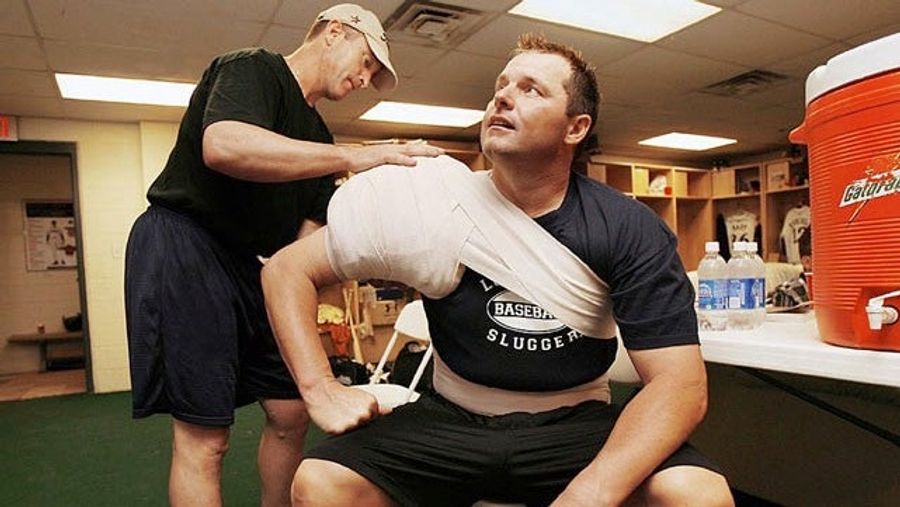
<![CDATA[Book Excerpts That Don't Suck: "The Rocket That Fell To Earth"]]> Jeff Pearlman's "The Rocket That Fell To Earth" comes out today. It's an unflinching look at how Roger Clemens became one of the most dominating pitchers before and after his alleged steroid use.

The following excerpt talks about Roger's former sister-in-law, Kathy Huston Clemens, who was killed in a drug-related shooting incident at her home in 1999. Even though they were only bonded by Clemens' drug-addicted brother Randy, her former husband, Kathy was one of the most influential people in Roger's life growing up.

This is when the happiness is supposed to begin.

Roger Clemens was, at long last, a world champion. On October 29, 1999, he rode in the Yankees' confetti­ coated victory parade down Manhattan's Canyon of Heroes. He looked up at the tall buildings that lined Broadway and marveled at his good fortune. He was fitted for a three­ carat diamond ring, featuring a blue stone shaped in the interlocking NY symbol in the middle and a 14­ carat white gold NY covered with round diamonds on top. He was lauded for his "gutsy" performance in game four of the World Series, when he had finally pitched like the Rocket of old.

Clemens reported to spring training in the best shape of his career, aided by Brian McNamee, whom the Yankees had hired as an assistant strength and conditioning coach. He pitched relatively well to open the season, helping the Yankees jump out to a 22­12 start. He had his trainer, he had his fastball and he had his ring.

And, then, silence.

The phone call came on May 18, 2000. The words hit Roger Clemens hard, like one of his very own 98­ mph fastballs to the head.

"Roger, Kathy has been killed."

"Kathy" was Katherine Huston Clemens, Roger's former sister­-in­-law and the woman largely responsible for turning the baseball player from an awkward, uncomfortable boy into a confident, successful man. When Roger had moved from Ohio to Houston as a teenager to live with Kathy and Randy, his older brother and childhood hero, she had been the one who made certain he did his homework; who talked to him about everything, from girls to college to careers; who saw him as more than a vehicle to fortune and fame.

"She loved Roger," says Carolyn Gray, Kathy's sister. "And Roger really loved her."

The once­ upon­ a­ time Vandalia­ Butler High School prom king and queen had been divorced for more than a decade, yet Kathy was still tormented by Randy and his alleged drug abuse. He often asked her for money and had been in and out of rehab oh, how many times? Two? Three? "It hurt Kathy so bad," says Gray. "You could have no idea." A popular third­ grade teacher at Holmsley Elementary School in Houston, "Mrs. Clemens" was known for making up stories about the cursive letters and arriving at school with rollers in her hair.

In short, Kathy wanted nothing to do with the world her ex­husband had subjected the family to. Yes, she was once married to a junkie. But why should that ruin her life? Why did it have to haunt her all these years later? Most troubling was what Randy's addiction had done to their two children, Marcus and Jessica. In particular, it was her 19­ year­ old son who warranted the concern. Coated in tattoos and piercings, Marcus- like Randy- turned to dealing and using drugs in his late teenage years. Once, Marcus had come to visit his uncle in Houston, only to be stopped at the front door. "Son, you can come in," Roger said. "But first you've gotta take all those metal things out of your body. I don't want my kids seeing you looking like that."

On the night of May 17, Marcus Clemens, now 19, was sick in bed with the flu, and his mother had stayed home at their apartment to care for him. There was a knock on the back door. Kathy looked through the peephole and, not recognizing the men standing there, returned upstairs to her boy. Marcus asked his mother for some Sprite, and as Kathy walked back down to the kitchen, she heard another knock. This time, for a reason that has never been determined, she opened the door.

Five men, ranging in age from 18 to 26, barged into the apartment, demanding to see Marcus. They had come to steal what they were certain would be a large amount of money and Marcus' stash of Ecstacy. Her son still upstairs, Kathy ordered the intruders to leave.

Justin Gore, a 20­ year­ old wayward drug dealer, whipped out a gun and pointed it at the woman who had once been named Houston's Teacher of the Year. Kathy let out a terrified scream.

Then Gore squeezed the trigger.

"I jumped up as fast as I could and went to the top of the stairs," Marcus later said. "There were two more shots, and I saw her fall." As the intruders ran off, Marcus dashed downstairs, dragging his mother's body into the living room. She had been hit in the head, neck and chest and wasn't breathing. Blood streamed across the floor. The ambulance came within minutes but nothing could be done. Kathy died en route by Life Flight to Memorial Hermann Hospital.

She was 46 years old.

At approximately the same time Kathy's life was ending, Roger Cle­mens' night was thriving. As she was staring down a gunman, he was facing the Chicago White Sox at Yankee Stadium. As she was being pronounced dead, he was being pronounced alive, having won his fourth game with a beautiful seven­ inning, two­ run, nine­ strikeout masterpiece. As Marcus was describing to Houston police what had transpired in his apartment, Clemens was describing to the Times, the News and the Post what had transpired on his home field. "When we're right as a team swinging the bats, there are not too many holes in our lineup," he said. "That was evident tonight."

In hindsight, it all seemed so . . . vapid. Bernie Williams hit two home runs for New York, Chuck Knoblauch tripled, Jorge Posada stole a base- blah, blah, blah. Who the hell cared? Certainly not Clemens, who was shocked, dismayed, heartbroken by the news.

And furious.

Not merely at the killers, whom police described as transients who "float from one rave party to another rave party." No, he was furious with his older brother, Randy. When Roger learned the details of the case- the drugs, the violence- he blamed Randy. His brother was the one who had made drugs a part of the family's life. Had Randy died in a drug deal gone bad, well, Roger would have been devastated but not surprised. His life had been heading in that direction for many years.

But this was Kathy.

The next day, Roger spoke with Carolyn Gray and her husband, John, who lived in Vandalia, Ohio, near his boyhood home. "Listen, you don't worry about paying for anything involving the funeral or burial," Roger told them. "If it hadn't been for Kathy, I have no idea where I'd be today."

"No," said Carolyn, "she was my sister, and I should . . ."

"Yes," Roger said firmly. "I'm going to handle this. She was your sister, but she was like a mother to me. You have so much to worry about. Let me worry about this."

"As far as I'm concerned," says Carolyn, "Roger can do no wrong in my eyes. I'll always remember the way he was at that time. Always."

On the morning of the viewing, Kathy's family was asked to come to Holmsley Elementary School. Upon arriving, Carolyn began to sob. The sidewalks were coated with farewell messages written in chalk. A banner stretched across a hallway read WE LOVE YOU MRS. CLEMENS and was signed by every student. Carolyn was handed an envelope filled with letters from Kathy's third­ graders.

Dear Mrs. Clemens:
I'm very, very sad that you have a new address. But one good thing is I know where it is- heaven. I'm very, very sorry that your wonderful and beautiful life had to end in pain. I guess God couldn't wait to get you in his arms. Maybe he wants to start a school, up in heaven for the younger angels, and he knew you would be the best. Though I can never see you in this lifetime, I can always have you in my hart [sic] and mind. There are also great memories I wouldn't change a bit. I miss you very much.

Love,
Leslie
PS: See you in heaven.

The funeral was held in the chapel at Waltrip Funeral Directors in Houston. An overflowing crowd of family members, friends and coworkers bid farewell to a woman described by her sister as "loving, adventurous, daring, full of life."

Outside the building, a handful of police officers lined the front steps. They were there at the behest of Roger, with one primary directive: If you see Randy Clemens, do not allow him inside.

Somehow, New York's rapacious press corps missed the news about Kathy Huston Clemens. Not a single article appeared in the local newspapers. Clemens kept the information mostly to himself, confiding only in manager Joe Torre and a handful of teammates when he left for the funeral.

As far as Roger was concerned, the relationship with his brother was irreparably harmed. Though it was Kathy who had passed, Randy Clemens- the man largely responsible for creating the Rocket- was dead to him, too.

]]>
http://deadspin.com/index.php?op=postcommentfeed&postId=5182034&view=rss&microfeed=true
<![CDATA[The Rocket That Fell To Earth And Landed On Top Of Mike Piazza]]> Jeff Pearlman's "The Rocket That Fell To Earth" extinguishes the leftover burning embers of Roger Clemens' baseball dignity in one big 320-page stomp. But Mike Piazza won't be pleased with this book either.

Murray Chass was ridiculed for bringing up Piazza's back acne in a cranky blog post published earlier this month. Today, Chass uses Pearlman's book to get all me-equals-not-crazy on those who criticized his post.

I hope the same readers who sent e-mail messages to this site harshly - in some cases viciously - criticizing me for the Piazza column I wrote earlier this month will read those pages.

Face.

The pages of note dissect the long-standing feud between Clemens and Piazza, building up to its broken-bat chucking crescendo in the '00 Subway Series. Pearlman not only manages to out Piazza as a steroid user in the section, but also characterizes him as a timid wimp unwilling to stand up to Clemens. In the book, former Mets outfielder Darryl Hamilton says he was furious at how Piazza reacted after Clemens threw the broken bat at him. "I wanted to know why Mike wasn't going after him. When he was hit in the head I understood because he was shaken up. But in the World Series, why were you confused? This guy threw a bat at you, and you do absolutely nothing? You don't stand up for yourself? You don't defend your manhood? Baseball is a game of pride, and we were all getting on Mike. 'Where's your pride, man? Where's your pride?' "

Well, it's good to know that even though Piazza suffered from horrific back acne due to his steroid use, 'Roid rage' was apparently not a problem for him.

Mike Piazza And Steroids Revisited [Herald de Paris]
The Rocket That Fell To Earth [Amazon]

]]>
http://deadspin.com/index.php?op=postcommentfeed&postId=5180516&view=rss&microfeed=true
<![CDATA[The Real Frauds: Why Did A-Rod's Teammates Even Bother To Show Up?]]> SI writer Jeff Pearlman offers his thoughts about the A-Rod press conference. Specifically, why are his teammates still supporting him?

They sat like lemmings, one alongside the other alongside the other, nodding with Alex Rodriguez's words, showing that-good or bad-he is one of them. That he is a New York Yankee.

And then, I vomited my Honey Nut Cheerios back into the bowl.

Will someone please tell me what, in the name of Steve Balboni, were ARod's teammates doing at today's press conference? Why were they there? Why were they supporting this man and his actions?

You're Derek Jeter. You've presumably played the game cleanly since making your debut 14 years ago. You're known as a stand-up guy and a hard-nosed shortstop who believes in the pure goodness of baseball. Why would you support ARod?

You're Andy Pettitte. You've been down this road before. You claim to detest cheating and how it has corroded the sport. Why would you support ARod?

You're Brian Cashman. You (laughably) claim to never have suspected Rodriguez or Roger Clemens or Jason Giambi or Jose Canseco any of the other juiced Bombers who have graced your roster. Why would you support ARod?

The answer, of course, is simple: Baseball players are dolts.

Admittedly, I am not that bright. I attended the University of Delaware. I am a sports writer. I liked Charles In Charge. But when Jayson Blair and Stephen Glass were outed as the worst kind of journalists (not mere plagiarists or mis-quoters, but inventors of reality), I didn't show up for their farewells in a display of support. I didn't have anyone's back or stick up for a peer. No, I saw the massive damage they did to our profession … and I was royally pissed off.

So, once again, why?

In my 15 years of covering sports, I've heard hundreds of athletes talk of "being a real man" A real man plays hard. A real man shows up on time. A real man admits his mistake. A real man ... blah, blah, blah. Truth be told, being a real man (if one must use such a stupid phrasing) means having guts to go against the uniform and the expected behavior. Of course the Yankees stood behind Rodriguez-because 95 percent of these boobs have never taken a stand in their lives. The foundation of their existences centers around repetition and precision; doing as told and being robotic in response and output. That, more than anything, is why I'd rather my daughter and son become bowling shoe cleaners than pro athletes. I want them to be blessed with conviction and decency, not mindless adherence.

So, New York Yankee players, line up behind a man who cheated; who lied; who shamed the game. Line up behind someone who has shown you and your profession no respect.

At some point, clean ballplayers must take action. No more support for disgraced teammates; no more "We just need to move past this" BS monologues; no more calls for fresh starts and short memories.

No, somebody like Jeter or Johnny Damon or Mark Teixeira needs to make clear that steroids are a disgrace, and those who use are damnations to the game.

It's time to stop supporting Alex Rodriguez-and start supporting baseball.

Jeff Pearlman is a writer for Sports Illustrated, purveyor or JeffPearlman.com and the author of "Boys Will Be Boys."

]]>
http://deadspin.com/index.php?op=postcommentfeed&postId=5155368&view=rss&microfeed=true
<![CDATA[One Day Simmons Will Do One Of These]]> Former ESPN writer Jeff Pearlman lists the things he dislikes about the WWL. [Jeff Pearlman.com]

]]>
http://deadspin.com/index.php?op=postcommentfeed&postId=5146505&view=rss&microfeed=true
<![CDATA[Philly Bluntness]]> So, not to get all sappy, but it would be really great if any of you Philly-based Deadspinners (or those from other parts of the country with kind souls) would take the time to read this piece about freelance journalist Brian Hickey. He's one of the smartest people on the planet, friend to many, a diehard — and surprisingly rational — Philly sports fan and just a quality human being.

"Boys Will Be Boys" author and Deadspin favorite Jeff Pearlman also knows Brian. He wrote this essay for his friend. Read on if you're so inclined. Please do what you can to help out.

We last spoke a little more than a week ago, when the Philadelphia Eagles were sitting ugly at 5-5-1 and everyone was calling for Donovan McNabb's head.

"Man," I told Brian Hickey, "your team stinks."

"Maybe," he said, "but I'm still standing behind my QB."

I found this hard to believe. Actually, impossible to believe. Once one of the league's elite, McNabb was now playing like Browning Neagle on roller blades. His passes fluttered, his timing was off, his judgment seemed that of a 10th grader. In short, he stunk. "How," I asked, "can you still believe in this guy? How can anything think Dono—"
Hickey, the biggest sports fan I've ever met, interrupted. Some 9 1/2 years ago, he had attended the NFL Draft at Madison Square Garden, and as other Philly fans booed their new quarterback while suffering through Ricky Williams envy, Hickey went out of his way to shake McNabb's hand and welcome him to town.

In other words, enough was enough.

"You know what," Hickey said. "It's easy to bash Donovan. But in the end, when he's as low as can be, the dude always finds a way to battle back. Always."

I can't help but think of those words tonight, as Brian Hickey—my longtime pal and the former managing editor of the Philadelphia City Paper—remains unconscious and in critical condition at Cooper Union Hospital.

Last Friday, after meeting up with some friends in Westmont, N.J., he was walking toward the train station on Atlantic Avenue in nearby Collingswood when a car slammed into him and sped off, leaving Hickey—who landed on his head—confused and bloodied, with a swollen brain and a cracked spine. For the ensuing 13 hours, Hickey's wife Angela frantically called everyone she knew in search of her husband. Finally, the police knocked on her door with sobering news.

"When officers arrived at the scene, they found the subject lying in the street with no vehicle here," said Capt. Richard Sarlo of the Collingswood Police Department. "They know what they hit. I mean, it not a secret to do it. And they just left the scene. It was a pretty cowardly act, if you ask me."

Cowardly is a receiver failing to cross the middle. Cowardly is lying about using steroids. This act was not, by any means, cowardly. No, it was evil. Pure, 100-percent evil. A decent person doesn't hit someone with a car, then drive away. And, if a decent person does hit someone with a car and then drive away, he wakes up the following morning and turns himself in. Immediately.

Brian Hickey is the rare homo Sapien I've never heard anyone utter a bad word about. At The Review, University of Delaware's student newspaper, he could either be found behind a computer trying to expose some corrupt local official or leaning out a window, smoking a cigarette and staring into the Newark, Del. night. He would destroy all comers in Jeopardy (Hickey is a Mensa member), and is as quick with Snoop Dogg and Dr. Dre lyrics as he is, oh, geography or science. He's funny and kind, and never at a loss for words. Whenever we speak, the calls never begin with "Hey" or "Hello," but a simple, hip-hop-influenced "Yo!"

A lifelong Philly sports diehard, Hickey had been floating on a cloud for the past month, ever since he attended the Phillies' World Series victory parade and celebrated what he had assumed to be a impossibility. I still think back to 1993, when we worked as editors at The Review. Inside our crack den office was a small black-and-white television, and as other editors scurried this way and that, Hickey plopped himself down in front of the tube, screaming obscenities toward Mitch (Wild Thing) Williams as he blew the ultimate Philly fanatic's dream. In the ensuing years, Hickey latched onto everyone from Jerry Stackhouse and Allen Iverson to Eric Lindros and Mickey Morandini and Kevin Sefcik, eternally desperate for a championship.

This year, at long last, his wishes came true.

Now, I'm hoping for a wish of my own.

]]>
http://deadspin.com/index.php?op=postcommentfeed&postId=5102465&view=rss&microfeed=true
<![CDATA[Excerpt: "Boys Will Be Boys" By Jeff Pearlman]]> "Boys Will Be Boys", Jeff Pearlman's fascinating account of the glory days of the Cowboys dynasty is making the media rounds this week and we will happily join in to promote it. It is ridiculously entertaining. Yes, Charles Haley is the star, but there is so much more to it than just his dong-flapping craziness. Honestly, buy it. It's worth its weight in White House coke. Pearlman has generously offered up another chapter titled "Chapter 24: Super Bowl XXX (AKA: Attack of the Skanks) for the Deadspin readership

"After the Super Bowl ended, nobody wanted to leave the locker room. It was like being a marine at sea for seven months. You come to land and think everyone wants to run off the ship. But no one wanted to leave. They knew it was the end and they wanted it to last."—Robert Bailey, Cowboys cornerback

When the Dallas Cowboys prepared to leave Texas for Tempe, Arizona, the site of Super Bowl XXX, they made certain every necessary item was packed and loaded for the 1,056-mile journey.
Helmets—check!
Pads—check!
Athletic tape—check!
Shoes—check!
Playbooks—check!
Skanks—check!
Skanks?

Yes, you read that correctly. Skanks. Lots of skanks.

Being a veteran team with a wealth of Super Bowl experience, members of the Cowboys had learned what they needed to survive—and, indeed, thrive—in the week before the big game. Leading up to the first two Super Bowls, Cowboys players combed the streets, clubs and bars of Los Angeles and, to a lesser extent, Atlanta. Yet such an approach comes with risk. The women, for example, could be stalkers. Killers. They might have STDs. Or older brothers with a quick fingers and loaded XM8 lightweight assault rifles.

Hence, the skanks. Knowing that the wives and family members would not arrive in Tempe until the Thursday or Friday before the big game, several Cowboys—ranging from Emmitt Smith and Charles Haley to Erik Williams and Nate Newton—paid for a fleet of 11 white stretches from the First Impression Limousine Service to drive 16 hours and 1,000 miles from Dallas to Tempe, many with their special skank, uh, female friends along for the ride. The price: $1,000 per night per limo (Far from objecting, Jerry Jones brought along his own party vehicle, the six-bed tour bus that once belonged to Whitney Houston). By the time the Cowboys arrived for check-in at The Buttes, the team's first-class, $285-per-night hotel, on the Sunday before the game, the lobby was filled with tacky high heels and legs that stretched from Minneapolis to Mahopac.

"The limo thing was as blatant as anything the Cowboys had ever been a part of," says one team employee. "We had this huge caravan arrive from Dallas, and some guys had a bunch of their dancer girlfriends ride out and party with them. They brought the White House to Arizona."

Irvin enthusiastically endorsed the port-a-skank concept and, in fact, rented his own 10-passenger, 30-foot monstrosity customized with a black leather-and-brushed crome interior (and equipped with a bounty of Absolut Vodka and hip-hop CDs). What baffled some about Irvin's ways was that his wife Sandy was intelligent, loving, an excellent mother to the couple's two daughters—and drop-dead gorgeous. "She's the most beautiful black woman I've ever seen with my eyes," says Kenny Gant, the former Cowboy defensive back. "I've loved her to death since the first time I met her." Yet Irvin—who sported a large gold cross around his neck—never thought twice about professing his devotion toward his family one minute, then jumping into the hot-tub with two coked-up strippers the next. Why, on the evening before the Cowboys departed for Tempe, Irvin had partied with a pair of prostitutes at the Irving Residence Inn.

"This stuff happened more and more under Barry, because the rules were just completely relaxed," says a team employee. "Now here comes Deion Sanders, the most flamboyant guy going. The combination of Sanders' flamboyant ways, Irvin's lifestyle and the fact that Barry Switzer said, 'Hell, I don't care what you do. I'll see you Sunday afternoon,'—it led to bad things."

Awaiting the Cowboys and their high-heeled entourage in Tempe were the AFC-champion Pittsburgh Steelers, a gritty 11–5 football team that had upended the Indianapolis Colts in the AFC Championship Game to reach its first Super Bowl in 16 years. Were there ever a textbook example of overlooking an opponent, here it was. The Steelers featured the league's No. 2-ranked run defense and a powerful tailback in 244-pound Bam Morris, but nobody—the Cowboys, the media, the fans—believed Pittsburgh could challenge Big D.

When the Cowboys prepared for Super Bowl XXVII three years earlier, they practiced with an intensity that Jimmy Johnson and his crew demanded. This time around members of the team came and went as they pleased, working out with half-hearted determination. In what was undoubtedly a Super Bowl first, Nate Newton, Erik Williams, Leon Lett and Irvin took a stretch Lincoln to and from practices. The players stayed out early into mornings and arrived to work hungover following wild sojourns to clubs like Empire and Jetz & Stixx. "The police came in and gave us a list of places not to go," Newton said. "I wrote 'em all down and went there."

The Cowboy who partied the hardest, the longest, the latest was not Irvin or Sanders or Newton or Lett but Barry Switzer, 58-year-old night owl. The Cowboy coach transformed his two-bedroom suite into a 24-hour rave, with an endless stream of family members, friends, confidants and strangers. "You have to understand the scene," says Michael Silver, the former Sports Illustrated scribe who spent much of the week alongside Switzer. "Barry basically decided, 'OK, this is the only time I'll ever be at a Super Bowl and I'm going to live it up.' So he called everyone he knew and said, 'C'mon, we're all going to the Super Bowl!'" Along for the ride were—among others—Switzer's three children, his girlfriend Becky Buwick, his ex-wife Kay (the two women shared a room) and a never-ending conga line of former Oklahoma players, coaches and boosters. The end-of-the-week liquor bill exceeded $100,000.

On the night following the team's arrival in Tempe, Switzer and a slew of assistant coaches and players attended a Super Bowl party beneath an enormous outdoor tent. Switzer and Larry Lacewell, the Cowboys' director of pro and college scouting (and the man whose wife Switzer once slept with), downed shots until both were stumbling around like kangaroos atop surfboards. Silver was minding his own business when he turned and spotted Switzer furiously kicking with his right foot. "What the fuck are you doing?" Silver asked. Upon stepping closer, Silver saw that Switzer was actually booting Lacewell, who was trying to urinate beneath a wood deck. "Barry was getting Larry to piss all over himself," says Silver. "Urine everywhere." Done harassing his friend, Switzer stumbled to the dance floor and began hyperactively shaking his body—a la Pee Wee Herman. Nearby Emmitt Smith was grooving the night away, showing off the moves that, a decade later, would make him a champion on Dancing With the Stars, when he caught a glimpse of Switzer. "Emmitt can't believe what he's seeing," says Silver. "He just stops and stares at Switzer, and his jaw drops. He just gets this look on his face that I can only describe as 'Oh my God, my coach is fucking crazy!'"

Switzer's week was one uproarious blur—a little bit of football (Steelers? What Steelers?) mixed in with a whole lot of debauchery. On the night of Friday, January 26, less than 48 hours before kickoff, Switzer hosted his dream party in Suite 4000 at The Buttes—his suite. With his son Greg, a trained classical pianist, jamming away on the room's black Steinway, Switzer led an obnoxious, infectious, inebriated sing-along of Ray Charles' What'd I Say. Instead of repeating Charles' lyrics, however, Switzer and Co. filled in their own words—praising Jerry Jones, mocking Jimmy Johnson.

Tell your mama, tell your pa
I'm gonna send Jimmy back to Arkansas
Oh yes, ma'm, Jimmy don't do right, don't do right
Aw, play it boy
When you see him in misery
Cause Jimmy fuckin' sucks on TV
Now yeah, all right, all right, aw play it, boy

"I didn't know if we'd win or lose the Super Bowl," says Switzer. "But I knew I was gonna have one helluva week. You don't reach the heights and then play it down. You make the moments memorable."

Although the Cowboys expended a great deal of time, money and energy overtaking Tempe, not every player thought it appropriate to turn Super Bowl week into Animal House II: Attack of the 300-pound Texans. Defensive lineman Russell Maryland, for example, spent much of his free time reading, watching TV and quietly touring the area. Upon graduating from Chicago's Whitney Young High School in 1986, Maryland—a former usher at St. John Church—made a promise to the congregation that he would live righteously. "My mom and dad would tell me all the time not to embarrass the Maryland name," he said. "And I took that seriously."

Linebacker Robert Jones, about to play his final game with Dallas, avoided the limelight and temptations by sticking with his wife, Maneesha, and their two sons. "I didn't come to party," he says. "I came to win."
And then there was the man deemed Cowboy Most Likely to Blow the Super Bowl. Raised in Southern California, Larry Brown attended Los Angeles High, spending four years as a moderately successful All-City selection. With few available post-graduation options, Brown enrolled at Los Angeles Southwest College, where he played tailback as a freshman and defensive back as a sophomore. Asked to assess Brown's collegiate legacy, Henry Washington, his former Southwest coach, noted that, "Larry wasn't what you'd call a great player. But he always got the job done."
Brown believed his two years of junior college ball would result in attention from UCLA or USC or at least Cal or Stanford. Instead, the only offer came from Texas Christian University, home to the mighty purple-and-white Horned Frogs.

Though Fort Worth was a far cry from L.A., Brown took advantage of the opportunity. He started both seasons for TCU and was named one of the Most Valuable Players of the 1990 Blue-Gray game. "I was sure I'd be drafted in the first four rounds," says Brown. "I'd played on the same stage with the guys from Miami and Florida State and Notre Dame and I more than measured up."

On the afternoon of April 21, 1991, Brown sat before his television and waited to be drafted. On April 22, he waited some more. Finally, with the 320th pick of the 12th round, the Cowboys nabbed Brown. He was the 57th defensive back selected, following such immortals as Jacksonville State's David Gulledge and James Smith of mighty Ripon College. In the minutes preceding the pick, those in the Dallas draft room debated Brown's merits. "The kid's OK," said one scout. "Not great, not terrible."
"That may well be," said another, "but he's already in Texas. He won't cost us an airplane ticket."
Larry Brown it was.

By Super Bowl XXX, Brown was enjoying his fifth-straight season as a Cowboy regular—and nobody could quite figure out why. Neither especially fast, strong nor tough, Brown worked moderately hard and studied film with average acumen. When Dallas signed Deion Sanders, it was assumed Brown would finally land on the bench. Then Kevin Smith got hurt and the crabgrass of cornerbacks remained. "Larry's hands were awful—just awful," says Clayton Holmes, his fellow cornerback. "He was knowledgeable on defense and he would bust his ass on the field. But he couldn't catch and he played scared. On the sideline, it was always pretty clear he just wanted the game to be over with."
Despite the drawbacks, Brown was—if nothing else—liked. He cracked corny-yet-well-received jokes, rarely complained, attended church weekly and never ripped teammates or coaches to the media. "He was a really good guy with a great outlook on life," says Greg Briggs, a Cowboys defensive back. "He appreciated what he had going."

Brown's unyielding positivism was put to the test in August 1995, when his son, Kristopher, was born 10 weeks premature, weighing one pound, nine ounces. Immediately following his delivery, the baby was brought to the ICU and placed on a ventilator. With each passing hour, Larry and his wife Cheryl gained hope. Their 1 1/2-year-old daughter Kristen had been three months premature, and she turned out to be perfectly fine. "Then I was holding him one day and I noticed that the back of his head was kind of soft," says Cheryl. "They took him in to do an X-Ray and found that part of his brain had dissolved."
Kristopher Brown was brain dead.
"The hardest day was when we had to decide to take him off the respirator," says Brown. "We talked and prayed, but when you're not going to have a brain, there's no hope. I'm still in disbelief. Every day, I'm in disbelief."
Kristopher died on Thursday, November 16, the worst day in Larry and Cheryl's lives. Brown had been away from the team for several days, and Switzer insisted he not return for that Sunday's game against the Raiders in Oakland. "Take whatever you need," Switzer said. "Give yourself time to heal."

Despite his wife's objections, Brown decided the best way to recover would be to do what he loved most. On the day before the game Brown flew to Oakland on Jerry Jones' private jet. He was mentally drained and physically weak—and shocked by the reaction of his teammates. The Cowboys had decided to dedicate the rest of the season to Kristopher. Every helmet was adorned with a small KB sticker. "The whole thing moved me to tears," he says. "Before the game I told myself, 'Play this for Kristopher,' and I did. My conditioning was so poor that they took me out to give me oxygen, but I felt like I was in the right place."

Dallas won 34–21, momentarily lifting their cornerback's blighted spirits. For the remainder of the regular season and into the playoffs, Brown was a mixed bag of emotions. He could focus on football, but thoughts of his son always crept in. There were good days and bad days, smiles and tears. Against Green Bay in the NFC title game, his fourth quarter interception of a Brett Favre pass sealed Dallas' trip to Tempe. "Larry had a very, very hard season," says Darren Woodson. "He deserved something really great happening to him."

The Pittsburgh Steelers were pissed off. Who could blame them?

In the two weeks leading up to Super Bowl Sunday, members of the AFC champions were asked hundreds of questions—nearly all of them having to do with Dallas' irrefutable advantages in skill, experience and legacy. It was as if the Steelers were lambs being led to slaughter; the questions from the media their last rites prior to the butcher's knife. "The whole thing was really annoying and disrespectful," says Levon Kirkland, Pittsburgh's standout linebacker. "You got tired hearing how great Dallas was. Everyone thought Dallas would run us over. We believed we were going to shock those guys."

Throughout the week, members of the slighted Steelers griped incessantly. Why, they wondered, had each member been permitted to purchase only 20 Super Bowl tickets, while the Cowboys were granted 30 apiece? (This was an understandable complaint. Recalls Greg Schorp, a member of Dallas' practice squad: "Everyone on the team was selling their tickets for $2,000, $3,000 a pop. It was a great chance to make a lot of money.") The Steelers also caught wind of Dallas' snazzy digs at The Buttes, which was like The Four Seasons compared to their digs at the $180-per-night Doubletree Paradise Valley Resort. During a team meeting, linebacker Greg Lloyd fumed aloud about the "cheap-ass accommodations," when head coach Bill Cowher interrupted him to say, "Greg, I'd like to introduce you to Peter Ottone, the hotel's general manager, who's standing next to you."

As the Cowboys loafed, the 13½-point underdog Steelers felt they had something to prove. Under the 38-year-old Cowher, Pittsburgh had implemented a 3–4 defense that evoked comparisons to the old Steel Curtain of the 1970s. Like Dallas, Pittsburgh's unit—led by the Lloyd, Kirkland and veteran linebacker Kevin Greene—was built on merging speed, reaction time and power. "We were the best in the league, and there was no way Dallas was going to take advantage of us," says Kirkland. "Whether they knew so or not."

With lines clearly drawn between the "good" Steelers and "bad" Cowboys, Dallas nestled comfortable into its black hat. The Cowboys were callous and cocky; perfectly represented by the string of expletives Irvin fired at the assembled TV cameras three days after the victory over Green Bay. "The media can't control my mouth," he said. "I'm not living on the plantation. Get the hell out of my face with that." One week before kickoff a PR firm announced that, come Feb. 2, the Cowboy cheerleaders would release a video entitled, "1996 Dallas Cowboy Superbowl (sic) Shuffle." During Dallas' Media Day session, Sanders said that Arizona was "too white" for his tastes. "I just bought a 747 and I'm telling them to stop in all the other cities and bring some black people in here," he said. "Someone asked me if I'd like to live here. That's like asking Rodney King to take a stroll through the LAPD."

Wrote Dan Shaughnessy in the Boston Globe:

The Cowboys are going to Super Bowl XXX, which means two long weeks of bad hair, big egos, big hair, bad egos, arrogance, corporate gluttony, cheap shots and cut blocks.

Ugh. Dallas in the Super Bowl means Nike "swoosh" stickers on every cactus in Arizona. It means 77 Farrah Fawcett look-alikes prancing on the sideline. It means the insufferable Neon Deion as Grand Marshal…
Really, how can anyone root for Dallas? If you back the Cowboys, you've got to be an insatiable front-runner, a cabbage or, worse, a Texan.

On the morning of Super Bowl XXX, Larry Brown woke up, brushed his teeth, took a shower, ate some breakfast and, before leaving the hotel for Sun Devil Stadium, heard his wife ask, "Larry, are you nervous?"
It was a fair question, in that Larry Brown was almost always nervous. Whether he was playing for Texas Christian or the Dallas Cowboys, rare were the pre-game rituals that didn't include heaping spoonfuls of anxiety. For some reason, this day was different.
"Nah," he said. "With Deion on the other side they're going to be throwing at me all day. I plan on picking off two or three balls by the time it's over."

Although Cheryl would later boast of her husband's Nostradamus-like moment, it didn't take a starting NFL defensive back to know that, in the battle of quarterbacks, Dallas possessed a tremendous advantage. While Pittsburgh's secondary had to contend with the strong-armed Troy Aikman and his two favorite targets, Irvin and tight end Jay Novacek, Dallas' defense would be facing Neil O'Donnell, the league's most ordinary signal caller.
A fifth-year veteran out of the University of Maryland, O'Donnell possessed above-average accuracy, slightly below-average arm strength and an introverted personality that hardly inspired teammates. "Neil was very self-critical," says Mike Tomczak, Pittsburgh's backup quarterback. "He was a tough kid from New Jersey who strived for perfection." O'Donnell's stats were always more impressive than the actual, in-the-flesh player. Over 12 games during the '95 season, he threw for 2,970 yards and 17 touchdowns, with a mere seven interceptions. "Was Neil a good quarterback?" says Andre Hastings, a Steeler wide receiver. "Well, he was pretty O.K., I guess. But I would never say he was a Hall of Fame or Pro Bowl type of guy. He did his job."
"I look at it this way," says Ernie Mills, another Steeler receiver. "We ran a lot of four- and five-receiver sets, so somebody was going to be open."

After the requisite two weeks of hype, Sunday evening finally arrived. It was a mild evening in Tempe—70 degrees, little breeze, a blue, cloud-less sky. As America's Team, the Cowboys were used to charging onto the field and hearing substantially more cheers than boos. Such was certainly the case in the previous two Super Bowls, when the Cowboys were the Rolling Stones playing Madison Square Garden and the Buffalo Bills were Bad Ronald at the Stormville Flea Market. This time was different. The Steelers represented every blue-collar American fatigued by the whole flash-and-dash Dallas mojo. It didn't hurt that Pittsburgh had won an NFL-high four Super Bowls, a past that made them one of the league's more popular franchises. "Usually when we came to Arizona, if there were 75,000 fans at the game, 50,000 or so were Cowboy fans," says Dale Hellestrae, Dallas' long snapper. "Well, this time we go running onto the field for pre-game warm-ups and we're getting booed. Cowboy fans were outnumbered by Steelers fans and those Terrible Towels are everywhere. I remember us looking around and going, 'What the hell is going on here?'"
Dallas took the opening kickoff and casually marched down the field behind a 20-yard pass from Aikman to Irvin followed by a 23-yard Emmitt Smith run. Though they settled for a 42-yard field goal from a shaken Chris Boniol ("I couldn't make a kick from 25-to–45 yards in pre-game," Boniol says. "I mean, not one."), the Cowboys had set a tone.
After limiting Pittsburgh to three plays, Dallas dominated again, this time starting at their own 25-yard-line and confidently attacking the vaunted Steeler defense. The key play—the sort of play that becomes a game's signature—came on a first down and 10, when Aikman dropped back and launched a 47-yard spiral to Sanders, who dashed past cornerback Willie Williams to make an artistic, over-the-left-shoulder haul. Four plays later Aikman hit Novacek, who tiptoed into the end zone from 3 yards out. When Boniol kicked another field goal on the following series, the score was 13–0.

Across the nation, 94.8 million TV viewers began to wonder whether Diana Ross' halftime extravaganza would feature songs from her Supremes days or the solo years.
"Those Cowboys sure didn't lack for confidence," says Kendall Gammon, the Steelers' long snapper. "But neither did we. We were new to the Super Bowl, so maybe there were some nerves. But we were too good to lie down and get our butts kicked."
Following an exchange of punts, Pittsburgh attacked. Facing a third-and–20 from his own 36-yard line, O'Donnell rifled a 19-yard bullet to Hastings. "That was awful," says Switzer. "(Linebacker) Darrin Smith was supposed to play zone and just stay in the middle. Instead he followed a receiver and (Hastings) was wide open. If the players just followed my damn instructions we would have won easily."

On fourth-and-one, Cowher's directive was a simple one: Make a first down and steal momentum. Come up empty again, and the night belongs to Dallas. Into the game came rookie receiver/running back/quarterback Kordell Stewart, who gained the needed acreage with a three-yard dash. As Stewart popped to his feet, thousands of Terrible Towels twirled in the air, transforming Sun Devil Stadium into a swaying black-and-gold ocean. With 13 seconds remaining in the first half, O'Donnell hit receiver Yancey Thigpen with a 6-yard touchdown strike. A potential blowout had turned into a legitimate battle. Halftime score: 13–7.
"We were rejuvenated," says Hastings. "The rest of the game was going to belong to us." In the Steelers' locker room, Cowher was at his fiery best. The players loved their head coach because he never concealed an emotion; instead, he was known for shoving his ironworker's jaw in a Steeler's face and screaming or crying or laughing. Now he was all rage. "Those sonsofbitches thought you were nothing!" he screamed. "They thought they were going to run all over you! They thought you were a joke. Well, they're not laughing anymore! We took their best shots! Now it's our turn! Let's go take what's ours …"

As Cowher spoke, not a peep was uttered from his players. Pittsburgh had endured two weeks of ridicule, and it stung. The players stormed back onto the field with a fire Dallas lacked. This was about disrespect; about payback; about overcoming the odds and doubters. "You hear enough trash, you snap," says Hastings. "We snapped."

After dueling unsuccessful drives to start the third quarter, Pittsburgh began to grind its way down the field, rolling over a sagging Cowboy defense to its own 48-yard line. Facing third down and nine, O'Donnell received the snap, took five steps backward and was pressured by Chad Hennings, who charged through the middle of the Pittsburgh line. On the verge of being sacked, O'Donnell tossed the ball to the outside, where he expected to find an uncovered Mills. Instead, it floated into the arms of Brown, who returned it 44 yards to the Steelers' 18. On the Dallas sideline, players lept with excitement. "I can't lie," says Brown. "That one was a gift." With 6:42 left in the third quarter, Emmitt Smith ran in from one yard away, handing Dallas a 20–7 advantage.
"That was Neil's fault," says Mills. "He played great for us that season, but on the one play he made a really bad read."
The Steelers and Cowboys traded aborted drives, and when Pittsburgh got the ball again, they used nine plays to advance from their own 20-yard line to the Cowboys' 19. But on third-and-eight, O'Donnell was hammered by Dallas defensive end Tony Tolbert, who slammed the quarterback down for a devastating nine-yard loss. A 46-yard field goal from Norm Johnson cut the Dallas lead to 20–10 with 11:20 left in the game, and then Cowher—a calculated gambler—took a major chance. With the Cowboys lined up for a run-of-the-mill kickoff, Norm Johnson squibbed the ball off the tee toward the right sideline, where Pittsburgh defensive back Deon Figures scooped it up. First and 10, Steelers, on their own 48-yard line. "At that moment I was thinking, 'We're gonna lose this thing. I can't believe it,'" says Dallas linebacker Jim Schwantz. "Because I thought it was gonna be an easy game. I thought we'd throw our helmets out there and win."

Nine plays later, Pittsburgh running back Bam Morris rammed through a one-yard touchdown run, cutting the deficit to 20–17. "Once we got the jitters out," said Steelers cornerback Carnell Lake, "we outplayed them."
It was going to happen. It was really going to happen. The Pittsburgh Steelers were about to beat the Dallas Cowboys. Impossible. Unimaginable. With 4:15 left in the game, Pittsburgh got the ball back on their own 32-yard line, momentum on their side, the fans in a frenzy, one of the greatest upsets in Super Bowl history within reach.
And their quarterback was nervous.
Extremely nervous.
O'Donnell's eyes were wide and his breaths were deep. "I talked to some offensive guys later and they said Neil wasn't looking so good in huddle," says Jerry Olsavsky, a Steelers linebacker. "I didn't understand that—we weren't scared on defense. We were never scared on defense."
On first down and 10, O'Donnell scrambled left and threw toward Hastings, who dropped the ball.
On second down and 10, two men sealed their eternal NFL statuses:
One turned into Mookie Wilson.
The other—Bill Buckner.
O'Donnell and the Steelers bounded out of the huddle convinced they had a play certain to work. O'Donnell would take a four-step drop and fire a pass to Hastings, who planned on using his speed to run a slant route across the field and in front of the sagging Dallas secondary. Worst-case scenario, Hastings scoots for a first down. Best-case scenario, he outruns the Cowboys and scores the game-winning touchdown.
"We were going to pull it out," says Olsavsky. "I felt it."

Aware of O'Donnell's spineless reputation, Cowboys defensive coordinator Dave Campo spent the game urging his linemen to thump the Steelers quarterback whenever possible. "We caught Pittsburgh by surprise by running zone blitzes," Campo says. "We wanted to confuse their quarterback." When the two teams met to open the 1994 season, the Cowboys sacked O'Donnell nine times. The memory was in his head. Had to have been. Now, with a Super Bowl in the balance, Campo wisely called out "Zero!"—code for a nine-man blitz. Darren Woodson looked toward Brown and shouted, "Larry, be aggressive here! Be aggressive! They're coming your way!" As O'Donnell dropped back, he was harassed by a collapsing wall of defenders. He did what a good quarterback does—threw to the spot, knowing exactly where Hastings was supposed to be and trusting the route-running abilities of Pittsburgh's second-leading receiver.
Yet instead of slanting one way, Hastings went the other. For the second time that evening, Brown was in the exact right spot at the exact right time—all alone with a football fluttering his way. It was Christmas and Easter and Kwanzaa and Purim rolled into one, and Brown eagerly caught the ball and dashed 33 yards to the lip of the end zone.
"It was like a cartoon—noooooooooooooooooo! Poof!" says Hastings. "It was a pretty bad feeling. Like, 'This cannot be happening.' It's one thing to get blown out and say 'OK, it wasn't our Sunday.' But to be that close, it's pretty heartbreaking."
Emmitt Smith scored shortly thereafter, and the game was done. The Steelers had held Smith to 49 yards rushing, limited Irvin to five catches for 76 yards, held Aikman to a single touchdown pass … and still lost.
Cowboys: 27.
Steelers: 17.

"We gave away the Super Bowl," said running back Erric Pegram. "We gave the darn thing away."
What few Steelers could know in the immediate aftermath was that while O'Donnell was responsible for interception No. 1, it was the inexperienced Hastings who, in the final minutes, cost his team the victory with the errant route. Hastings later publicly blamed O'Donnell, kicking off a mini-war of words among ex-Steelers. "That definitely wasn't Neil's fault," says Tomczak. "He made a read and it was right. Mistakes were committed by other people. But the quarterback always gets blamed."
Though O'Donnell turned into Pittsburgh's No. 1 goat, Brown found gridiron salvation. Upon entering the locker room, he was greeted by an unruly serenade of "L.B.! L.B.! L.B.!" The 12th round pick was now Super Bowl XXX's unlikely MVP. He would get the car and—as a pending free agent—a $12 million contract to join the Oakland Raiders.
Wrote Shaughnessy in the Boston Globe: "(Brown) was like a backup catcher who wins a World Series game by getting hit by a pitch with the bases loaded. He did almost nothing to earn the trophy. Twice Brown was standing in the open field, minding his own business, when an O'Donnell pass came his way. Both of his catches could easily have been made by Mike Greenwell, Jose Canseco, Charlie Brown or Downtown Julie Brown."
Few could argue.
"Man, Larry knows he's lucky," says Briggs, the Cowboy defensive back. "If I'm standing there like he was, minding my own business, I'm the Super Bowl MVP. Shoot, that would have been sweet."
Briggs pauses, taking a minute to reconsider.
"But you wanna know something," he says. "Larry was a great dude. And guys like that deserve to have their moments, too. So God bless Larry Brown. God bless him."

]]>
http://deadspin.com/index.php?op=postcommentfeed&postId=5051649&view=rss&microfeed=true
<![CDATA[Will Clark Is A Cackling Douche]]> Being a sports reporter is, at times, an absolutely horrible job. Sure you get to watch games, travel, and interact with athletes, but there is a horrendous downside. (Which is pretty much everything else.) And this is never more disturbingly clear than when a reporter has their first (or 50th ) awful experience with a half-naked, exhausted athlete. Sometimes they'll be openly dismissive, sometimes they'll yell, and sometimes, well, they'll fart in your face. Most of these stories never end up in the newspaper the next day. So now, Deadspin proudly presents "The Dark Side of the Locker Room" where current and former sports writers can share some of their most distressing interactions. If you've got your own story to share, please send it along to ajd@deadspin.com.

Today, author Jeff Pearlman shares his tale of contentious triumph over former major leaguer Will Clark. Pearlman is a columnist for ESPN.com and the author of an upcoming biography of the 1990s Dallas Cowboys. The book, being published by Harper Collins, is scheduled for an August 2008 release date. Working title: Boys Will Be Boys.

It was spring training 2000, and Sports Illustrated had me roaming Florida for the upcoming baseball preview issue. On this particular day I was down in Ft. Lauderdale, trying to uncover some insights into the wild, wacky, Pat Rapp-led Baltimore Orioles. While standing by a buffet table in the clubhouse, I was approached by Will Clark, who gazed at my press credential with a curious sort of expression.

"Why's your pass turned over?" he asked.

I looked down. "Oh," I said. "You're right."

When I flipped it to the proper side, Clark leaned toward me and read the small writing.

"Jeff Pearlman?" he asked.

"Yup."

"Jeff Pearlman! Jeff fucking Pearlman!" Clark's voice grew increasingly loud — the famous, cat-choking-on-a-lugnut Will the Thrill cackle in full bloom.

"Uh, yup."

"Jeff fucking Pearlman! Now why the fuck would anyone in here want to talk to you? Why the fuck would we wanna talk to you, after what you did to (John) Rocker? Why?"

I just stood there, feeling sort of naked. I was 27 years old, and had yet to fully grasp that men like Clark were actually schoolyard bullies hiding behind a loud voice and the uniformity of a major league clubhouse. Truth be told, I was also naively unprepared for the backlash that followed the John Rocker profile. Though the story generated a fair share of controversy, all of it had come during the offseason.

Clark continued. "No wonder you have your pass backward, you fucking coward! Nobody here is ever going to talk to you. No fucking way!"

"Did you have a problem with the way I wrote that story?" I asked (dumbly).

"Are you kidding me?" Clark replied. "Are you fucking kidding me?"

With that he huffed off, seemingly satisfied that he had outed me to his peers. My head tucked to my chest, my confidence at an all-time low, I shuffled over to good ol' Delino DeShields, hoping he didn't share Clark's feelings.

"I guess you saw that," I said, referring to the browbeating.

"Yeah," said DeShields, grinning slightly. "But you've gotta consider the source."

A quick epilogue. In the spring of 2006 I was in Tucson to do some reporting for a book I was writing on Barry Bonds. Upon entering the Diamondbacks clubhouse one morning, who was the first person I saw?

Will Clark — a special assistant for the team. This being six years later, I approached Clark, re-introduced myself ("Oh, I remember you.") and asked if I could borrow a few minutes to talk Bonds.

"I guess so," he said.

"OK, well, what was your initial reaction when the Giants signed Bonds as a free agent?"

"Yup."

"What do you mean?" I asked.

"Yup."

"Yup?"

"Yup."

"You're not gonna talk to me, are you?" I asked.

"Nope. I would never talk to you. Look at what you did to Rocker. You think I forgot that? You think you could just walk in here and talk to me? You think ..."

For the record, I'm not saying my reaction here was righteous. Or, for that matter, professional. But I was now 33 years old; married, a father, a locker room veteran. I certainly didn't feel the need to take any more abuse from an obnoxious, beer-gutted has-been (nothing against beer-gutted has-beens).

"You know what," I said, "I don't have to listen to this shit. You don't wanna talk to me, don't talk to me. I don't care. But what you did back with Baltimore was bullshit, and it was cowardly. You obviously had the right not to talk to me, but to call someone out — someone you didn't even know — in front of the entire team was just pathetic ..."

"Screw you," Clark said. "You ..."

I interrupted him. "No, screw you. What are you doing here, anyway?"

We sparred for a few more minutes, and as Clark walked away I realized this was the first time I truly stood up to a ballplayer.

It felt great.

]]>
http://deadspin.com/index.php?op=postcommentfeed&postId=379815&view=rss&microfeed=true
<![CDATA[Jeff Pearlman, On His Subject Barry Bonds]]>
Barry Bonds remains just two homers away from Hank Aaron's record, and in the wake of this historic and confounding achievement, we felt we should talk to a guy who knows the life of Bonds better than anyone else in the media: Jeff Pearlman, Bonds' biographer in Love Me, Hate Me. We've interviewed Pearlman when the book came out, but with all that's going on, we felt a revisiting was worth our time.

So, henceforth, our interview with Jeff Pearlman about this weird moment in sports history, in which one of the game's most hallowed marks is about to be broken by a guy everybody hates. (Pearlman is currently working on a book about the 1990s Dallas Cowboys, the progress of which you can track here.

When we interviewed you when your book first came out, you said, "Bonds doesn't want Aaron's record. I'm convinced of this," pointing out that Bonds would lose a ton of African American support. At the time, we absolutely understood this. What changed, if anything? Or were you just wrong?

Hate to admit it, but I was apparently wrong. It's funny—I interviewed more than 500 people for my book, and the hardest thing was finding anyone with a positive thing to say about Bonds. I dug and dug and dug and dug, and the one pro-Bonds thought that was regularly repeated was that—if nothing else—the man has a profound respect for the history of the sport. You know, his dad being Bobby Bonds, his uncle being Willie Mays, his cousin being Reggie Jackson, two of his childhood heroes being Mickey Mantle and Hank Aaron.

But in the time since I made that prediction to you about Barry, I've had a chance to re-read my book, go through old notes, do some promotional stuff, etc. And the truth of the matter is, Bonds is completely, undeniably 100 percent full of shit. He truly is. I no longer buy his love of baseball history any more than I buy the sanctity of his marriages or the purity of his blood stream. I was at Shea when the Giants came to New York a few weeks ago, and I had to laugh when hundreds of my media peers swarmed around him for comments. I understand why they were there, but it's a waste of time. Nothing he says holds any meaning. He'll say the sky is blue one second and red the next. He loves Dusty Baker, then he hates him. So on and so on. Bonds cares no more about baseball history than does my goldfish. He knows what Hank Aaron went through to hit 755 home runs, and he was more than happy to cheat, load up on steroids and HGH and surpass him.

Some have said that the feds are hounding Bonds unfairly, extending their investigation just to further embarrass him and shroud him in suspicion. Do you agree?

Anyone in the media who says they know the answer to this is either psychic or dishonest. It's impossible for me to say. My guess is that they have a legitimate reason to be going after Bonds, because it's pretty clear he didn't pay taxes on baseball-related earnings. Of course, there's a history of the government trying to make examples of celebs, from (recently) Martha Stewart to Paris Hilton to so on and so on. So if they're going after Bonds for his name, it wouldn't be the first time.

Is Bud Selig wimping out by not showing up to see Bonds break the record? Or is he making some sort of quiet, subtle protest? Do you think Hank Aaron drove this debate a little bit? That is to say, he was one of the first people to come out and say, "I don't want anyone who has done steroids to break this record." That shifted the conversation a little, we think.

First, huge praise goes to Hank Aaron, who has made an important statement throughout this whole ordeal. I was surprised by the number of journalists who have hammered Aaron for his stance, and I think it's disgraceful. Let's see—we have a man of undeniable integrity who went through unspeakable racial hatred while breaking Babe Ruth's cherished record. He turns a baseball mark into a baseball/civil rights mark. Seven hundred and fifty five is an American number, not a sports number. Aaron spends much of his career bemoaning cheaters and endorsing righteousness. Then Bonds comes along, cheats and erases Aaron from atop the greatest record in sports. Why in the world would Hank Aaron follow Bonds around? Bonds is as un-Hank Aaron as anyone this side of Ty Cobb.

As for Selig, he comes across as pathetic. The man presides over the steroids era, sits back and silently watches as McGwire and Sosa surpass Roger Maris, does nothing for years and years—and now he's so righteous? It's garbage. This is as much Bud Selig's record as it is Barry Bonds'. When the turnstiles were humming in '98 and '99 we heard nothing from Selig. Now that the media has exposed the fraud for everyone to see, he's Mr. Anti-Steroid. Insane.

You talked to hundreds of people for your book. Are you still in touch with any of them? What do they think of him breaking the record? Do even the people who loved him feel a little odd about it? On the other hand, do those who hate him respect the achievement?

I've maintained some contacts, and I know of no one who's actually happy that he's breaking the record. It's like I wrote in the book—Bonds has never treated people especially well, so there's very little loyalty for the man. Do you root for someone who refused to sign a ball for your kid? Who ignored you when you asked for advice? Who told you you couldn't carry his jock? I still often think of Dan Peltier, the former Giant backup who brought his young son to the team's Family Day. When Bonds asked the kid to name his favorite ballplayer, he said, "My dad!" To which Bonds replied, "Why? He never plays."

Any respect for Bonds is a respect for his ungodly ability as a baseball player, not for his personality or ethics.

That said, I'll tell you something that fascinates me. I contribute regular columns for ESPN's Page 2 now, and I've written a few anti-Bonds pieces. The reaction is almost entirely negative—you suck, you suck ass, you're only trying to promote your f-ing book (the irony being that bashing Bonds does not help my commercial cause). The media makes it sound like most people want Bonds to fail. I disagree—the media wants Bonds to fail. Most fans don't find him especially likable, but they're enamored by his achievements and size and longevity and the chance to see a record fall. Ethics? Ehhhh ... whatever.

Do you think there's any way, in 40 years, we'll look back on Bonds the way we look back at Maris, as a guy who got a bum rap from media while he was playing and was actually a true superstar? To put it with less hyperbole, when he retires, will his reputation improve?

Roger Maris lost his hair when he was setting the record. Barry Bonds' head was growing when he set the record. Roger Maris was a quiet, humble man who wanted the media to go away. Barry Bonds is a brash, arrogant man who wants the media to go away. Roger Maris' peer was Mickey Mantle, whom he genuinely embraced. Barry Bonds' peer was Jeff Kent, whom he genuinely detested. Roger Maris broke the record, tucked his head to his chin and rounded the bases. Barry Bonds will break the record and receive a new car or a golden bat or whatever the Giants lavish upon him. Maris was honest. Bonds is a cheater. In presidential history, time tends to shine an accurate light upon administrations. I believe the same goes for baseball. Forty years from now Bonds will be what he truly is—a once-in-a-lifetime talent who gave into greed and jealousy. An asterisk and a big, HGH-bloated head.

Few people have researched Bonds more than you have. Do YOU want him to break the record?

Here's the truth. I set out to write a fair, honest, balanced biography of a misunderstood legend. I did my absolute best, and the result is a book that I'm very proud of. I've received strong reviews, in part because I didn't take sides. Now that I'm well beyond the researching and writing; now that I'm beyond the promotional, 20-second soundbite push, I feel liberated to express my conclusion of the whole experience.

It is this: Barry Bonds is evil.

Alongside Mark McGwire and Sammy Sosa, he is responsible for the illegal, unethical tattering of the most important page of the baseball record book. I grew up knowing what 755 meant. Hell, my mom—who knows nothing about sports—understands 755. I hate—absolutely, positively hate—that Barry Bonds is doing this. I'm mad if my 6-year-old nephew cheats in first grade. So for Bonds to come along and cheat to surpass Aaron—it's criminal. I read writers like Bill Rhoden and Dave Zirin—guys I respect—and I just don't understand what the hell they're doing. They maintain there's no proof that Bonds used, so how can we condemn him? If we used that mode of thinking in day-to-day life, there'd be no need for juries. You either catch a person in the act of committing a crime or he's innocent. Factually—and I mean, 100% factually—Bonds used, and the evidence is overwhelming. Game of Shadows, my book, his ties to Greg Anderson and Victor Conte, the expansion (impossible, unless he used HGH or suffers from Acromegaly) of his skull, a former teammlate like Jay Canizaro telling me how Anderson said he can design a steroid cocktail for him that would be just like Barry's, so on and so on. Every time someone writes that there's no "proof," he/she is gifting the designers of masking agents. If we reward and praise the cheaters in sports, what are we saying to the kids who follow the games? What are we saying about decency and integrity?

I don't root against Bonds because he's a bad man. I root against him because he's a dishonest one. For me personally, this isn't an issue of race or class or status. It's an issue of someone taking the game I truly love and making a mockery of the whole thing.

]]>
http://deadspin.com/index.php?op=postcommentfeed&postId=281739&view=rss&microfeed=true
<![CDATA[Pearlman About As Pleased With Rocker Right Now As Rocker Is With Him]]> rockeralicia.jpgYou might have missed our interview with John Rocker yesterday, but there's one person who didn't: Jeff Pearlman, the man who wrote the initial SI story on Rocker (and one-time Deadspin interview himself).

Pearlman, who in recent years has tried to put the story behind him in a similar fashion as Rocker, was less than pleased by Rocker's "New York liberal Jew" comment and has penned a Page 2 piece saying so. He minces few words.

It's official: The gloves are off.

Part of me would love to use the rest of this space to simply print the entirety of my daylong interview with Rocker. You know, more of his deep thoughts on gays, blacks and the like. But, alas, who has the time?

And that's one of the nicer things he says. If you're one of those people who only reads Page 2 and hadn't heard of this "Deadspin.com" business until the story, well, welcome: Here's the interview he's talking about.

We'd like to reiterate that Rocker (and Alicia) was unfailingly polite and open during the interview. Which, of course, might have been the problem.

Our Interview With John Rocker [Deadspin]
The Light Beyond Rocker [ESPN]
Authors With Pure Hearts: Jeff Pearlman [Deadspin]

]]>
http://deadspin.com/index.php?op=postcommentfeed&postId=221882&view=rss&microfeed=true
<![CDATA[In The Oblique Wake ...]]> OK, we figure we're probably ready to talk about this now.

As you might have heard, Cardinals first baseman Albert Pujols went on the disabled list and could be out as long as two months with an oblique injury, and oblique is not being used as an adjective. There. We typed it. We weren't sure we could do it, but we did.

Now ... what can we say about it? Well, it's obviously horrible, not just for us and our fellow Cardinals fans, but for baseball in general. We had been thinking a lot about Pujols of late, namely after reading Jeff Pearlman's Slate piece which basically postulated that all sportswriters should be much more skeptical about players using steroids today. Fortunately, we're not a sportswriter, so we don't have to follow the marching order, but still: Something about the column stuck in our craw.

Basically: Is it natural, now that we know what we know, to suspect all current players of steroid use? (Whether we should care is another question, and one we won't address here, for now.) We probably should, right? Believe nothing, assume everything, they're all trying to screw you. Pearlman's right; any sportswriter doing his job should be constantly pestering players about this ... we guess.

But sorry: We can't do it. Maybe we're too starry-eyed about Pujols — we grant for this possibility — but we just can't live life as a sports fan and be that cynical ... even if it's warranted. Maybe everyone's using steroids, and maybe everyone's not, and maybe we shouldn't care; we'll leave that question for the Lupicas (and Pearlmans). But sports are supposed to be fun, and constant suspicion may make sense for the brain, but we don't have the heart for it. This is supposed to be fun. We're supposed to enjoy this.

Anyway, no one will be able to bug Pujols about steroids suspicions for a while. Hope you're happy there. Sigh.

Strained Oblique Grief Counseling [Viva El Birdos]

]]>
http://deadspin.com/index.php?op=postcommentfeed&postId=178351&view=rss&microfeed=true