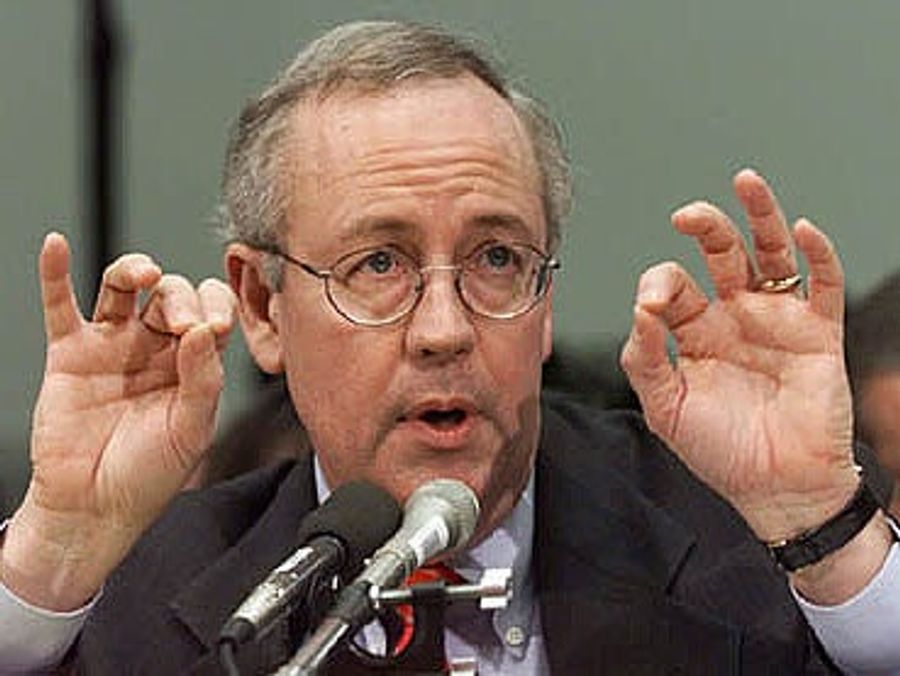
<![CDATA[Deadspin: michael lewis]]> http://tags.deadspin.com/assets/base/img/thumbs140x140/deadspin.com.png <![CDATA[Deadspin: michael lewis]]> http://deadspin.com/tag/michaellewis http://deadspin.com/tag/michaellewis <![CDATA[Yet Another Reason Not To See The Blind Side]]> Michael Lewis, author of the book that is currently being butchered at a theater near you, reports that presidential-blowjob sleuth Ken Starr was so moved at a screening of the movie that he cried. [NYMag.com]

]]>
http://deadspin.com/index.php?op=postcommentfeed&postId=5408450&view=rss&microfeed=true
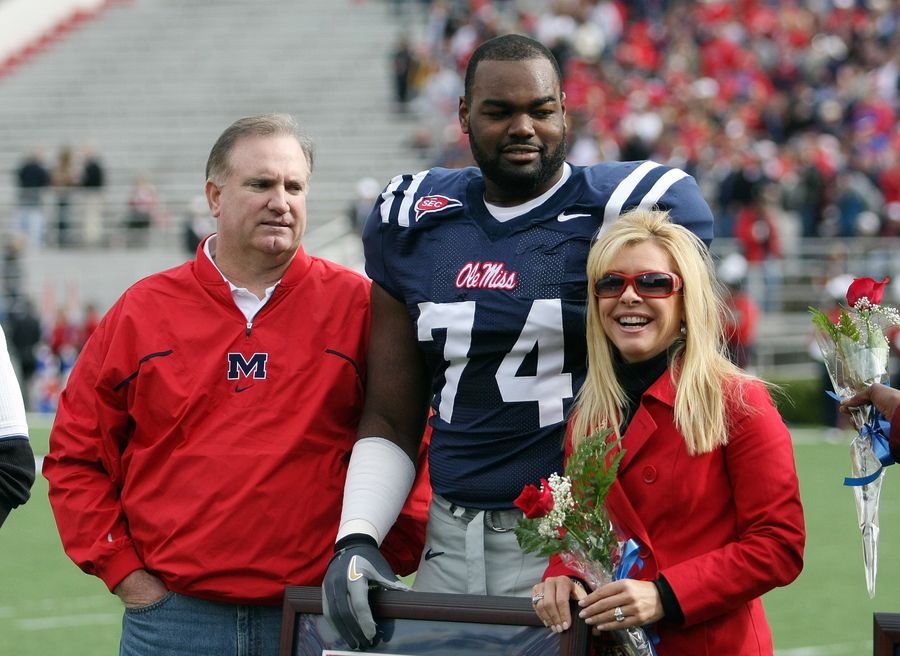
<![CDATA[Sandra Bullock Will Ride Michael Oher To Oscar Glory]]> If the trailer for The Blind Side—coming this Thanksgiving!—doesn't scream "Oscar Bait", then my name isn't Steven Spielbergo. The important takeaway here is that Sandra Bullock is not the crazy racist she portrayed in Crash.

For those in the dark, this is the movie version of Michael Lewis' book about Baltimore's No. 1 draft pick Michael Oher, a hulking black kid who was taken into the loving embrace of a lily white family in rural Mississippi after they found him bleeding and hungry on the side of the road. The fact that he was built like a dump truck and the high school team needed a left tackle is not really relevant here. What is relevant is that if the kid playing Oher doesn't get an Best Supporting Actor nod after looking that mopey for two straight hours, then Obama's America doesn't really exist.

Unfortunately, Tim McGraw's acting prowess kinda gets short shrift here. Hmm. I wonder why that is? That just means more time for White Ladies Threatening Gangsters! In Short Skirts! With Southern Accents! Bring the Kleenex, fellas.

* * * * *

Thank you for your continued support of Deadspin Under Siege. Barry P. will be here shortly to tuck you in for the evening. That wasn't so bad now, was it?

]]>
http://deadspin.com/index.php?op=postcommentfeed&postId=5330073&view=rss&microfeed=true
<![CDATA[Soderbergh's Moneyball Script Too Real To Get Made]]> The Sony Pictures executive who pulled the plug on Moneyball says that Steven Soderbergh changed the original script because he didn't want anything in the movie that didn't actually happen. So Billy Beane isn't a sweaty, foul-mouthed, Hooters waitress slayer?

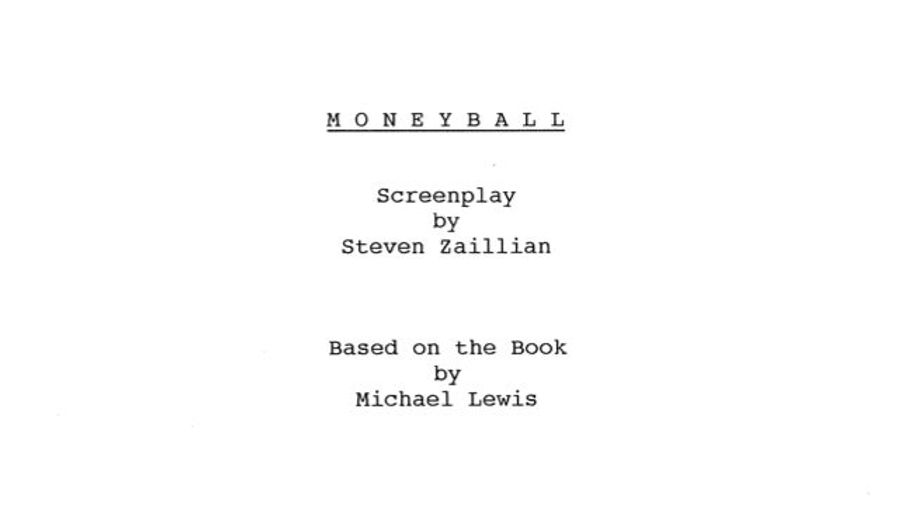
Everyone loved Steven Zallian's version (he's an Oscar-winner, you know!), because it had jokes and snappy dialogue and actually made sabermetrics non-mind numbing. But Soderbergh wanted realism so much, he was determined to only film events that took place in real life. He also scrapped the conceit of having Bill James as the "Greek chorus", bookending the film with his anecdotes with and wise old man stories. The verdict:

That might make for an intriguing art film, but it clearly was no longer a film that any studio would spend $58 million to make, especially with baseball films having virtually no appeal outside of the U.S.

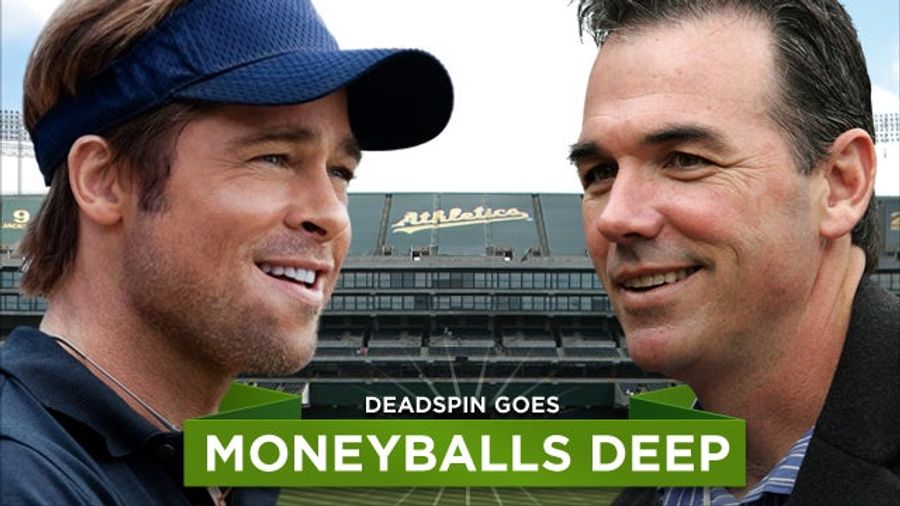
We got our hands on the Soderbergh draft, and it's about as bad as others have said. Gone, thankfully, is the Beane-as-dork-Messiah stuff. Soderbergh's Beane is more of a proxy for the audience this time — Bud Fox meets Crash Davis, as they say in Hollywood — and in his script, Moneyball is more of a Beane-Paul DePodesta buddy movie, which maybe makes some sense when you imagine Brad Pitt and Demetri Martin in those roles. Maybe.

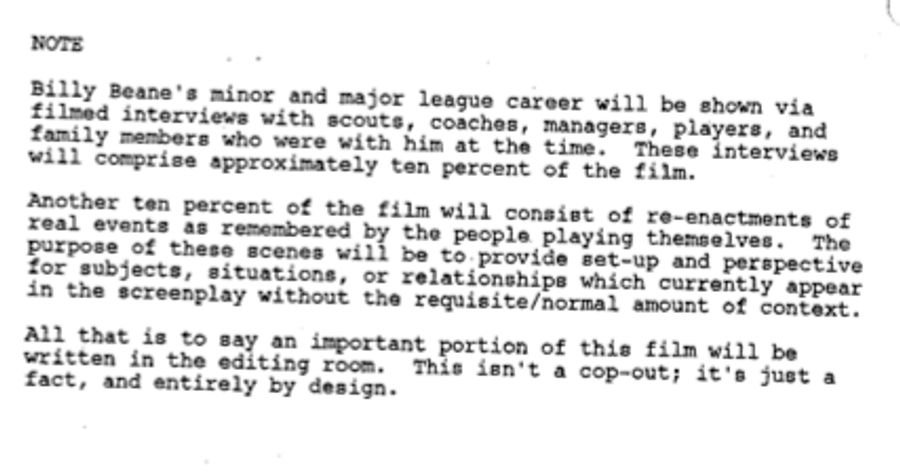
The script was probably doomed from its second page, from which the above image was taken. Here's Soderbergh's disclaimer:

Billy Beane's minor and major league career will be shown via filmed interviews with scouts, coaches, managers, players, and family members who were with him at the time. These interviews will comprise approximately ten percent of the film.

Another ten percent of the film will consist of re-enactments of real events as remembered by the people playing themselves. The purpose of these scenes will be to provide set-up and perspective for subjects, situations, or relationships which currently appear in the screenplay without the requisite/normal amount of context.

All that is to say an important portion of this film will be written in the editing room. This isn't a cop-out; it's just a fact, and entirely by design.

That sounds an awful lot like, "Yes, this script sucks. But trust me. I made The Limey." It was probably at this point that Amy Pascal, the Sony executive, optioned the script to the bottom of her coffee mug. Even though it was five days from shooting and Sony had already sunk $10 million dollars into the film, Pascal pulled the plug. The movie is now in limbo. The studio would presumably still make the Zaillian version if they could find a director, but would likely lose Brad Pitt if Soderbergh walks. And the current talent is free to take the project somewhere else, but no one is biting, because that brings us all back to the original argument, "Why anyone make a movie about this?" Maybe Scott Hatteberg is really big overseas?

(Additional Soderbergh script reveals, information by Tommy Craggs.)

Sony's Amy Pascal speaks out about 'Moneyball' [Los Angeles Times, via Gawker]
What happened to...Moneyball? [ScriptShadow]
Billy Beane Is A Golden God: Excerpts From The Scrapped Moneyball Script

]]>
http://deadspin.com/index.php?op=postcommentfeed&postId=5305316&view=rss&microfeed=true
<![CDATA[Billy Beane Is A Golden God: Excerpts From The Scrapped Moneyball Script]]> It looks like Moneyball might not be coming to the big screen anytime soon because director Steven Soderbergh tinkered with the script and everyone realized that a movie version of the book made about as much sense as Joe Morgan.

But an earlier draft of the script, dated Dec. 1, 2008, is making its way around the Web. It's 129 pages, which means it's up to the intern to parse through it, pick out the good parts and then compile the particularly entertaining excerpts. It wasn't hard to find a handful of lowlights, and in addition to the ones included, there are a surprisingly large number of pointless factual inaccuracies: The Charlotte Knights are Triple-A, not Double-A; Scott Hatteberg never played one year for the Rockies; Bryan Bullington and Roger Ring were not the draft choices directly before Jeremy Brown; and when Olmedo Saenz grounded out in the ninth inning of the fifth game of the 2001 ALDS, there were no outs, not one, thank you very much.

Besides that — and plot twists that pit Beane as an avid concertgoer and convert Paul DePodesta into a weightlifter — the screenplay made me wish some studio would take a chance with this movie, even if Michael Lewis himself didn't see the movie in the book. The first two acts are slow, relying on Bill James to explain sabermetrics to the women dragged to the theater by their geeky boyfriends brothers. The last 30 pages, though, are as action-packed and climactic as a trading deadline and AL West race can be.

And yes, there are cameos from Lenny Dykstra and Joe Morgan, outright allusions to Roy Hobbs and Jimmy Stewart and subtle nods to Bobby Knight and Angels in the Outfield. It's Moneyball, coming to a theater near you... well, maybe never, but hopefully soon.

"OK, Let's start with a naked Billy Beane, the steam rising off the shower and crowning his head, like... God!"

"Great idea, but here's a better one. We'll cut to a Bill James voiceover, and then cite Henry Chadwick."

"Oh, I like it. But it's a bit too, hmm, secular. Let's throw some stigmata in there."

"You sure you want to go that route?"

"Absolutely. And blood! Lots of blood!"

Lest the movie offend the Jewish crowd, Arn Tellem makes a cameo when Beane goes to Tellem's son's bar mitzvah and, like everyone else, struggles to keep a yarmulke on his head. Bobby pins, Billy. That's the trick. And don't be depressed — bar mitzvahs are fun!

A few scenes in and Beane's already throwing chairs against the big board. Nobody pays any attention. Apparently there is fighting in the war room.

I think this is the beginning of a beautiful uncomfortably intense friendship.

Because after you seduce an Outback waitress, your next step isn't to call the Indians' general manager in the middle of the night?

Ah, Christmas — makes more sense than you think. But don't bother trying to figure out how It's A Wonderful Life comes into play.

I thought this was the most entertaining soliloquy of the movie, but then everyone's favorite Sunday Night Baseball analyst makes an appearance.

And the Lord said, "Ask and ye, Chad Bradford, shall submarine, no problem."

Well, all of this certainly makes a lot more sense now.

From bar mitzvahs to Auschwitz? Let's hope this was one of the segues Soderbergh edited out.

One of the screenplay's more puzzling revelations is that Jeremy Giambi is obsessed with The Natural. And, apparently, he's so caught up in the climax that he yells, "Yeah, Hobbs!" even though he's seen it hundreds of times. Also, this is why Beane trades him. Yeah, Beane!

Billy Beane and fantasy baseball owners across the country: not so different after all.

Should make for an interesting Spanish subtitle.

Aaaaaaaand scene!

]]>
http://deadspin.com/index.php?op=postcommentfeed&postId=5302144&view=rss&microfeed=true
<![CDATA[Moneyball's Deep-Sixed]]> Break out the baseball puns! Columbia has dropped Steven Soderbergh's Moneyball adaptation like an overvalued, arbitration-eligible pitcher after a career year. Why, it's as if producers made a running, 20-foot backhand flip to cut down the movie at the plate.

Reports E! Online (which went with the decidedly weak "Columbia Drops the Ball on Brad Pitt's Moneyball" for its punning headline):

They can't all be home runs for Brad Pitt.

His latest project, the Steven Soderbergh-directed Moneyball, has been put into "limited turnaround" by Columbia Pictures honcho Amy Pascal after receiving a much different final draft of a script she once fought for.

Production on the film was set to start Monday in Phoenix, and with only 96 hours to go, Soderbergh's change in vision unsettled Pascal and the brakes were immediately applied to the project.

The "limited turnaround" gives Soderbergh the opportunity to try and settle with another studio, the aim being bigwigs such as Paramount and Warner Bros. The filmmaker has until Monday to tie down the deal, having spent the weekend with both his and Pitt's CAA agents attempting to hit one out of the park-so to speak.

If that doesn't happen, America will very likely have lost its only chance at ever seeing Lenny Dykstra and Demetri Martin together on the big screen. Just a few weeks ago, Lewis seemed nonplussed that the movie was being made at all. In an interview with the Today Show's Dan Fleschner, he said: "I didn't understand why they bought it for a movie in the first place."

At least the adaptation of Lewis' Blind Side is proceeding apace. Sandra Bullock and Tim McGraw, folks. Touchdown!

Columbia Drops the Ball on Brad Pitt's Moneyball
[E! Online]
Has Soderbergh's Moneyball Movie Been Canned? [Slate.com]

]]>
http://deadspin.com/index.php?op=postcommentfeed&postId=5299791&view=rss&microfeed=true
<![CDATA[Moneyball’s Deep: How Baseball Prospectus Is Like The Oakland A’s]]> Under Billy Beane, the Oakland A's won by scraping together undervalued assets. Since the rest of baseball has started valuing assets properly, the A's are having a harder time. The same thing is happening to baseball's leading propeller-heads.

When it launched on the Web in 1997, Baseball Prospectus was a gadfly that hadn't yet caught the ear of the major leagues. Nevertheless, it became a gathering place for sabermetrics' brainy hobbyists: The site laid out the concept of value over replacement player, pushed for teams to do a better job tracking pitch counts, and ran Voros McCracken's breakthrough study that pitchers have little control over the hits they allow.

By the time Moneyball came out in 2003, major-league teams had figured out the value of BP's writers. In 2002, the Blue Jays hired BP's Keith Law as a consultant. Keith Woolner, who invented VORP, left in 2007 to join the Indians, James Click and Chaim Bloom joined up with the Rays, and Dan Fox quit to work for the Pirates. Last year, the entire world realized that Nate Silver was an undervalued asset when he started devoting his genius-power to politics. Two months ago, he resigned as BP's managing partner and announced he'd likely "not be able to write about baseball with the frequency that [he] once did."

Kevin Goldstein, the site's new lead business guy, says the departure of the site's top analytical minds is "a real pain in the ass." He says there are now more than 10 people working for major-league clubs who have BP on their resume. "If someone's really valuable to you, you can usually keep them if you play the money game," he says. "We can't do that because working in baseball is their dream."

Unlike a baseball team, BP doesn't get talented youngsters back in trade when its veterans leave town. The need to find new, cheap, unknown talent explains something as bizarre and seemingly un-wonky as the site's current Prospectus Idol contest, in which 10 finalists are competing to become a columnist.

Along with getting raided by the big leagues, BP also has to compete with a bajillion other baseball-wonk clearinghouses—and the other guys don't charge a subscription fee. One quantitative analyst who does work for several major-league teams told me that BP has less path-breaking statistical material these days than sites like Fangraphs and The Hardball Times. Fangraphs has done more and better work than BP using Pitch f/x, the amazingly rich new data on pitch types, speeds, and location. (BP's former Pitch f/x guru, Dan Fox, is one of the guys who left for MLB. Another f/x expert, Eric Seidman, is now writing for BP along with Fangraphs.) I also heard from several different people that Dave Cameron, who writes primarily for Fangraphs and the Wall Street Journal, is the closest thing on the Web to a proto-Silver—the most-promising young sabermetrician writing today.

Goldstein says that, while he believes BP's writing is better than the competition, Fangraphs has moved the ball when it comes to tech-y tools. He doesn't see it as a problem, however, that BP is no longer the lone port of call for spreadsheet lovers: Joe Sheehan is one of the best baseball columnists anywhere, Will Carroll is the industry's leading injury guru, and Goldstein himself is a respected prospect evaluator. "I don't want [statistics] to be only what we do," he says. "I don't want to be pigeonholed as that, and that's ticked off a lot of people. … There is a certain subset out there who wants us to stick to our roots and talk about the numbers and be more hardcore."

While Prospectus might be losing stathead mindshare, it does still have PECOTA, the player-forecast system invented by Nate Silver. Goldstein emphasizes that the site's subscriber-base and traffic are bigger than ever. The BP gospel has also spread to mainstream publications like ESPN.com and Sports Illustrated, and the Prospectus brand has now extended to include a basketball site and a hockey site. Inspired by Silver's political work, Goldstein and co. are now thinking about moving beyond sports. "I don't want people stealing our ideas, but we've got things in our cooker for the next couple of years," Goldstein says. One clue: "We wouldn't do data on the plumbing industry, because there's not a lot of plumbing fans."

]]>
http://deadspin.com/index.php?op=postcommentfeed&postId=5279714&view=rss&microfeed=true
<![CDATA[Michael Lewis Explains Why Your Kid Is Overvalued]]> An interesting Q&A with Michael Lewis covers Moneyball ("The A's have no intellectual advantage, as evidenced by their performance"), the Rockets, his books being turned into movies, and his new tome about being a father. Joe Morgan's kids have already panned it. [MSNBC]

]]>
http://deadspin.com/index.php?op=postcommentfeed&postId=5273849&view=rss&microfeed=true
<![CDATA[Of Ron Zook, Twitter And Big Swinging Dicks]]> Ron Zook had a busy Wednesday afternoon. First, he went to the Chicago Mercantile exchange. Then, he channeled his inner Faulkner and finally, he tweeted about the entire experience.

But Zook isn't the only sports figure to haunt a trading floor recently. On Tuesday, BTIG in New York invited Eli Manning, Johnny Damon, Reggie Jackson and a group of other luminaries to witness the firm donate equity and derivative trading commission (yeah, that) to a stable of nonprofits. Charity!

The kicker of Zook's tweet ("Unbelievable intensity," if you managed to get lost in a 123-character message) speaks to one commonality between stock exchanges and locker rooms, and it's not the only shared trait. Go back and read Liar's Poker, Michael Lewis' seminal account of working as a bond salesman in the 1980s, and you will meet the studliest salesman on the floor, the ones who raked in millions of dollars and earned the obvious envy of everyone in the Salomon Brothers training program.

Their nickname on the floor, according to Lewis, isn't so different from what these guys are called in the clubhouse: Big Swinging Dicks.

]]>
http://deadspin.com/index.php?op=postcommentfeed&postId=5263215&view=rss&microfeed=true
<![CDATA["Moneyball" Author Has A Small Penis, Cruel Family]]> "Daddy has a small penis!" That's according to his toddler daughter, who likes to let everyone at her day care center know that fact about her father. [NYP]

]]>
http://deadspin.com/index.php?op=postcommentfeed&postId=5220398&view=rss&microfeed=true
<![CDATA[So Is Shane Battier Any Good Or Not?]]> As expected, there's been a lot of talk generated by that Shane Battier piece—talk that will continue until Michael Lewis writes a 10,000-word story about how centers are the smartest guys in football. (They are.)

It's good to see that most of that talk has risen above the level of "this guy is a stupid idiot jerk," but it also seems like the biggest issue is that most people still can't wrap their minds around Shane Battier as a quality NBA player. Or Daryl Morey as having any kind of basketball sense.

For example, to complain that Morey must be dumb for trading Rudy Gay to get Battier is a willful disregard of the article's thesis. Yes, Gay is obviously the better basketball player, but ... Memphis stinks. They made the playoffs three straight years with Battier and are now on their way to three straight 60-loss seasons without him. Is that all Shane's fault? Probably not. But if anyone's judgment should be questioned here, it's probably not Morey's.

The most interesting point—and I may have misrepresented this in my post as well—is that it's not just about some complex, unknown formula that proves Shane Battier's worth. It's that no contribution matters, if it doesn't help the team win. Isn't the knock on the Kobe Bryant that he's selfish? That he scores thousands of points a season, but doesn't make his teammates better. So here's a player with obvious individual weaknesses, who does appear to make his team better and very few people seem to know how to quantify that. So how does he do it?

Yes, for an article that purports to examine statistics, there is very little math here. However, the Rockets aren't going to discuss their internal strategies with a journalist. And even if they did, the readers of the New York Times Magazine could not possibly care to read about it. You, the hoops loving junkie with NBA League Pass on your satellite dish, are the not the target audience of this article. It's meant to be understood and digested by many people who understand nothing about sports, but are maybe interested in science and non-conventional thinking. (i.e. eggheads who like proving people wrong.)

That's also why the article contains so many details of Battier's upbringing and racial tension. It's called "color" and it is what separates dry, boring articles from entertaining ones.

Yes, there is a lot going on here and the constant gear-changing can occasionally be disorienting for some, but that's a criticism of Lewis' writing, not his ideas. Does the article tell the whole story? Of course not. No single story could. But it's meant to introduce an unfamiliar (to most) concept, break it down, and make people think. On the last point, it has definitely accomplished its goal.

It may have even accomplished a more important goal from the Rockets' perspective: increasing Shane Battier's trade value. The way Morey talks about him in the magazine, you would think Battier was indispensable, but apparently he's so good that the Rockets now want to trade him. That's one way to make your team better!

—-—--

Oh, one other thing. Some people may have liked the article better when it was written the first time, over a year ago. I stumbled across this 2007 piece by Jason Friedman of the Houston Press that covers the exact same territory—Morey as stats genius—but obviously it didn't get as much attention without the names "Michael Lewis" and "New York Times" attached. I guess you won't see that play in the box score either.

Lies, Damned Lies, and Obama [Talking Point Free]
Statistics, Battier Are No Way to Stop Kobe | NBC Los Angeles [NBC LA]

From 2007
Rocket Science [Houston Press]
What the Box Score Data Says About Shane Battier [Wages Of Wins]

And from 2005:
Measure Of Success [SI]

]]>
http://deadspin.com/index.php?op=postcommentfeed&postId=5155881&view=rss&microfeed=true
<![CDATA[Michael Lewis Gives The NBA Its "Moneyball"]]> It took me the entire weekend and most of Monday, but I finally got through Michael Lewis' epic deconstruction of Shane Battier, also known as "Moneyball: NBA Edition."

If you didn't read it, here's the Cliff Notes:

• The Houston Rockets are the Oakland A's of basketball and GM Daryl Morey is their Billy Beane.

• They have quietly invented a whole new class of basketball statistics that the article will not share with you, because right now that is their biggest advantage over the rest of the league.

• Those statistics say that Shane Battier is the greatest player alive.

It is not surprising that Lewis would write an article about math nerds (Morey went to Northwestern and M.I.T.) changing the way players are evaluated, but it is sort of amusing to see Battier as its protagonist. He is slow, undersized for his position, can't dribble, can't shoot and is kind of a pathetic loner—facts that everyone already knew about him when he played at Duke. However, he spent four years there infuriating college basketball fans as the Dick Vitale brigade fawned over his "heart" and "hustle" and "determination"—universal code words for "the best white guy in the room." (Even though Shane's father is black.) The media proclaimed him the best back then, even as it was painfully obvious to everyone else that he was not. Yet, somehow his teams just kept winning. Now it turns out that he really was the best in the room.

Of course—before I get a letter from Joe Morgan's taller brother—if you read the story closely you can see that it is not actually arguing that Battier is better than Kobe Bryant. It is more simply that the strengths of his game (good defensive awareness, smart shot selection, and yes, hustle) are not measured by traditionally obvious statistics and—via the original corollary gleaned from "Moneyball"—those strengths are grossly underrated by most ball clubs. That's what most critics of Beane and the A's always missed. It's not about re-defining what's valuable—it's about finding value that others can't see.

On the other hand, last week Lewis also wrote a bizarre screed—which may an intentional joke—for Bloomberg arguing that the problem with Wall Street is actually a lack of greed and selfishness, so take his advice for what it's worth. However, this article is also partly a fascinating bio of Battier, a brief examination of race and playing styles, and a small glimpse behind the curtain at an NBA game. I highly suggest that you read it all yourself, if for no other reason than it may be the first shot in basketball's upcoming sabermetric war and you'll want to be well prepared.

Sorry, firebillwalton.blogspot.com was already taken.

The No-Stats All-Star [NY Times Magazine]

]]>
http://deadspin.com/index.php?op=postcommentfeed&postId=5154705&view=rss&microfeed=true
<![CDATA[The Underrated Genius Of Shane Battier]]> "Moneyball" author Michael Lewis picks apart the Duke legend's unheralded NBA career. It's a long article in the NY Times magazine, but definitely worth a read during your weekend lounging. [NY Times Magazine]

]]>
http://deadspin.com/index.php?op=postcommentfeed&postId=5153661&view=rss&microfeed=true