Vaccine passports could be the ticket back to full stadiums

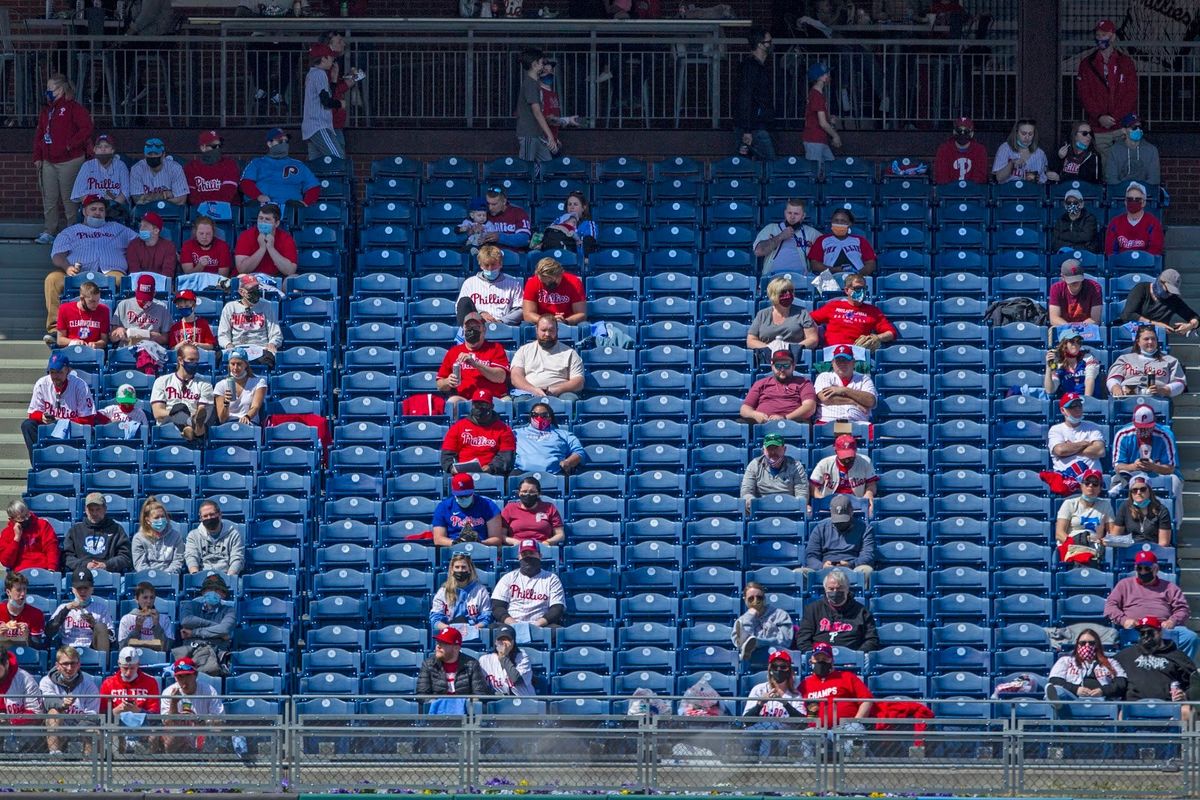 Baseball’s back... at partial capacity. source: AP
 Ah, baseball’s opening weekend, fans in the stands and the Nationals sidelined by the coronavirus.
While Joe Biden pleaded with the Texas Rangers not to open their stadium at full capacity yet, MLB Commissioner Rob Manfred expressed optimism that all baseball parks would be fully open this summer. Meanwhile at Yankee Stadium on opening day, some fans got into a heated discussion, maskless.
Not coincidentally, a national discussion is starting over the idea of vaccine passports.
They don’t exist on a wide scale yet, but a vaccine passport could be a way to get more fans back in the stands and indoor arenas, maybe even sitting next to a stranger while yelling at the refs just like we all used to. If more research confirms what the data currently points to, that the vaccinated don’t spread the coronavirus in addition to not getting sick from it, then a future might be emerging that makes a full stadium less of a public health risk.
Over the weekend, news emerged of a 23-year-old Alabama fan who died of the coronavirus after attending an NCAA tournament game. It’s hard to know how many people have been infected at pro and local games in the past year. The NFL has said that no local COVID clusters were attributable to NFL games last season with 1.2 million fans, but contract tracing is spotty in many areas and, with the virus so rampant, it’s hard to prove a negative. On the other hand, outdoor venues are safer than indoor ones.
“It’s really hard to contact trace a basketball game,” said Kathleen Bachynski, an Assistant Professor of Public Health at Muhlenberg College. “You look at a situation like that and think, if everyone had been vaccinated would we be in a different situation?”
Right now, as a massive vaccination effort is underway, some people have been vaccinated against the coronavirus and some haven’t. Some have access to the vaccine and some don’t. In many states, a 23-year-old isn’t even eligible. But at some point, most Americans will have had the choice to be vaccinated, and that proof could be required for schools and travel, or perhaps events.
This is too important for the honor system. And given how contentious mask-wearing and vaccines have become, a person who wants to avoid the virus shouldn’t have to hope and pray the other people in the stadium wear a mask and socially distance. Your ticket shouldn’t require you to enforce the rules that a stadium won’t.
The idea of a vaccine passport isn’t new. Kids have vaccine records that get printed out from a pediatrician and sent to school districts during the enrollment process, and some nations require proof of a yellow fever vaccine before stamping a passport for entry at a border.
Bachynski notes that the idea of a passport, which is really a QR code that contains a yes or a no on vaccination status along with name and birthday, has been associated more with institutions than single events like concerts and games.
“Whenever you give up something health related, there is a concern about privacy,” Bachynski said. “But through our phones, a lot of that information is already being provided.”
She points out that we are in a moment of transition with the virus, and things may look very different in six months. We could be in a situation in the next NBA season where most adults have been willingly vaccinated, or we could be challenged by more lethal variants that have outwitted us.
“It’s a fast moving target,” she said.
When the virus first emerged as a public health threat, many doctors and health officials were concerned about a lack of ventilators, yet evolving treatments and poor outcomes for ventilated patients meant there wasn’t the anticipated demand for the machines.
So another question for health officials with vaccine passports is, what would the reduction of risk look like? If societies impose a cumbersome requirement, not everyone has smart phones or printers for those QR codes, would we see the payoff in lowered transmission and prevention of death? Are stadiums really that great a risk?
We just don’t know. Just like we don’t know if we are at the end of this fight or the middle. Right now people have different levels of comfort with being in crowds. While filling a stadium on opening day might be easy for the novelty of it, if leagues want people to come back on a regular basis, assuring more reticent fans that it’s safe-ish might require some work.
We are entering a new phase of the pandemic, one where some people are safer than others from the virus. Trying to find a fair way to lower the spread of the virus should be a goal, and filling sports stadiums again might be dependent on it.
“The answer is, always lower transmission,” Bachynski said.
Related



MLB Playoff Picture: Biggest Races to Watch on Final Weekend


The Numbers Behind Raul Rosas Jr.’s First UFC Main Event
Browns Defense Is Struggling Without Myles Garrett
6 Most Underrated NBA Teams Heading Into the 2026-27 Season
- Indiana vs. Northwestern Prediction: Best Bets To Start Week 4
- UFC Vegas 121 Betting Splits: Where the Sharp Money Is Landing This Weekend
- Diamondbacks vs. Padres Friday Best Betting Picks and Predictions
- MLB Best Bets Today: 3 Picks for Thursday September 24 Slate
- College Football Week 4 Picks: 3 Best Bets for Saturday
- Best Bets for Falcons vs. Packers Thursday Night Football
- MLB Best Bets Today: 3 Picks for Wednesday, September 23rd