The value of Pokémon cards is soaring. New and long-standing collectors are seeing certain sets and cards multiply in value, but what are the most valuable Pokémon cards to get your hands on today? This guide covers it all.
As you read on, you’ll soon discover all there is to know about the most expensive Pokémon cards in the hobby, including that unbelievable $16.5 million price tag attached to the Pokémon Illustrator. We then highlight how we came up with our rankings before offering up some top tips for you true collectors out there.
Let us get right into it. Here, you’ll see a snapshot of the most valuable Pokémon cards available, followed by an overview of what makes these cards such collector’s items.
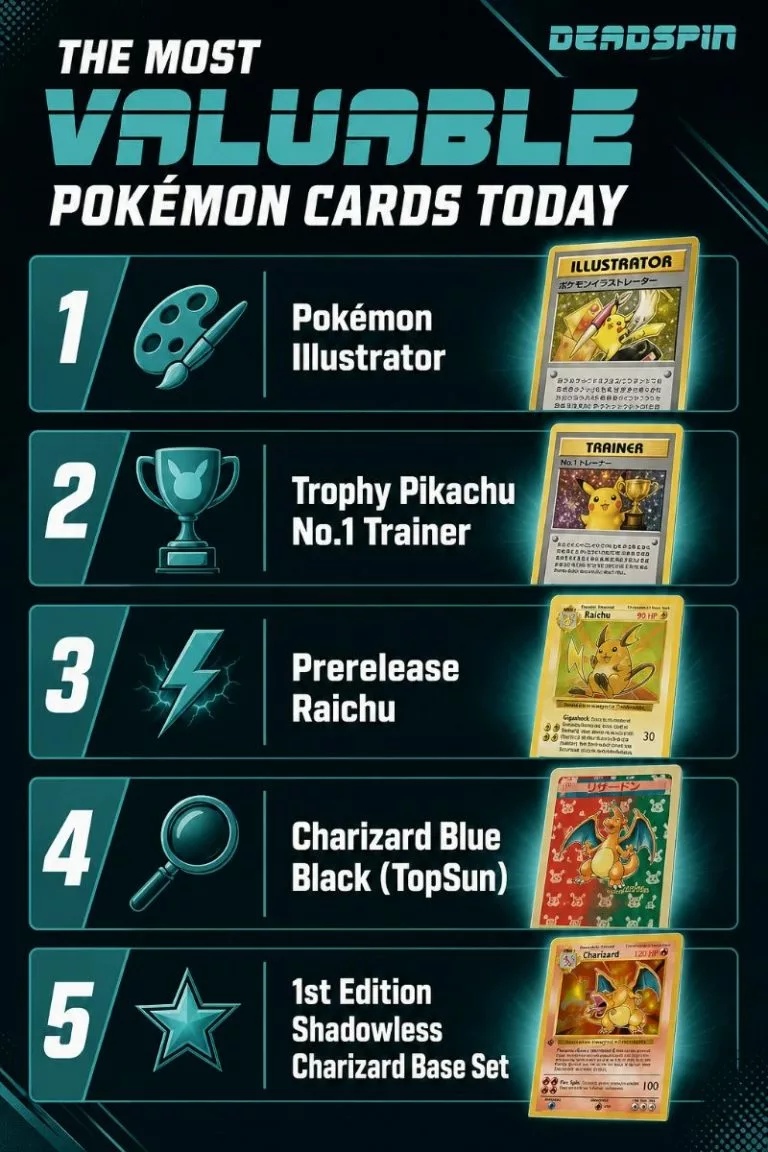
| Rank | Card | Set | Ungraded market value | Graded market value |
|---|---|---|---|---|
| 1 | Pokémon Illustrator | CoroCoro Comic | Unknown | $16.5 million (PSA 10) |
| 2 | Trophy Pikachu No.1 Trainer | 1998 Tournament Promo | Unknown | $3.0 million (PSA 8) |
| 3 | Prerelease Raichu | Error | Unknown | $555,000 (PSA 6) |
| 4 | Charizard | Blue Black (TopSun) | Unknown | $493,230 (PSA 6) |
| 5 | Charizard | Base Set Shadowless | $2,000 | $422,000 (PSA 10) |
Now you have the basics covered, we want to explain what makes them such expensive cards within the hobby. This isn’t just about grading; it’s about scarcity, relevance, and picking up a piece of Pokémon history.
If you follow Pokémon in any capacity, you’ll be well aware that the Pokémon Illustrator is now considered one of the most valuable trading cards of all time. This card has broken records within the franchise time and time again, and there is only one copy that is considered a PSA 10, out of the 40 total copies. The artwork comes from Atsuko Nishida – the original creator of Pikachu – and it is uniquely labeled Illustrator, rather than the typical Trainer.
In second place, we have yet another card that you wouldn’t be able to get your hands on through a Pokémon card rip, but instead for winning the first Pokémon official tournament in 1997. In total, just a few copies of this card were made, and even fewer copies made it to Professional Sports Authenticator (PSA) or Beckett Grading Services (BGS) at any standard. The art itself also comes from the legendary Mitsuhiro Arita. If you combine all of this together, you can soon see why even at a PSA 8 you will be expected to see a price tag of around $3,000,000 attached to this one.
Third, we have the Prerelease Raichu. At $550,000 for a PSA 6, you can see just how valuable these cards are, and the main reason is down to a simple error. The Raichu card is a fan favorite from the base set. The card is holographic and depicts Raichu (Pikachu’s evolution), so it is already going to be of value (and is to this day). However, the Prerelease stamp was intended for Clefairy from the Jungle set. Only 8-10 of these cards were ever made, and it was kept hidden by Wizards of the Coast for many years, adding even more mystery to it.
So far as non-TCG memorabilia goes, the Charizard Blue Black first-print variant takes some beating. A PSA 6 would set you back more than $490,000, but why would a non-TCG card pack such weight? Well, Pokémon fans seem to love errors, as these errors make them so special. The original print of the Charizard Blue Black card forgot to add the #006 Pokédex entry. Again, prints are limited, with just 50 copies of this error card reported, and it features the original art from Ken Sugimori. Did we mention you can’t rip this one through a standard pack? Instead, it was released in packs of apple gum.
We round off this list with a grail from one of the best Pokémon card sets of all time. This is the 1st Edition Shadowless Charizard from Base Set. For older collectors, this was the pinnacle of any collection, and is considered a grail by most new to the scene. These were some of the first English Pokémon cards to launch, and initial print runs were limited. With scarcity and nostalgia ticked off the list, the Base Set’s 1st Edition Shadowless Charizard was always going to feature here.
When it comes to ranking the most valuable Pokémon cards, market value has to come into it. Naturally, we are looking through higher-end graded cards, as these come with certifications and a guarantee that they are of a certain caliber. However, that doesn’t mean we all need to rush to learn how Pokémon cards get graded to boost our portfolios; you also need to consider the following:

We have years of collecting experience behind us, but we are always learning new tricks of the trade. So, in this section, we want to share some of this insight with you, to help get your experience up and running.
There are hundreds of ways for you to collect Pokémon cards, and we all want to find value in our collection. While we may have covered the most expensive Pokémon cards here today, that doesn’t mean they mean the most to you. If market price isn’t your sole reason for collecting, then consider what is. You could choose to collect cards from the vintage era, build master sets, only own graded cards, or only own Quaxwells. Whatever it may be, make sure your collection is for you.
The recent Pokémon boom has been both a positive and negative for graded collectors. Many of you will presume that a graded card will instantly add value; however, it all depends on the era and state of things. Naturally, a PSA 9 and PSA 10 will rocket the price, but over recent times we have seen ungraded modern cards valued similarly to PSA 9s. In essence, this means that only modern PSA 10s lead to a guaranteed increase in value. Obviously, things are a bit different with vintage cards, but you just need to be aware of this before sending things off.
Knowing when to buy and sell is crucial with any investment, and those collecting Pokémon should view their cards the same as any other tradable asset. Sure, we don’t need to take things too seriously, looking at Bollinger bands and other trading signals, but you will want to track the price of your cards with a credible tracking tool or app. If the trajectory is up, wait for things to hit a wall before selling. If on its way down, we suggest holding out and waiting for another peak.
We would hope that all of you are doing this already, but it is worth reminding those completely new to the hobby to grab some sleeves, toploaders, and binders. If not, you could find that scratch-free pull with PSA 10 potential suddenly becomes a 7.
Finally, when it comes to adding to your collection, we are well aware that products are tough to find. Rather than paying higher rates at local stores or trading off your own collection to cover the costs at the local card show, you should consider checking out card rip sites. These sites allow you to purchase packs and have them ripped for you online. You can then decide whether to sell your pulls, store them, or have them shipped out.
Safe to say that the Pokémon Illustrator runs away with the title of the most expensive Pokémon card available, setting you back over $16,000,000 for its one-of-a-kind PSA 10 variation. This card couldn’t be ripped traditionally, but was awarded to 40 entrants of the CoroCoro Comic competition.
There is a theme behind the top-value cards: They all feature popular characters; there are very few copies; they all stem from the vintage era. Not to mention that only the 1st Edition Shadowless Charizard could be physically ripped in packs.
Without a shadow of a doubt, the most expensive Pokémon card is the Pokémon Illustrator. The PSA 10 is a one-of-a-kind card that has reached a peak of over $16 million.
There are many reasons why Pokémon cards may increase in value. We would consider scarcity, fan base, relevance, and graded population to be good indicators, but sometimes it is simply a sudden shift in the market.
There are various ways for you to store the most expensive Pokémon cards, including sleeves, toploaders, binders, and specifically designed graded cases. You may even want to invest in a safe to keep some top-end cards out of sight.
Loading …