Plinko has been taking the gaming world by storm with its fun gameplay style and great multipliers. I’ll explain how the game works, so that you can decide on the best Stake.us Plinko strategy for you.
Understanding the ins and outs of Stake.us Plinko can significantly boost your gameplay, so if you’re new or already a pro, there will be something for you to learn here. Explore how the game features affect the potential outcomes, and strategies to help you maximize every drop of that Plinko ball.

Exclusive Stake Originals Games. Impressive live games library. 3,000+ games from Hacksaw Gaming and more. Playthrough: 3x. T&Cs and 21+ apply
Stake.us only features one Plinko variant. If you’re looking for a diverse set of Plinko titles, you can check out High 5 Casino, which features the likes of Xmas Plinko, Plinko XY, Pine of Plinko 1 and 2, Prospector’s Plinko, Easter Plinko, Plinko 2, Plinko Dare 2 Win, and more.
The odds are that you’ve probably seen a version of Plinko before, either watching The Price is Right, or in the Japanese game, Pachinko. The main difference between the games being that Plinko is the digitized version of it. The gameplay for Plinko is very straightforward. There are a bunch of pegs arranged in a triangular shape.
You start by setting an entry amount, and then dropping a ball into the top of the pyramid, and watch it make its way to the bottom as it bounces off each peg randomly. The returns are based depending on which slot the ball falls into at the bottom, with larger potential winnings on the outside, and the lowest in the middle.
Now, that is the most basic rundown of how the game works, but what makes Stake.us Plinko unique is that you can customize a variety of settings that can affect your winnings. From changing the amount of rows, or the risk factor, you can create a Stake.us Plinko strategy that is more suited to your style of play.
In the core game flow on Plinko, everytime you drop a ball, this is what happens behind the scenes, broken down strategically – step by step:
Now, let’s decode how the structure of the board and its physics affect actual strategy.
In Stake.us plinko, each additional row adds more complexity and further potential outcomes. Here’s what that means in practice.
| Rows | Peg Hits | Outcome Spread | Strategic Use |
|---|---|---|---|
| 8 | 7-8 | Narrow | Low volatility, easier to predict range |
| 12 | 11-12 | Wider | Moderate volatility, balance of risk |
| 16 | 15-16 | Very wide | High volatility, maximum risk/reward |
Strategic Implication:
If you’re grinding for consistent returns (like on SC balance), it’s best to stick to 8-10 rows.
The risk setting doesn’t change the way the ball moves, but it changes the payout assigned to each slot. Higher risk equals bigger range, but deeper valleys too.
| Risk Level | Lowest Multiplier | Highest Multiplier | Range Impact |
|---|---|---|---|
| Low | 0.5x | 5.6x – 16x | Safe, steady |
| Medium | 0.3x – 0.4x | 13x – 110x | Riskier, more win potential |
| High | 0.2x | 29x – 1,000x | Brutal odds with huge win potential |
Strategic Implication:
It’s best to use high-risk mode only when you’ve got a cushion of Stake Cash or Gold Coins and you’re okay with going bust. You should never mix high-risk with high bet size unless you’re prepared to lose 10+ in a row.
Stake’s Plinko game doesn’t officially confirm it, but just like in physics-based versions, where you drop the ball may subtly affect outcome spread over time.
Strategic Implication:
If you’re running high-risk, 16-row plays, try dropping on the far left or far right. Since you’re already playing a volatile game, it’s best to fully lean into the risk and aim for the edge multipliers.
Both modes use the exact same RNG. However, they change how you control the gameplay:
Strategic Implication:Auto-play is best when using fixed strategies like “100 drops at low risk, 12 rows” to test payout consistency.
Make sure to set a stop-loss or a win target before using auto-play because it’s too easy to let it burn through your full balance in one streak.
In summary, you can’t control where the ball will land, but you can control, your bet size, how often you play, how risky your multiplier setup is, where you drop the ball – and when to walk away. That is the essence of Plinko strategy, as its not about beating the RNG, but about managing your volatility.
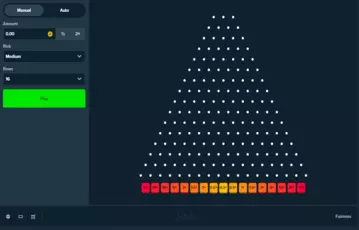
Like I mentioned earlier, Stake.us Plinko stands out among other similar versions of the game thanks to its engaging features that you can customise to enhance the gameplay experience. Here’s a breakdown of the different features that you can change to suit your Plinko strategy at Stake.us.
One of the best features of Plinko is the way that you can adjust the risk level to suit your playing style. The three different levels that you can choose between are low, medium, and high risk. Take a look at the table to see how this affects the multipliers:
| Risk level | Lowest payout | Highest payout |
|---|---|---|
| Low | 0.5x | 5.6x – 16x |
| Medium | 0.3x – 0.4x | 13x – 110x |
| High | 0.2x | 29x – 1,000x |
Choosing the number of rows that your game will have is another important feature to consider. If you increase the number of rows, you enhance the maximum payout multiplier, but it also lowers the smallest potential payout. The minimum number of rows is 8, and the maximum is 16.
When playing Plinko, you can choose to play in either manual or automatic mode. In manual mode you have to select the entry, risk level, and number of rows for each round, and manually click the “Play” button to start, whereas in automatic, you can preset your settings and let the game run automatically for as many rounds as you like.
Plinko at Stake.us is a mostly chance-based game, with the outcomes being determined by a random number generator that makes the game provably fair. With that being said, there are some strategies that you can try out when you play the game that can suit your playing style/level.
If you’re new to Plinko, it can be a good idea to start playing with a low-risk setting. By setting the risk level low and selecting 8 rows, the chances of you receiving smaller but more consistent payouts is much higher. This will help you get familiar with the game without risking too much game tokens.
After you try out using less rows, you can slowly increase the number of rows to increase your chances for bigger returns. By increasing the number of rows, you will introduce the higher multipliers, but be aware as it also increases the risk. If you find a number of rows that you are happy with, you can use the automatic play mode to run you through a selected amount of games to prevent you from changing the settings each time.
By choosing high-risk settings, you introduce the largest multipliers, which go all the way up to 1,000x. The highest risk settings will include setting the risk to high, and selecting 16 rows. These settings will also increase the chance of losing, so use this strategy carefully and only if you’re prepared for higher entries.
Before you head out and try out a Plinko on Stake strategy for yourself, I’m sure that you will want to know how you can get some bonus tokens after you sign up for an account. In our Stake.us review, we mentioned the generous welcome offer for new players, which includes 55 Stake Cash, 560,000 Gold Coins, and a 5% Rakeback that can be used to play any games on the platform. Here’s how you can take advantage of this fantastic offer:
Exclusive Stake Originals Games. Impressive live games library. 3,000+ games from Hacksaw Gaming and more. Playthrough: 3x. T&Cs and 21+ apply
While Plinko at Stake.us is driven by random outcomes, there’s more depth to the game than meets the eye. The ability to control your risk level, row count, and even play mode creates room for strategy, particularly when it comes to managing volatility and balancing your risk with potential reward.
Whether you prefer a safer, low-risk approach with consistent small payouts or enjoy the thrill of chasing high multipliers with high-risk settings, Plinko allows you to tailor the experience to match your preferred playing style. The key is to understand how each setting changes the odds, then apply that knowledge to stay in control of your gameplay and budget.
Playing with fewer rows (such as 8 or 10) tends to keep results more consistent, as the ball has fewer chances to steer off course. This lowers volatility and makes your outcomes a bit more predictable, which is ideal if you’re looking for stability and small, frequent wins.
Using more rows (up to 16) increases both the potential rewards and the unpredictability. The ball can take more extreme paths, which opens up the possibility of landing in high-multiplier slots – but it also raises the chance of ending up with a very low return.
Choose fewer rows if you want steadier results. Increase the rows only if you’re comfortable with the added risk in exchange for a shot at bigger multipliers.
The risk level setting changes the range of possible outcomes, not how the ball moves. A low-risk setting offers more frequent wins, but the multipliers are smaller. This is a good choice if you want to stretch your balance and play longer.
Medium and high-risk settings introduce larger multipliers, including some as high as 1,000x. However, the chances of hitting those big payouts are much lower. These settings result in more frequent low-payout rounds or total losses, especially if you’re using the highest risk and row count.
If you’re aiming to win consistently, start with low risk. If you’re playing for the thrill and potential for large prizes, then high risk may be worth trying – just manage your balance carefully.
Yes, Stake.us offers an automatic play mode for Plinko, which lets you preselect your bet size, risk level, and number of rows. Once set, you can run the game for a fixed number of rounds without needing to click manually each time.
This feature is helpful if you want to test a strategy over many rounds, or if you prefer to let the game run in the background. The outcomes are still determined by the same provably fair random number generator, so automation doesn’t reduce your chances, instead it simply speeds up the process and makes longer sessions more convenient.
While the game uses a random number generator to determine outcomes, the drop location (left, center, or right) may influence the general path the ball takes. Dropping from the center tends to keep outcomes closer to the middle slots, which usually offer smaller multipliers.
If you drop the ball from the far left or right, you may see it travel more toward the edges of the board, where the highest multipliers are typically placed. While not guaranteed, these edge drops are often used by players who are aiming for bigger wins and are willing to accept the increased risk.
For conservative or longer sessions, it’s usually best to select: low risk, 8 to 10 rows, manual or short auto-play runs. This combination provides smaller but more reliable payouts, reducing the chance of losing your balance quickly. It’s a solid approach if you’re playing with Stake Cash from bonuses or just want to enjoy a longer gaming session without major swings.
You can, but it’s risky. Systems like the Martingale – where you double your bet after a loss to recover previous losses – can lead to fast balance depletion, especially on high-risk settings where long losing streaks are common.
Since Plinko is a game of chance with no memory between rounds, these systems don’t actually improve your odds. They’re best used cautiously, and only on low-risk settings with strict limits in place.
Loading …