Garrett Adelstein’s Beneath the Cards Is About Much More Than Jack-Four

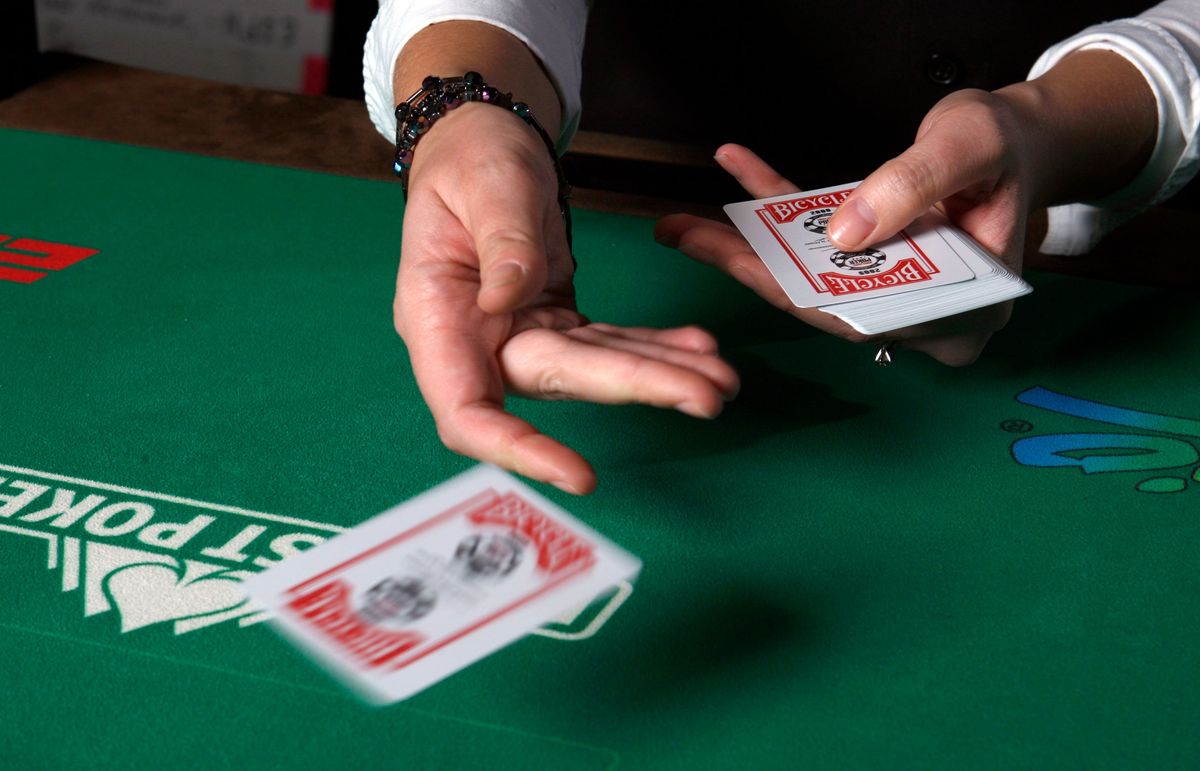 6/16/09 12:09:33 PM -- Las Vegas, NV, U.S.A --Dealer Sara Abdich, 26, tosses out a card during the World Series of Poker at the Rio hotel-casino in Las Vegas -- Photo by Steve Marcus, Freelance ORG XMIT: SM 36601 WSOP 6/16/2009 (Via MerlinFTP Drop) XXX _WSOP SD10998.JPG S USA NV
 Poker is a strange place to look for heroes.
At the table, everyone else is by definition the villain. Away from it, the ecosystem can be even murkier. Money, ego, game selection, private-game politics and the relentless pursuit of an edge have a habit of revealing things about people that you would sometimes rather not know.
For me, Garrett Adelstein is one of a few exceptions.
I first became properly obsessed with poker in 2018, while interning at PokerStars, learning the game and religiously watching Live at the Bike. Those games felt like another world: crazy characters, eye-watering pots and players operating at a whole other level. Andy Tsai was there. Chris Brewer was there. And Garrett Adelstein was an ever-present.
Eight years later, having since played in some of those same Los Angeles cardrooms myself, reading Adelstein’s memoir, Beneath the Cards, felt strangely like a full-circle moment.
Fortunately, nostalgia isn’t what makes the book good.
What makes it compelling is Adelstein’s willingness to explore not only what made him one of the best live cash-game players of his generation, but what those same qualities cost him away from the table.
The defining feature of Beneath the Cards is its lack of sentimentality about what becoming elite at high-stakes poker actually required. Adelstein doesn’t fill the book with the upswings, big wins and amazing games he played in. He spends just as much time examining the machinery underneath them: obsession with perfection, brutal downswings, damaged relationships, mental health struggles and the uncomfortable role luck and variance played throughout his career.
Poker has a habit of reducing successful players to one of two stories: winning genius, or lucky degenerate. Adelstein’s story is much more complex than this.
He was extraordinarily good. He worked relentlessly at the game. He was opportunistic about finding the best games. He understood the politics required to get into them. He endured brutal swings that would be psychologically unbearable for most.
And, by his own admission, luck mattered too.
Poker Is More Than the Cards
Poker books tend to focus on the decisions at the table. Beneath the Cards is just as interesting on everything required to get into the game in the first place.
Private-game politics. Networking. Being denied seats. Finding profitable lineups. Managing relationships with wild recreational players. Dodging cheaters and private game set-ups.
At the highest stakes, playing poker is only a part of the job.
There is no training manual for learning how to navigate the politics of a private game. There is no solver output telling you when the person controlling the lineup has decided that you are simply too good for the game, or wants to swindle you out of your money.
Adelstein lived inside that world for years, and became exceptionally good at navigating it.
The result is a first-hand account of the less glamorous reality of high-stakes poker: sometimes being good enough to beat the game is precisely what prevents you from being allowed to sit at it. That idea comes up repeatedly throughout Beneath the Cards, and Adelstein does not pretend that poker is some pure meritocracy where the best players naturally rise to the top.
Skill matters enormously. So do relationships, timing and luck.
Los Angeles Poker Before the Livestream Era
For poker obsessives like myself, some of the book’s best material is Adelstein’s first-hand account of the Los Angeles cash-game ecosystem as it evolved from the late 2000s onward.
The action moves through the Commerce, the Bike and other Southern California rooms, occasionally ending up in places far removed from what most people would picture when imagining nosebleed poker, like a ramshackle cardroom miles from the Mexican border.
I have played in Los Angeles several times, usually in good, although far from mythical, cash games. And like almost everyone who plays there now, you constantly hear some version of the same sentence:
“You should have seen how good it used to be.”
Walk through Commerce, the Bicycle Casino, Hustler or the Gardens and there is always a sense that you are playing somewhere with ghosts at the tables.
Someone once lost a fortune at that table.
Someone played a legendary heads-up session in that corner.
Some ridiculous celebrity-laden lineup ran every night in a room that now has a $5/$5 game going.
Beneath the Cards gives you a window into that era from somebody who was actually sitting in the middle of it.
There are huge heads-up matches, enormous cash games and million-dollar swings happening yards away from tables where ordinary players are buying in for a few hundred dollars.
One of the standouts involves a series of $1,000/$2,000 heads-up no-limit hold’em matches against a player Adelstein refers to as “Cocky Banker.” The scale of those games feels almost absurd even by modern high-stakes standards.
It is also a reminder of how much poker has changed. The game became tougher. Information became easier to access. Solvers transformed strategy. Private games became increasingly protective of their lineups. The edges that existed 15 years ago became harder to find.
Adelstein benefited enormously from being both very good and very well positioned during a period when live cash poker offered opportunities that may never exist in quite the same way again.
His account of that is refreshing, particularly because successful poker players are rarely eager to dwell on how much timing and circumstance contributed to their success.
The Cost of Winning
The most interesting tension in the memoir is what eventually happened to his relationship with success itself. Poker players are conditioned to treat profit almost as a moral neutral. Make good decisions. Maximize expected value. Accept variance. Keep score in money won.
At the highest stakes, however, that abstraction becomes harder to maintain.
Your enormous win is somebody else’s enormous loss.
In our conversation after I finished the book, Adelstein put it plainly:
“Over the years, it became increasingly difficult for me to reconcile winning such massive amounts at the expense of others.”
That does not mean poker is inherently immoral, and Adelstein is careful not to claim that it is.
Millions of people play recreationally. Many professional players remain perfectly comfortable with the career they chose. I love poker, and have wrestled with this question a lot in my head.
But the question becomes more complicated once the numbers become enormous:
What happens when you become extraordinarily successful at a zero-sum game and discover that success doesn’t give you what you’re looking for in life?
That question runs through much of Beneath the Cards.
Adelstein also confronts the possibility that some of the traits that made him exceptional at poker worked against him elsewhere. Obsession is useful when you are trying to become one of the best poker players in the world. It can be considerably less useful in the rest of your life.
The ability to ruthlessly identify weakness, in opponents, games or yourself, is extraordinarily valuable in poker. Applied badly elsewhere, it can become destructive. This is where the memoir is strongest.
Jack-Four Is Here, But It Isn’t the Book
Inevitably, a substantial number of people are going to pick up Beneath the Cards because of one hand: Jack-Four.
The hand between Adelstein and Robbi Jade Lew on Hustler Casino Live became one of the most divisive poker controversies of the modern era and, for a period, dominated the conversation in the game.
Adelstein devotes substantial space to the hand, its aftermath and the evidence he believes supports his interpretation of what happened. Anyone hoping for his fullest account of the controversy will get it.
Some of the material is striking, and there are points that readers are likely to find difficult to dismiss outright. But this remains Adelstein’s account of an event that has been argued over for years, and readers will inevitably bring their own conclusions to it.
A memoir is inherently an act of self-curation. Adelstein is both narrator and protagonist, particularly when dealing with episodes in which opinions about him remain divided.
Readers do not have to accept every conclusion he reaches simply because he is unusually candid and honest about reaching it. If anything, the tension between confession and self-justification is part of what makes the book so interesting.
And reading Beneath the Cards purely for Jack-Four would miss the more interesting book around it.
The scandal matters partly because of what came afterward. Adelstein was suddenly forced to reckon with losing his place in the poker ecosystem that had occupied such a huge part of his adult life.
In that sense, Jack-Four is not really the climax of the memoir.
It is the event that forces the final act: figuring out who Garrett Adelstein is when poker is no longer the centre of everything.
When Poker Stops Being the Main Thing
Adelstein writes openly about his upbringing, mental health struggles, damaged relationships, mistakes and attempts to repair parts of his life that had been neglected because of the all-encompassing nature of high-stakes poker.
There is a temptation when writing about someone who has been extraordinarily successful to make every chapter part of the same upward trajectory. Adelstein largely avoids doing that. Some experiences helped make him an elite poker player while simultaneously making his life worse.
One of the characteristics required to become a very good poker player is the ability to review your own decisions without protecting your ego. You have to be able to look at a hand and say: I played badly. Not unlucky.
Then you work out why.
There is something compelling about watching Adelstein apply something resembling that same process to his life away from the table: stripping away the excuses, admitting where he got things wrong and deciding what he actually wants the next part of his life to look like.
Adelstein hasn't completely left the game behind, either. He is now doing live cash-game coaching and strategy content with Lucid Poker, passing on some of the experience accumulated over two decades in precisely the kind of games described throughout the book.
Six Questions With Garrett Adelstein
Cameron: If you were starting over in today's poker environment, would you still try to become a pro?
Garrett: Without the knowledge-base I have currently, I’d never even consider it. Poker in 2026 is remarkably difficult. It now mirrors many other brutally competitive fields where you’ll have to invest years and years, with no guarantee of even turning a profit, let alone getting rich.
There are so many challenges that coincide with a career in poker, issues that were only exacerbated by my mental health struggles over the years. In today’s environment, I wouldn’t encourage nearly anyone to get into professional poker cold turkey. Hell of a game when you play it for fun, though.
Cameron: You're honest about how poker brought out some negative traits in you. Do you think the game itself is fundamentally healthy or toxic?
Garrett: This is a really big question that I address in a couple sections of the book. Ultimately, it’s not for me to pass moral judgement on poker. Many make cards their lifelong career and are perfectly at peace with that decision. Countless more play recreationally for entertainment, and are no worse for the wear given the small amounts they win or lose. People love it, just as a part of me always will.
With that being said, poker is zero-sum. It’s set up, by design, to create winners and losers. And over the years, it became increasingly difficult for me to reconcile winning such massive amounts at the expense of others. This thought process largely explains why I’ve played only sporadically in recent years. At the (great) risk of sounding holier than thou, I was just looking to spend more time on something I found intrinsically rewarding.
Cameron: You played in some epic games, from the private stuff to online, LATB and HCL. Which one sticks out as the best? (I remember an unbelievable lineup that's sadly been scrubbed online, with you, Berkey, Jacky, Andy Stacks, Denis Blieden and others)
Garrett: Man, I have so many amazing memories in numerous huge games. But a series of $1,000/$2,000 no-limit heads-up matches I played against a guy I refer to as “Cocky Banker” immediately come to mind as the pinnacle. These sessions were the most thrilling and profitable of my career. I detail the ups and downs of these exhilarating showdowns in the book.
Cameron: If you had to point to one part of your game that put you above most other regs, what would it be?
Garrett: I’d argue that my success doesn’t stem from a single skillset. Playing elite poker isn’t about one thing. Making the big bucks (especially live) isn’t about knowing the GTO solution. Or incorporating the perfect exploit against every opponent. Or game selection. Or networking/poker politics. Or the stamina to play for more than 24 hours straight in the juiciest games. Or picking up physical tells and betsizing patterns. It’s about all those things—and so many more. I think reaching the top requires incredibly hard work and several lucky breaks along the way. My story exemplifies this.
To become great, you have to figure out the highest leverage skills in your playing environment. And then put in the (often monotonous) work of becoming elite in every one of those areas. For most players in 2026, it’s probably not a great use of your time. Non-professional poker is the way to go for most these days.
Cameron: You reflect a lot on sun-running and the more predatory side of winning big in nosebleed cash games. After all these years, how do you look at survivorship bias in poker?
Garrett: High-stakes poker isn’t all that different from many other highly lucrative, brutally competitive spaces. Over the years, I learned to not take it personally when other players went to great lengths to shut me out of games. It wasn’t personal. When you’re able to take the emotion out of it, the rejection becomes much more manageable. And you’re better able to think clearly and strategize a way to win.
Luck is a tricky thing. It’s central to our lives, and fully conceptualizing its role is critical to playing good poker. But if you use it as an excuse for inaction, you’ll be left behind. I think successful people—however you define that word—largely make their own luck. They work tirelessly to make things happen, no matter their circumstances.
Cameron: What's the biggest misconception people have about life as a high-stakes cash game pro?
Garrett: For one, the assumption that results are mostly a function of natural ability. In reality, I had to work diligently to improve in numerous areas, on and off the table, for over two decades to wind up where I did in my career. Plus, poker politics are supremely cutthroat and getting a seat is all but impossible for most, even if you do acquire all those skillsets.
The other is that it’s easy money. In truth, dealing with mid-six-figure swings every time I clocked in for work took a tremendous toll on my well being. I found the job so stressful that I had always planned to take a step back from poker once I became a father. If not for Jack-Four, who knows if I would have followed through. I’m not sure I could have walked away from my part-time, seven-figures annually gig as a livestream headliner otherwise. Silver linings are everywhere in life.
So, Is
Very much so. And not just because Garrett Adelstein was a crusher in nosebleed poker games.
Poker history is full of people who won and lost staggering amounts of money. A collection of big-pot stories would be entertaining, but it would not necessarily make for a particularly meaningful memoir.
What elevates Beneath the Cards is Adelstein’s willingness to interrogate the entire Faustian bargain of high-stakes poker: the talent and obsessive work that made him great, but also the game selection, politics and luck that enabled his rise — and the personal cost of it all.
And once you have achieved the thing you spent years pursuing, what happens when you begin questioning whether you still want it?
You can disagree with Adelstein on Jack-Four, on high-stakes poker, or remain unconvinced by some of the conclusions he reaches. But you cannot accuse him of shying away from some of the most uncomfortable questions in poker and life.
For anyone curious about what it actually takes, and costs, to reach the highest levels of poker, Beneath the Cards is one of the more revealing accounts we have had.
The hand everyone knows is only one part of the story. The more interesting book is everything around it.
Related

Guardians vs. Rays Prediction: Picks, Odds for ALCS Game 1






Brendan Allen Has Earned the Right to Fight for UFC Gold

Bills vs. Rams Odds, Prediction and Best Bet for MNF

Three Longshot NFL Futures Worth Betting in Week 5

- White Sox vs. Guardians ALDS Game 5 Betting Pick
- UFC Vegas 122 Betting Odds: The Biggest Line Moves Before Allen vs. Duncan
- UFC Vegas 122 Picks and Predictions: Three Bets for Allen vs. Duncan
- College Football Week 6 Bets: Three Picks for Saturday’s Biggest Games
- UFC Fight Night Underdog Pick: Why Kai Kamaka III Is Worth a Bet
- WNBA Playoff Picks: Best Bets for Liberty-Dream and Aces-Valkyries
- Friday College Football Best Bets: Iowa-Washington and BYU-Iowa State