Masahiro Tanaka And His Splitter Are Not Fucking Around

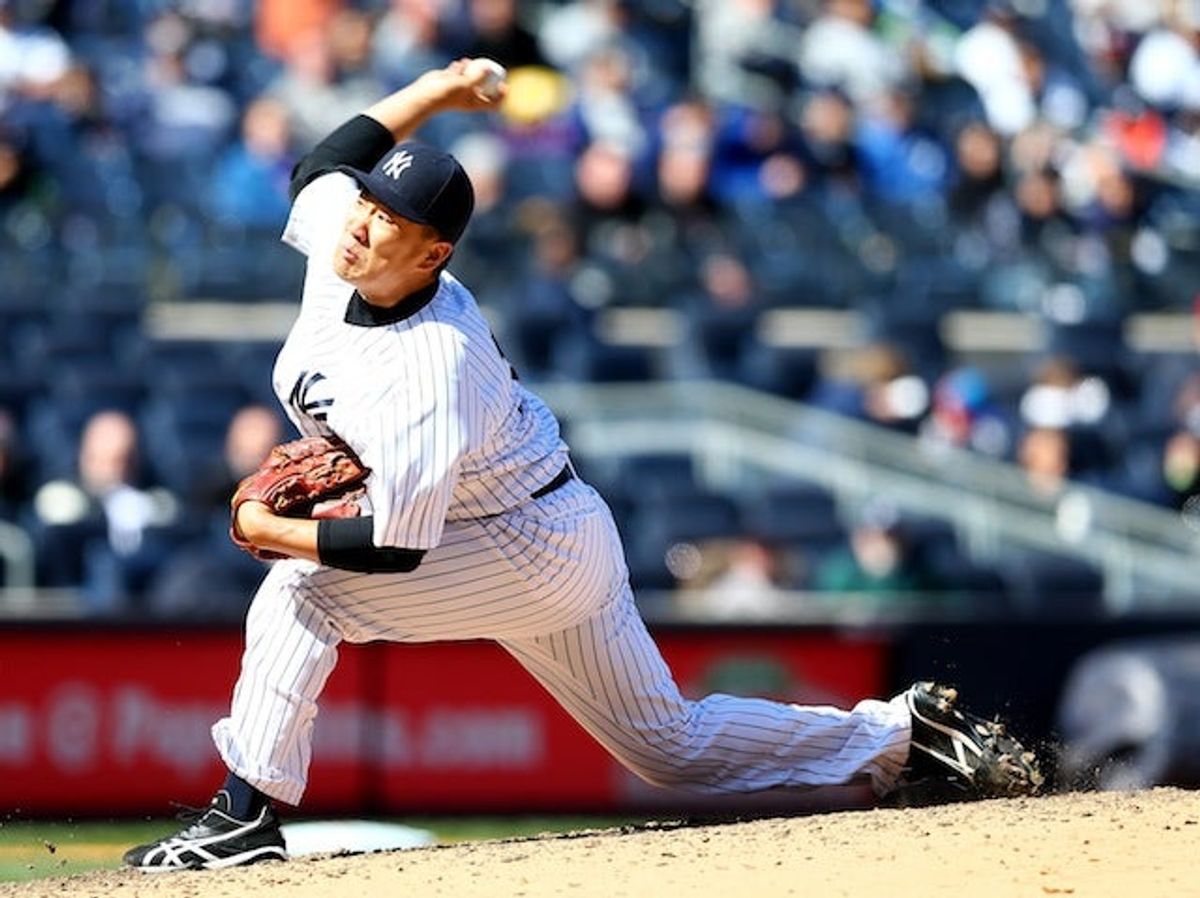
In the third start of his major-league career, Masahiro Tanaka struck out 10 Cubs in eight innings. In each of his two previous starts, he pitched seven innings, striking out eight batters against the Blue Jays and 10 batters against the Orioles. That's 28 strikeouts in 22 innings for the 25-year-old Japanese import, who is very quickly becoming one of the best pitchers in the American league.
So how's Tanaka going about mowing down hitters with such ease? He's doing a lot of things well, but most of his success is owed to his man-eater of a splitter. According to Pitch f/x data, Tanaka has thrown his splitter 24 percent of the time. It's a cruel little pitch, too, as it zips across the plate at an average velocity of 87 mph while diving out of the bottom of the strike zone. This leads to batters taking a lot of weak swings right over the top of it, most of which result in whiffs or weak contact.
Tanaka's splitter gets swung at 65 percent of the time, and more than half of those swings end up connecting with nothing but air. And when batters do manage to get his bat on it, they're not doing much damage; 72 percent of Tanaka's splitters that actually get put in play end up on the ground.
But Tanaka's more than just a guy with one devastating pitch. Part of what has made him so dominant through his first three outings is his approach. Despite having overpowering stuff, Tanaka approaches hitters with a junkballer's mentality. His fastball sits at 93 mph, but he's not the kind of pitcher who has to rely on it to set up his breaking stuff. In 0-0 counts this year, Tanaka has shown a willingness to throw just about anything. His sinker is his go-to first pitch, he starts at-bats with it 31 percent of the time, but he's also been ambushing hitters with a big, bendy curveball that he's uncorked as his first pitch 20 percent of the time. He's got a slider, too, with which he's started batters off with 19 percent of the time. Overall, he's throwing his splitter, slider, sinker, and fastball in near equal measure, making it nearly impossible for hitters to sit on one particular pitch.
This is a lot of what's leading to those gaudy strikeout numbers, and it's not too early to take them seriously—as a rule of thumb, a pitcher's strikeout rate stabilizes after about 70 batters faced. Not only is a strikeout rate of 11.5 per nine innings hugely encouraging in its own right, but it also shows that the main concern about him coming into the season—a declining strikeout rate that sank to a pedestrian 7.8 last year—probably isn't anything to worry about.
When a young pitcher blitzes the league with a string of dominant starts, we're always warned about how the league will eventually adjust to his stuff, identifying patterns that can be taken advantage of. That will surely happen with Tanaka to some extent, but based on what he's shown so far, he's not going to make it easy. It's hard to find a good pitch to swing at when you have to be ready for four or five different offerings at all times, all of them damn hard to hit, and the best of them nearly impossible when they're working.
Related

Three Longshot NFL Futures Worth Betting in Week 5



Georgia Football Could Return to No. 1 After Beating Alabama


Marvin Harrison Jr. Trade Mystery Makes Very Little Sense

White Sox vs. Guardians ALDS Game 5 Betting Pick


- UFC Vegas 122 Betting Odds: The Biggest Line Moves Before Allen vs. Duncan
- UFC Vegas 122 Picks and Predictions: Three Bets for Allen vs. Duncan
- College Football Week 6 Bets: Three Picks for Saturday’s Biggest Games
- UFC Fight Night Underdog Pick: Why Kai Kamaka III Is Worth a Bet
- WNBA Playoff Picks: Best Bets for Liberty-Dream and Aces-Valkyries
- Friday College Football Best Bets: Iowa-Washington and BYU-Iowa State
- UFC Vegas 122 Betting Splits: Where the Sharp Money Is Landing This Weekend