When Do Umpires Mess Up Balls And Strikes Calls?

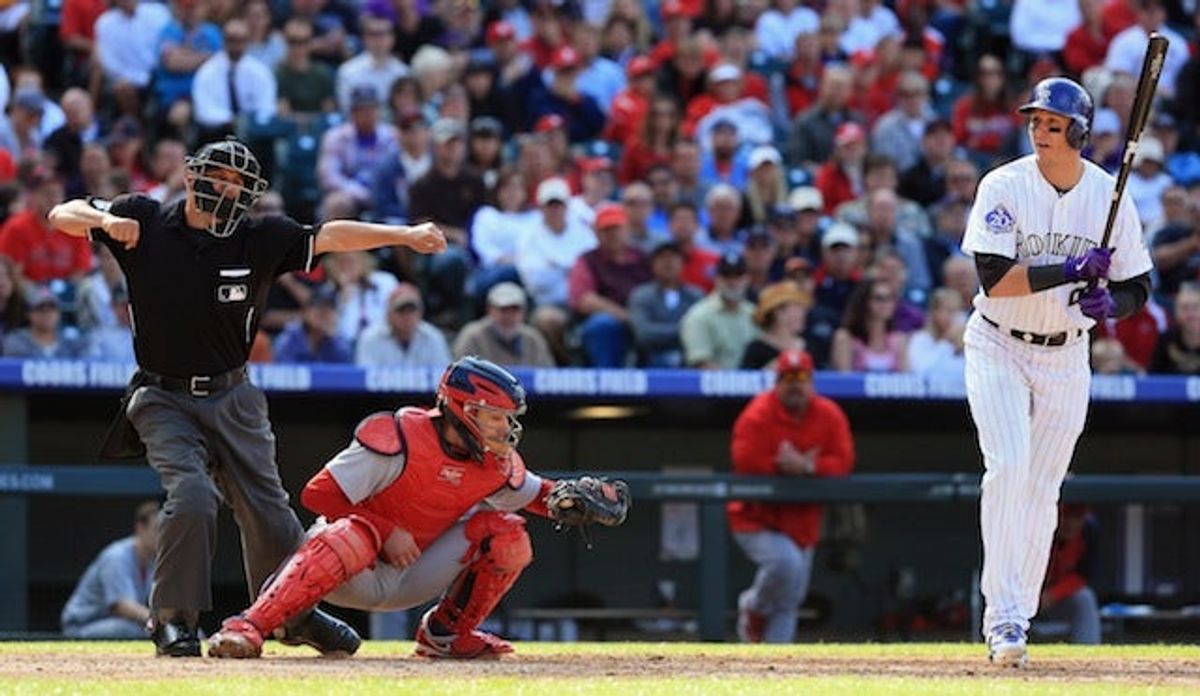
Baseball umpires are not immune to psychological biases, and it's an old adage of baseball commentating that strike zones get smaller when there are two strikes, and larger when there are three balls. In their Sloan finalist paper " What Does it Take to Call a Strike? Three Biases in Umpire Decision Making," authors Etan Green and David Daniels attempted to confirm the existence of these biases, looking at location data and calls for over one million pitches from 2009 to 2011, across 75 umpires*. Here's what they found:
The strike zone significantly decreased in two-strike counts. This was the largest observed effect; the probability of a called strike dropped by as much as 19 percent in the corners of the strike zone.
The strike zone decreased if the previous call was a strike.
The strike zone slightly increased in three-ball counts (but did not significantly increase if the previous call was ball). This was smaller than the effect seen for two-strike counts. As a result, the bias in full-counts was still against strikes.
While the size of these biases varied from umpire to umpire, they were signifiant in all 75 umpires.
If the umpires were under time pressure, you'd expect to see the bias shrink if it was deliberate (since the umps wouldn't have as much time to think the call through), and grow if it was intuitive. In very specific cases—three balls and a runner on first, excluding two out/two strike situations—the umpire has to make an immediate call to inform the catcher whether he can make a play on a (potential) runner. In these cases, the researchers found that the two-strike bias was accentuated, implying that it was intuitive. The impact of other game situations—scores, other base runners, outs, time in season, etc.—is left unexamined.
That these biases are intuitive and widespread is, in some ways, good news for the umpires, as it shows that they aren't intentionally and unfairly affecting the outcome of the game. It's not great news for baseball: Intuitive biases are very hard to shake, so don't expect these effects to disappear any time soon.
*Sample only included calls from umpires that saw at least 7,500 pitches across these seasons.
[ What Does it Take to Call a Strike? Three Biases in Umpire Decision Making]
Guardians vs. Rays Prediction: Picks, Odds for ALCS Game 1


Brendan Allen Has Earned the Right to Fight for UFC Gold
Bills vs. Rams Odds, Prediction and Best Bet for MNF
Three Longshot NFL Futures Worth Betting in Week 5
- White Sox vs. Guardians ALDS Game 5 Betting Pick
- UFC Vegas 122 Betting Odds: The Biggest Line Moves Before Allen vs. Duncan
- UFC Vegas 122 Picks and Predictions: Three Bets for Allen vs. Duncan
- College Football Week 6 Bets: Three Picks for Saturday’s Biggest Games
- UFC Fight Night Underdog Pick: Why Kai Kamaka III Is Worth a Bet
- WNBA Playoff Picks: Best Bets for Liberty-Dream and Aces-Valkyries
- Friday College Football Best Bets: Iowa-Washington and BYU-Iowa State