When You’re Down 14 And Score A Touchdown, You Should Go For Two

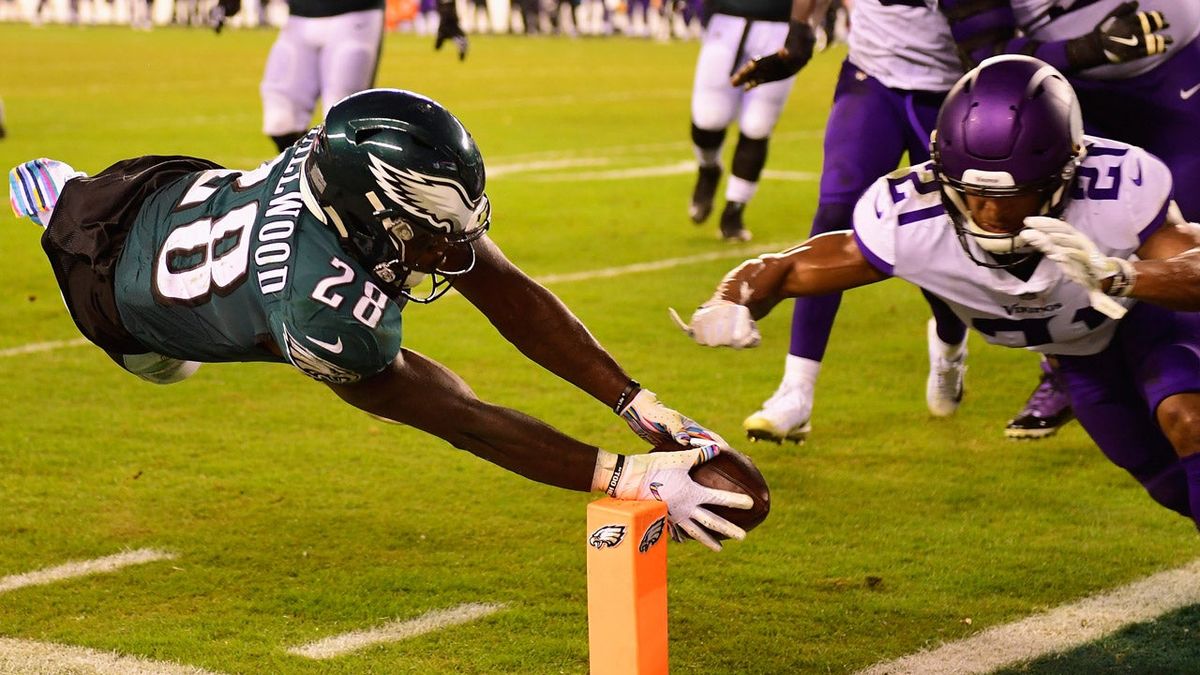 Wendell Smallwood dives for the two-point conversion to cut the Eagles’ deficit to 6 points. credits: Corey Perrine | source: Getty
 Earlier this year, he was a genius. Doug Pederson took the Eagles to the Super Bowl and won it, dethroning the mighty Patriots. Now the Eagles are 2-3 to start the season and he’s being questioned. Just check this headline on NBC 10: “ Doug Pederson to Blame for Many of Eagles’ Issues?” But there was one move he made on Sunday that was brilliant. Down 20-6, the Eagles finally scored a touchdown on a Carson Wentz pass to Wendell Smallwood with 12:05 left in the game. The offense stayed on the field and lined up to go for two to make it a six-point game.
It made sense. Hit the two-point conversion and suddenly you’re a touchdown and an extra point away from taking the lead. Or, since there’s still a decent amount of time left, you could even kick two field goals to tie.
Fail to convert, and you still get a chance to tie the game with another touchdown and two-point conversion. The rewards outweigh the risk.
This idea has been covered so much that when Chase Stuart, at his Football Perspective website, wrote about the strategy nearly three years ago, he said the topic had nearly already been exhausted:
The math has been clear for so long, and been presented by so many writers, that this topic is essentially beating a dead horse. Late in games, it has always made sense for a team, after scoring a touchdown to cut a lead from 14 to 8 points, should go for two. The trailing team gets two bites at the apple: if it converts, a touchdown now wins the game. If the team fails, they get a second chance to erase that mistake. Only if the odds of missing *both* attempts were higher than the odds of making the first attempt would this strategy fail to make sense.
ESPN’s Seth Walder dove into the data yesterday, saying going for two in that situation was a favorable strategy numbers-wise, as well. One can even come up with a dumb old-school reason for going for two: Your team has momentum, and going for a two-point conversion there would only add to it.
And yet nobody ever does it! Stuart names just two instances: Brian Billick did it in 2001 with the Ravens (a Randall Cunningham pass was incomplete) and Bill Belichick did it in 1994, the first year the two-point conversion rule was in place (Mark Rypien found Derrick Alexander in the end zone). Both teams didn’t score again, and lost.
The Eagles converted the two-pointer on a Wendell Smallwood run, and actually scored another late touchdown. Unfortunately for them, the Vikings kicked a field goal between those two and won the game 23-21.
Maybe Pederson’s play-calling has been the reason the Eagles are underwhelming so far this season. But yesterday he made an unconventional call that put the Eagles in a much better position to win.
Related





- Seattle Seahawks vs. Denver Broncos TNF Betting Pick
- Brewers vs. Dodgers Game 3 Predictions, Picks and Odds
- Dana White's Contender Series Week 10 Predictions and Picks
- Guardians vs. Rays Game 2 Prediction: Picks, Odds and Best Bets
- Bills vs. Rams Odds, Prediction and Best Bet for MNF
- Three Longshot NFL Futures Worth Betting in Week 5
- Falcons vs. Ravens Odds, Prediction and Best Bet for Sunday Night Football