With A Sub-Two-Hour Marathon, Eliud Kipchoge Breaks Distance Running's Most Elusive Barrier

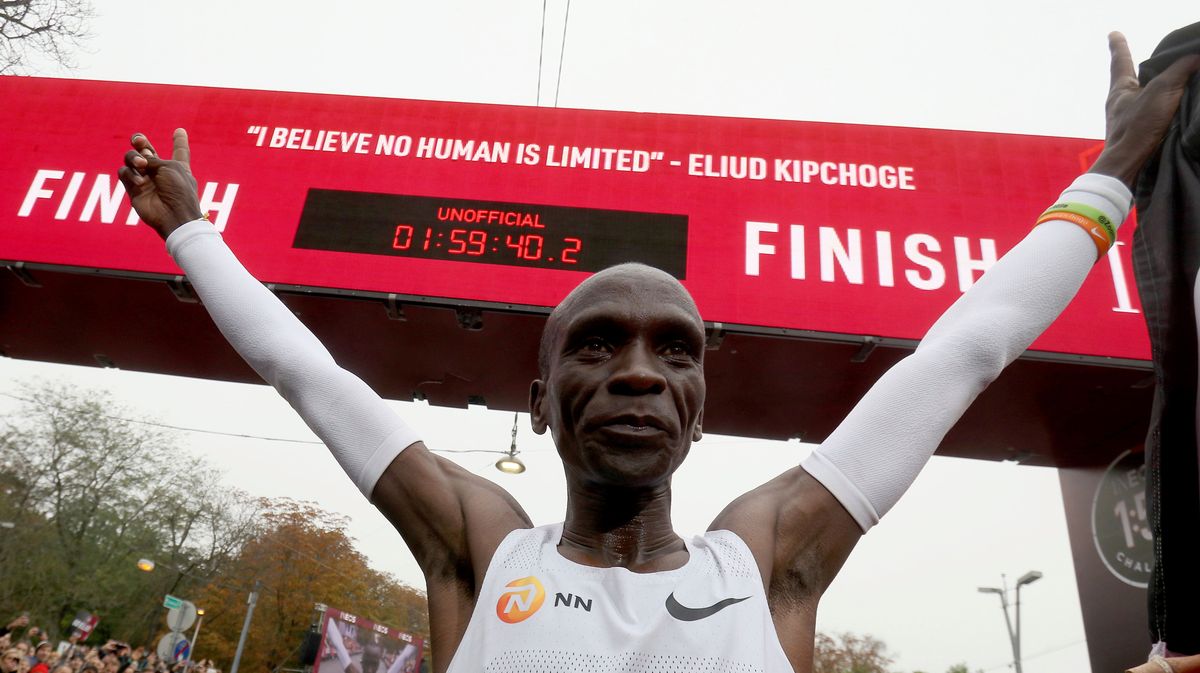 credits: Ronald Zak | source: AP
 Kenyan marathoner Eliud Kipchoge became the first human to finish a marathon in under two hours on Saturday in Vienna, running the 26.2 miles in 1:59:40, a time long believed impossible. The event in Vienna, a “moonshot” race specially planned to provide Kipchoge with favorable conditions, marked the runner’s second attempt to break the two-hour barrier. He’d previously tried at an event sponsored by Nike in Italy in 2017, where he ran a 2:00:25 marathon. Though Kipchoge and his team had prepared for a sub-two-hour time in Saturday’s event, Kipchoge finished 10 seconds faster than even they had anticipated.
Running a marathon in less than two hours, if you’d like to try it, requires an average speed of around 13 miles per hour for a mile pace of 4:34. On Saturday, Kipchoge’s splits were remarkably precise, thanks in part to a rotating team of 36 pacemakers—many of them the world’s best distance runners—who ran in 7-person pockets around Kipchoge to keep him on schedule and shield him from the breeze. An electric timing car driving a controlled pace of 4:34 per mile projected green laser lines on the ground for them to follow. While he raced, Kipchoge was delivered energy gels and carbohydrate drinks by bicyclists riding alongside him. The bottles Kipchoge used were picked up after being discarded and weighed to determine exactly how much was consumed, and what his future intake should be.
The event was sponsored by British petrochemicals company Ineos and its billionaire owner Jim Ratcliffe, whose company’s foray into sports—Ratcliffe also sponsors cycling, sailing and soccer teams—has been criticized as a cynical attempt to distract from Ineos’s production of plastics and its plans to frack for natural gas in Britain. The CEO of Ineos told the Wall Street Journal that Ratcliffe was merely “making decisions based on what’s a fun, interesting, cool thing to do.” The Ineos sailing team’s meteorologists suggested Vienna for the city’s temperate weather and its flat, straight, tree-lined course; the company’s cycling team consulted on aerodynamics.
Because of these special provisions—specifically, the bicycle drink deliveries and the use of pacers—the International Association of Athletics Federations won’t recognize Kipshoge’s attempt as a world record; it didn’t take place under open race conditions. But it’s really no matter. Kipchoge has redefined the possibilities of the human body, and dodged the limits of his own.

What Prediction Markets Are Telling Us About NFL 2026 MVP
The Sacramento Kings Need to Blow It Up Before It's Too Late


Ben Askren Didn't Win the Match—But He Won the Weekend
- UFC Fight Night Best Betting Picks for Du Plessis vs. Usman in OKC
- France vs. England Best Bets: Three Picks for the World Cup Third-Place Match
- Dodgers vs. Yankees Friday July 17 Best Betting Picks and Props
- July 17 White Sox vs. Blue Jays Prediction, Odds and Best Bets
- Three MLB Futures Bets to Make After the All-Star Break
- Three Heisman Trophy Sleepers Worth Betting Before the 2026 Season
- England vs. Argentina Best Bets: Three Picks for the World Cup Semifinal