A Nutty Theory About Lance Armstrong

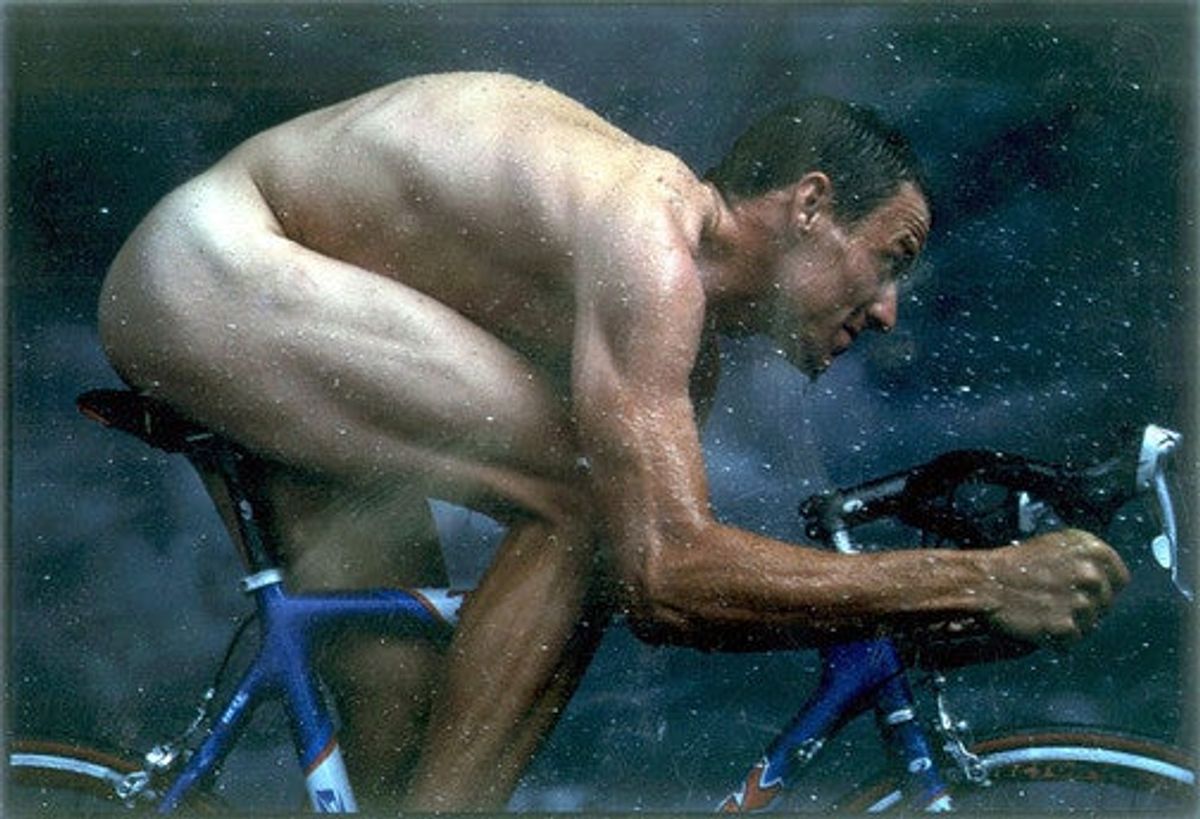
A couple of scientists argue that Lance Armstrong did indeed employ certain exotic performance-enhancing procedures before his run of seven consecutive Tour De France victories: namely, getting his diseased testicle lopped off.
This comes to us via True/Slant. In 2006, Craig S. Atwood and Richard L. Bowen published a paper in provocatively contrarian Medical Hypotheses — sort of the Slate.com of medical journals — in which they argued that Armstrong actually derived an athletic advantage from the treatment, in 1996, of his testicular cancer, known leg-crossingly as an orchiectomy:
While it is perceived that cancer, surgeries and chemotherapy might actually impede sports performance, the above evidence would suggest that unilateral orchiectomy promotes physiological maturation and athletic performance by enhancing fuel metabolism, muscle repair and erythroid function. Therefore, Armstrong's athletic advantage is most likely due to his unique genetic and physiological makeup coupled to the endocrinological changes induced by his unilateral orchiectomy, not drugs as suspected by certain reporters, cycling enthusiasts and French cycling authorities. Indeed, the use of drugs such as erythropoietin would be foolish given that there is evidence to suggest this mitogen can promote tumor growth.
Not that any of you athletes out there should try this at home:
The question remains then, would you give your left testicle to win the Tour de France? Only the foolish would undergo orchiectomy or administer drugs to alter sex hormone levels to enhance performance in endurance sports given the long-term risks to health and longevity. Likewise, the use of exogenous LH/hCG would be similarly problematic. Irrespective of this, artificially modulating these hormones for increasing human endurance performance is difficult due to the short half-life of LH in the blood. And while recombinant hCG has a longer half-life, it would be easily distinguishable from endogenous hCG. We do not recommend unilateral orchiectomy or endogenous sources of these hormones as performance enhancing modalities.
I have no idea if any of this is plausible, but the paper does boast an impressive array of footnotes and multisyllabic words, which leads me to believe the theory is not — you'll excuse the pun — entirely nuts. Science, however, has yet to answer the most important question about Lance Armstrong, which is what on earth compelled one of history's finest and most respected athletes into the arms of an Olsen twin?
Lance, enhanced [True/Slant] Metabolic clues regarding the enhanced performance of elite endurance athletes from orchiectomy-induced hormonal changes (PDF) [Medical Hypotheses]







- Commanders vs. 49ers Picks: Best Bet for Monday Night Football
- Rays vs. Guardians Game 5 Predictions: Best Bets for ALCS
- Cowboys vs. Packers Prediction: Best Bet for Sunday Night Football
- UFC Edmonton Best Bets, Predictions and Fight Picks
- Rays vs. Guardians Game 4 Best Player Props Betting Picks
- College Football Week 8 Best Bets: Ohio State, Alabama and More
- Joaquin Buckley Plummets From -300 Favorite to Underdog at UFC Edmonton