Chick-Fil-A Is Still Sponsoring NCAA Football

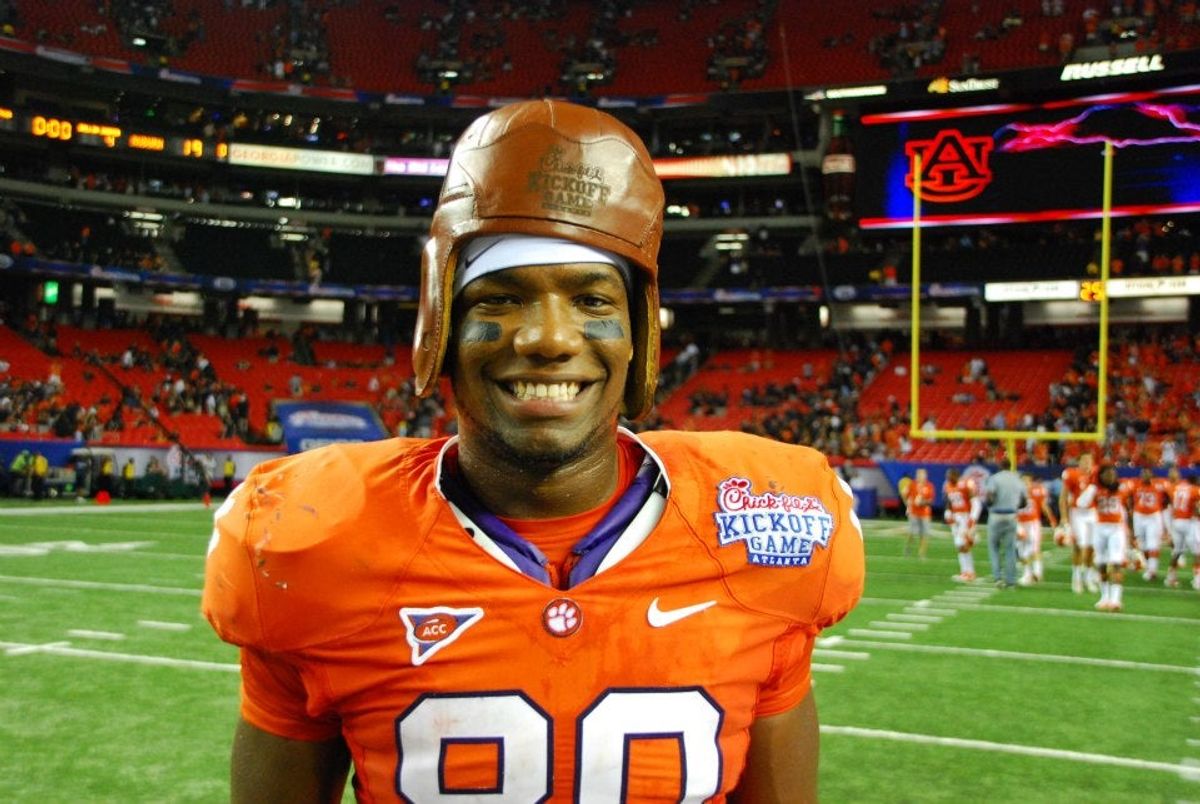
If you watched Clemson vs. Auburn at the Georgia Dome yesterday, or North Carolina State vs. Tennessee the day before, you undoubtedly noticed—because, you know, branding—that the sponsor for the games was Chick-Fil-A; the two-day event was called the Chick-Fil-A Kickoff Game. As you can see in the picture above, the players for all four teams wore patches on their jerseys indicating the game's most generous benefactor, which means every player on both teams came roaring out of the tunnel for the start of the 2012 college football season with a big ol' Chick-Fil-A logo on their their shoulder.
Fucking hell. That logo placement, and its legibility, enlists unpaid student-athletes as de facto soldiers in the image-rehabilitation of company that gives them no direct benefit, with which they couldn't negotiate. A lot of sponsored bowl games (this wasn't a bowl game, but it's a similar idea) put logos on jerseys, but they reduce the corporate vibe to some extent by blending their own logo with a new specialized logo. The effect can be subtler than what Chick-Fil-A came up with. The Outback Bowl uses the relatively restrained logo pictured here, while the Capital One Bowl uses the hybrid on display here. The Little Caesers Bowl has a ridiculous logo—but as far as I can tell, they don't sew it on the team's uniforms. The Godaddy.com Bowl doesn't either. When you're coming off as less tasteful than Godaddy.com—the company that popularized the porn-teaser Super Bowl ad—something went awry. If the prospect of advertisements on NBA jerseys makes you queasy (and there's a reasonable argument that it should), guess what: turning uncompensated amateurs into billboards when they're at their most visible is a hundred times worse. If it's to shine up your company's (rightfully) tarnished image, it's worse than that.
It's impossible to separate Chick-Fil-A from what it represents to most people: at minimum, the desire to withhold civil rights from gay people; in practice, a company-wide willingness to throw money behind efforts to keep gay people on unequal footing. Maybe none of the players felt uncomfortable with the sponsorship—if there's a popular institution as bigoted as Chick-Fil-A, it might be college football. But it's easy to imagine that someone on one of the four teams (that's about 400 kids suiting up in Chick-Fil-a branded apparel, all told) is gay, or has gay friends, or is just knowledgeable and empathetic enough to feel shitty acting as an advertisement for a business that unrepentantly symbolizes homophobia. While no one has to play college football, scholarships ride on participation and it's asking a lot of scholar athletes to make them publicly represent a company that many find offensive, if not outright hateful.
Related
Why Tyrese Maxey Is the Key to the Sixers’ Success
Seahawks vs. Chiefs Betting Pick: SNF Best Bets
Why Did Netflix Mike Tyson Docuseries Omit His Last Fight?

Ohio State’s Season Is in Jeopardy After Julian Sayin Injury
- UFC 333 Betting Lines Are Tightening Across a Wide-Open Fight Card
- UFC 333 Betting Splits: Where the Sharp Money Is Landing This Weekend
- NBA Best Bets Today: Pacers, Grizzlies and Trail Blazers Picks
- College Football Week 8 Best Betting Picks, Predictions
- World Series Game 1 Predictions: Rays vs. Brewers Picks and Best Bets
- UFC 333 Predictions: Best Bets for Volkov, Keita and Murzakanov
- UFC 333 Underdog Pick: Why Dominick Reyes Is Worth a Bet