Indiana's Schedule Proves College Football Has a Real Playoff Problem

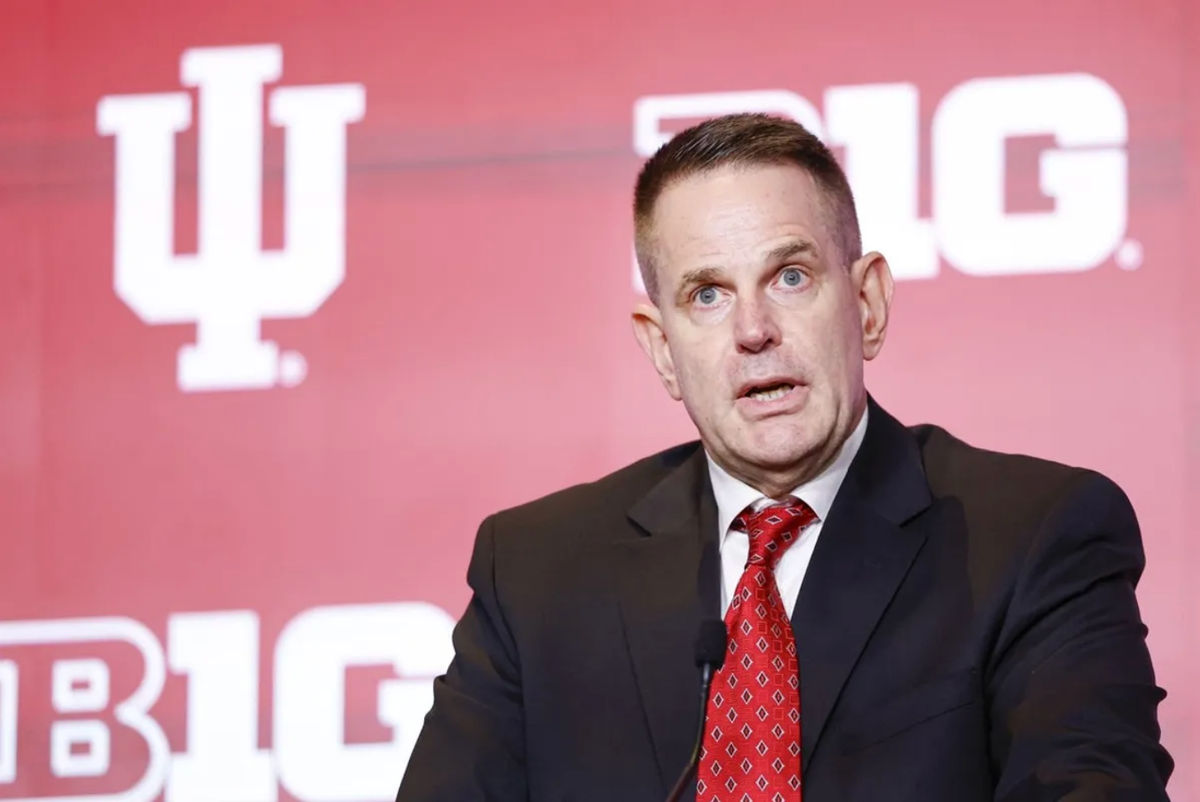 Jul 30, 2026; Chicago, IL, USA; Indiana Football head coach Curt Cignetti speaks during Big Ten Media Days at Hilton Chicago. Mandatory Credit: Kamil Krzaczynski-Imagn Images
 Days after Indiana head coach Curt Cignetti proclaimed the Big Ten college football’s “best league” and touted that its members “don’t cry a river, whine and complain,” the Hoosiers dropped a planned non-conference series with in-state counterpart Notre Dame. The Indiana athletic department’s decision may also be a harbinger of an unfortunate direction for the entire sport.
Now, head coach of the reigning national champion earns plenty of leeway for trash talk – perhaps doubly so when said national champion was perhaps the most moribund program among power-conference members before his arrival.
What’s more, Indiana is only exercising a formula that early indicators suggest is the most likely to land teams in the College Football Playoff: Quantity over quality.
Essentially, Hoosiers brass is banking on the Playoff selection committee emphasizing straight record over degree of difficulty, as evidenced in Indiana’s future non-conference slates with nary a power-conference opponent in sight.
The champs begin defense of their crown in 2026 with North Texas and Western Kentucky bookending FCS opponent Howard. To their credit, UNT went into the 2025 American Athletic Conference Championship Game contending for a Playoff berth and Western Kentucky pretty consistently contends in Conference USA.
However, that’s as tough as it gets on paper over the next half-decade, with such noteworthy matchups as Indiana State, a regular bottom-half-finisher in the FCS Missouri Valley Football Conference, and a UMass program widely considered the worst in FBS looming in the years to come.
To Cignetti’s argument that the Big Ten is the nation’s premier league, there’s certainly evidence to support the claim. Three different Big Ten programs have claimed the last three national titles, and the trio of Ohio State, Oregon and Indiana head into 2026 as preseason favorites to lead the race for this year’s championship.
Surely the rigors of conference play compensate for the fattening, cupcake diet on Indiana’s menu. It was the case in 2025, when the Hoosiers beat Oregon in Autzen Stadium, walloped a then-No. 9-ranked Illinois on the road, and held off an always-tough Iowa during the regular season.
Couple that with a Big Ten Championship Game tilt against Ohio State, and Indiana’s 13 games leading up to a dominant Playoff run became moot.
Still, just a year prior, Indiana was chosen for the inaugural field of 12 after going 11-1 against a schedule devoid of Top 25 wins – or with a single victory against an opponent that won more than seven regular-season games. The Hoosiers lost their lone matchup with a ranked opponent – eventual national champion Ohio State – by three-plus touchdowns.
Indiana’s selection for the 2024 season Playoff did indeed set a precedent that, until disproven, offers the least treacherous roadmap to the postseason. It also lends credence to Texas coach Steve Sarkisian’s lament since the Longhorns were excluded from the field in 2025.
“If I don't play Ohio State & play Jones Jr. High, we're 10-2 & our losses are to Georgia and Florida,” Sarkisian said in a SiriusXM interview last month. “[With a win against a lesser non-conference opponent], we're a playoff team.”
The early-season Ohio State-Texas matchup was a, if not the highlight of the 2025 season’s first month. The Buckeyes’ return visit to Austin this year for Week 2 should again be among the most exciting offerings of the early-season slate.
College football needs more such contests, but what incentive exists if the risk is greater than the inverse reward of scheduling, say, Houston Christian? Credit Texas and Sarkisian though, as in the same interview, the head ‘Horn said they “made a conscious decision to play that game and we will continue to do that just like we're doing this year and we're going to play Michigan the year after that."
The juxtaposition in scheduling philosophies will reach a crossroads sooner than later. As Sarkisian put it, “The challenge we're all faced with right now is how is that weighted?”
Playoff selection has felt nebulous since the original, four-team edition back in 2014. Committee spokespersons have repeated a mantra that the process is intentionally subjective.
For the long-term good of the sport, however, the Playoff committee should consider objective criteria to reward more ambitious scheduling. In a scenario when a team like Texas chooses to face Ohio State – and vice versa – a competitive loss should matter more than a lopsided win against an Eastern Illinois team that finished 2-6 in the Big South-OVC.
Related


Seattle Seahawks vs. Denver Broncos TNF Betting Pick

Los Angeles Chargers Shouldn’t Resist Justin Herbert Trade
- Guardians vs. Rays Game 2 Prediction: Picks, Odds and Best Bets
- Bills vs. Rams Odds, Prediction and Best Bet for MNF
- Three Longshot NFL Futures Worth Betting in Week 5
- Falcons vs. Ravens Odds, Prediction and Best Bet for Sunday Night Football
- White Sox vs. Guardians ALDS Game 5 Betting Pick
- UFC Vegas 122 Betting Odds: The Biggest Line Moves Before Allen vs. Duncan
- UFC Vegas 122 Picks and Predictions: Three Bets for Allen vs. Duncan