It Takes As Long As It Takes

Something to consider: The 2010 Paris Review Art of Non-Fiction Interview with John McPhee.
INTERVIEWER: What were your first impressions (of New Yorker editor William Shawn)?
MCPHEE: He spoke so softly. I was awestruck: the guy’s the editor of The New Yorker and he’s this mysterious person. It was the most transforming event of my writing existence, meeting him, and you could take a hundred years to try to get to know him, and this was just the first day. But he was a really encouraging editor. Shawn always functioned as the editor of new writers, so he edited the Bradley thing. So I spent a lot of time in his office, talking commas. He explained everything with absolute patience, going through seventeen thousand words, a comma at a time, bringing in stuff from the grammarians and the readers’ proofs. He talked about each and every one of these items with the author. These were long sessions. At one point I said, Mr. Shawn, you have this whole enterprise going, a magazine is printing this weekend, and you’re the editor of it, and you sit here talking about these commas and semicolons with me—how can you possibly do it?
And he said, It takes as long as it takes. A great line, and it’s so true of writing. It takes as long as it takes.
McPhee is talking about writing here but I think can apply to anything, a reminder that nothing worth having comes fast.
MCPHEE: The thing about writers is that, with very few exceptions, they grow slowly—very slowly. A John Updike comes along, he’s an anomaly. That’s no model, that’s a phenomenon. I sent stuff to The New Yorker when I was in college and then for ten years thereafter before they accepted something. I used to paper my wall with their rejection slips. And they were not making a mistake. Writers develop slowly. That’s what I want to say to you: don’t look at my career through the wrong end of a telescope. This is terribly important to me as a teacher of writers, of kids who want to write.
And this:
INTERVIEWER: After you’ve done your reporting, how do you proceed with a piece?
MCPHEE: First thing I do is transcribe my notes. This is not an altogether mindless process. You’re copying your notes, and you get ideas. You get ideas for structure. You get ideas for wording, phraseologies. As I’m typing, if something crosses my mind I flip it in there. When I’m done, certain ideas have accrued and have been added to it, like iron filings drawn to a magnet.
And so now you’ve got piles of stuff on the table, unlike a fiction writer. A fiction writer doesn’t have this at all. A fiction writer is feeling her way, feeling her way—it’s much more of a trial-and-error, exploratory thing. With nonfiction, you’ve got your material, and what you’re trying to do is tell it as a story in a way that doesn’t violate fact, but at the same time is structured and presented in a way that makes it interesting to read.
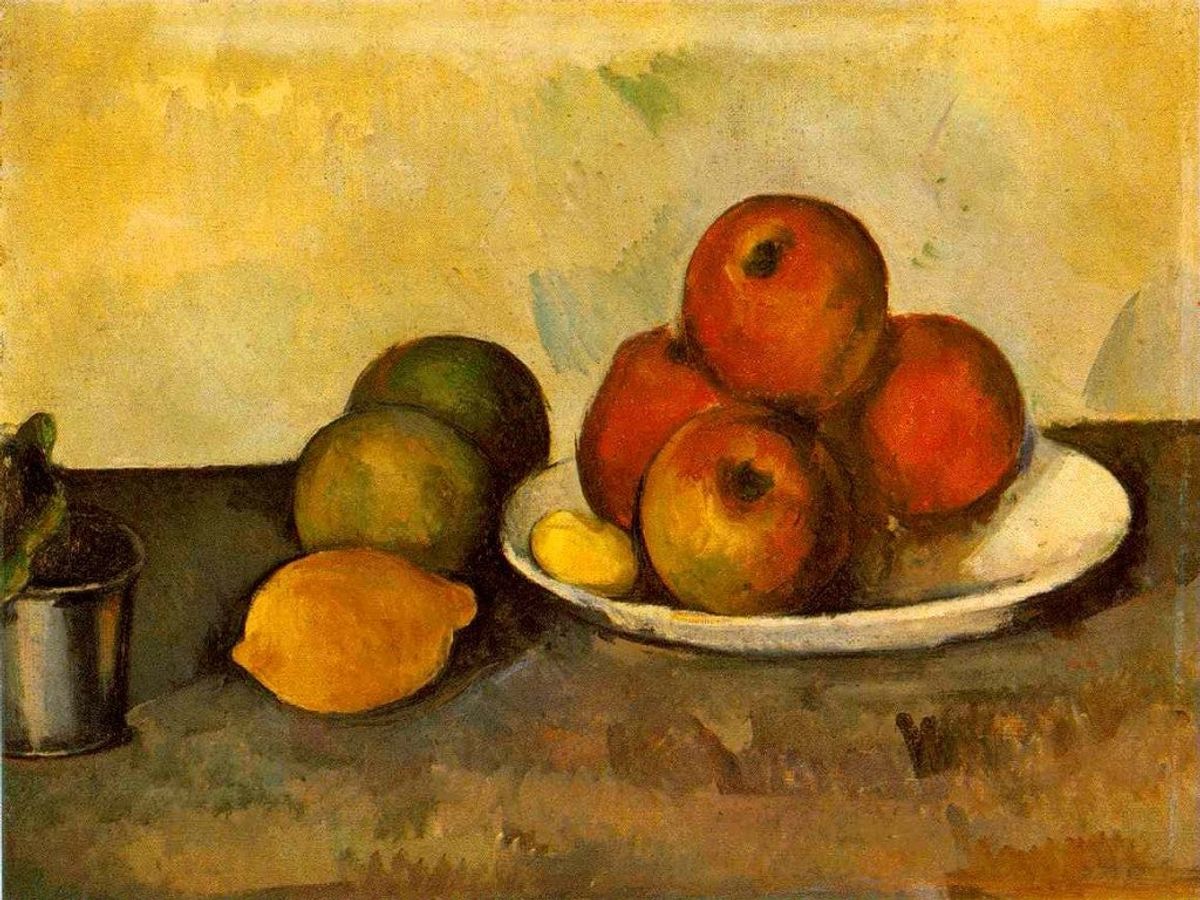
I always say to my classes that it’s analogous to cooking a dinner. You go to the store and you buy a lot of things. You bring them home and you put them on the kitchen counter, and that’s what you’re going to make your dinner out of. If you’ve got a red pepper over here—it’s not a tomato. You’ve got to deal with what you’ve got. You don’t have an ideal collection of material every time out.
[Painting by Paul Cezanne]
Related





Why the UFC Released Undefeated Bantamweight Farid Basharat

Why the Milwaukee Brewers Are Built to Win the World Series



The Most Shocking WWE Moments Fans Never Saw Coming
- Cowboys vs. Packers Prediction: Best Bet for Sunday Night Football
- UFC Edmonton Best Bets, Predictions and Fight Picks
- Rays vs. Guardians Game 4 Best Player Props Betting Picks
- College Football Week 8 Best Bets: Ohio State, Alabama and More
- Joaquin Buckley Plummets From -300 Favorite to Underdog at UFC Edmonton
- WNBA Finals Picks: Dream, Valkyries and Gabby Williams Best Bets
- UFC Vegas 122: 5 Underdogs Drawing Sharp Money This Weekend