Rocky Balboa Made Running Iconic, These Fighting Champions Have Other Ideas

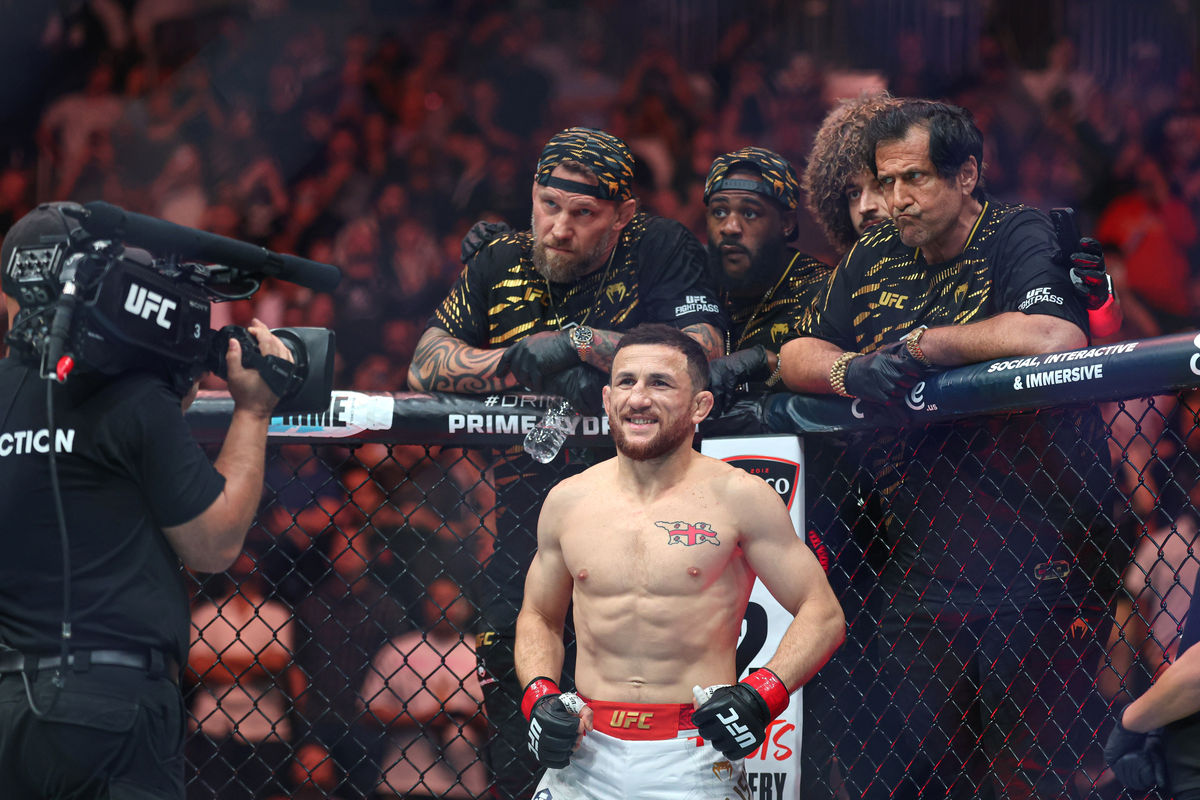 Jun 7, 2025; Newark, New Jersey, UNITED STATES; Merab Dvalishvili (red gloves) prepares to fight Sean OÕMalley (not pictured) in a bantamweight title fight during UFC 316 at Prudential Center. Mandatory Credit: Vincent Carchietta-Imagn Images
Rocky Balboa running up the steps of the Philadelphia Museum of Art is one of the most iconic images in sports history. For generations, fighters have been taught that getting in shape means waking up early, lacing up their running shoes and logging miles until their lungs burn. The message was simple: if you want championship-level cardio, you have to run.
But some of combat sports' biggest names have taken a different approach. From Kamaru Usman and Merab Dvalishvili to heavyweight boxing champions Deontay Wilder and Wladimir Klitschko, elite fighters have questioned whether traditional long-distance running deserves the place it has held in fight camps for decades. Some have replaced it with swimming, others with sport-specific conditioning, and a few have practically cut it out altogether.
The idea isn't that cardio no longer matters. It's that running for miles doesn't automatically translate into being able to fight for five rounds.
Usman made that point in 2019 when he explained that knee problems had kept him from running for three years. Despite that limitation, the former UFC welterweight champion remained known for his relentless pace and ability to push opponents into exhausting fights. When asked how he maintained his conditioning, Usman explained that he approached nearly every workout at fight intensity, from wrestling to pad work. He reiterated the point in 2023, saying he sometimes used the pool to work on endurance but relied heavily on hard, fast-paced training.
That's a pretty important distinction. Usman wasn't skipping conditioning. He was finding ways to build it without repeatedly pounding his knees against the pavement.
Wilder took the alternative approach even further. In 2016, the former WBC heavyweight champion said he avoided traditional roadwork and did much of his conditioning in the water around his home. Swimming, water resistance and workouts around his lake became part of his routine. Wilder believed the water allowed him to work his body without the same impact associated with running. His approach wasn't exactly conventional, but his ability to maintain a high pace in the ring showed that there was more than one way to prepare for a fight.
Wladimir Klitschko arrived at a similar conclusion during his heavyweight reign. After years of running, the former champion increasingly favored swimming and training that mimicked the movements and demands of boxing. In a 2016 interview, Klitschko explained that he had changed his routine and no longer ran as much. He also emphasized the importance of sport-specific preparation, including extensive sparring.
The reasoning makes sense. A boxer doesn't compete by running at a steady pace for several miles. Fighters must repeatedly explode into combinations, defend, wrestle, clinch, change direction and recover while an opponent is actively trying to hurt them. Building a strong aerobic base matters, but so does developing the ability to recover between bursts of high-intensity effort.
Swimming can help build cardiovascular fitness while reducing impact on the joints. Wrestling rounds, pad work, sparring and circuit training can also develop conditioning while forcing athletes to work through movements that more closely resemble the demands of competition. None of that makes running useless. It means roadwork is one tool in a much larger toolbox.
The next generation is making conditioning its own
Vasiliy Lomachenko has also adjusted his approach over the years. In 2018, the former world champion said he had significantly reduced his running to protect his knees. Rather than running every other day as he once did, Lomachenko said he had cut back to a 10-kilometer run once a week, with roller skiing taking on a larger role in his training.
That change reflects a bigger consideration for elite fighters: training isn't just about being ready for the next fight. It's about keeping the body healthy enough to compete for years. Repeated high-impact work can be difficult to manage alongside the demands of sparring, strength training and the physical punishment fighters take inside the gym. For athletes with existing joint problems, finding lower-impact ways to maintain fitness can be especially valuable.
Merab Dvalishvili offers another perspective. The UFC bantamweight has built a reputation for an almost absurd work rate, but he has said he doesn't usually treat endurance as a separate activity. Instead, he focuses on doing a high volume of training, with running, swimming and gym work serving as supplementary options rather than the foundation of his conditioning.
That approach is particularly interesting in MMA, where the best cardio often comes from being able to sustain the sport's actual demands. A fighter can be an excellent distance runner and still struggle to maintain an effective pace while defending takedowns, fighting off the fence or recovering after a hard scramble. Conversely, an athlete who spends hours wrestling, grappling and working through intense rounds can develop tremendous fight-specific endurance without relying exclusively on long runs.
Of course, no single approach works for everyone. Long-distance running remains a useful way to develop aerobic capacity, and many fighters continue to use it as part of their preparation. Swimming doesn't automatically produce better fight cardio, either. The right conditioning plan depends on the athlete, their health, their training load and the demands of their particular sport.
The more interesting shift is that fighters are no longer treating traditional roadwork as a mandatory rite of passage. The old-school approach still has value, but elite athletes are increasingly willing to question whether every part of it deserves a place in their camps.
Rocky Balboa will always be running through the streets of Philadelphia in the minds of fight fans. But modern champions have shown that there are other ways to build the engine needed to go five hard rounds.
The goal was never to become the best runner in the gym. It was to make sure you could still fight when the other person was exhausted.
And increasingly, fighters are finding their own ways to get there.

Why the Milwaukee Brewers Are Built to Win the World Series

The Most Shocking WWE Moments Fans Never Saw Coming





- Cowboys vs. Packers Prediction: Best Bet for Sunday Night Football
- UFC Edmonton Best Bets, Predictions and Fight Picks
- Rays vs. Guardians Game 4 Best Player Props Betting Picks
- College Football Week 8 Best Bets: Ohio State, Alabama and More
- Joaquin Buckley Plummets From -300 Favorite to Underdog at UFC Edmonton
- WNBA Finals Picks: Dream, Valkyries and Gabby Williams Best Bets
- UFC Vegas 122: 5 Underdogs Drawing Sharp Money This Weekend